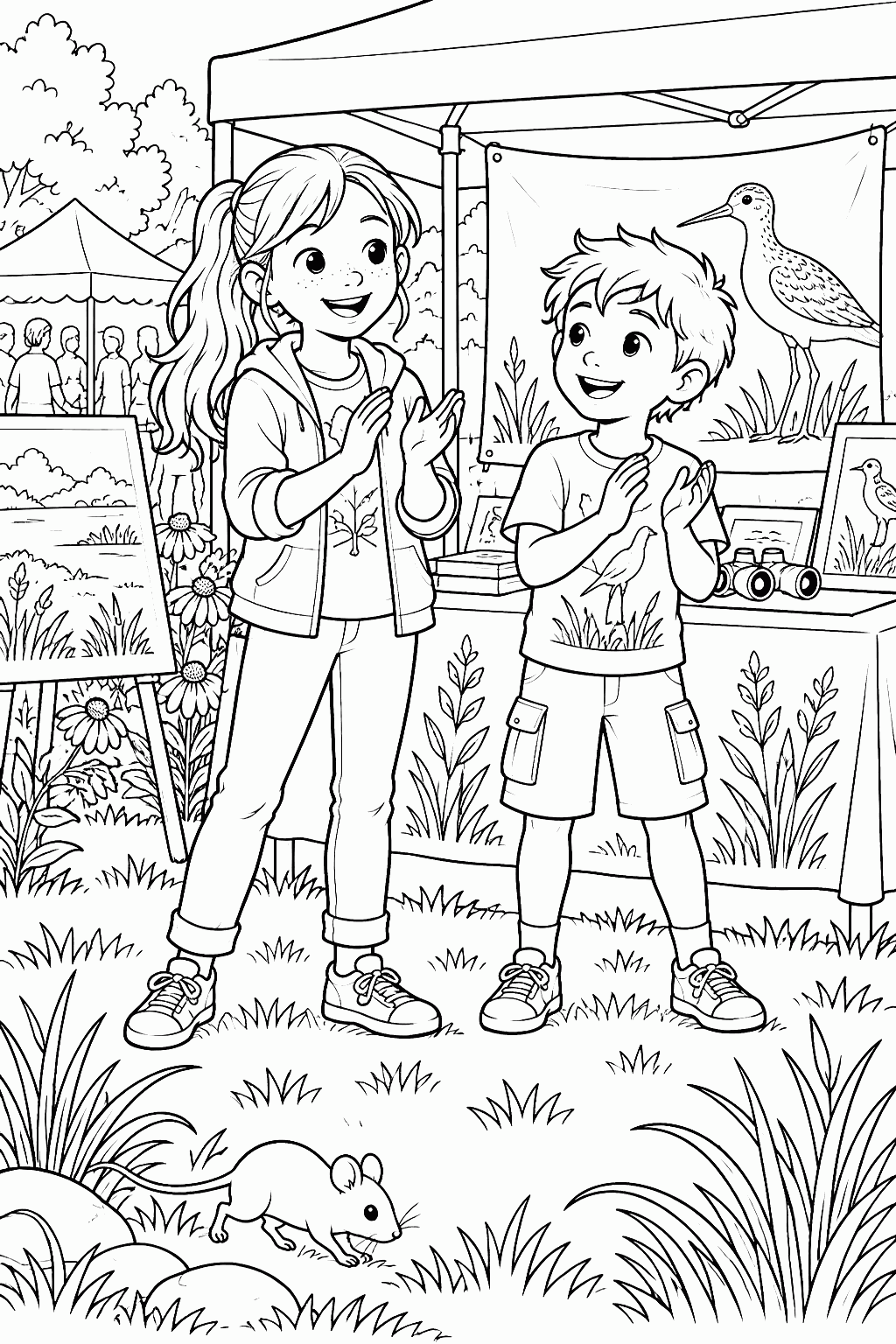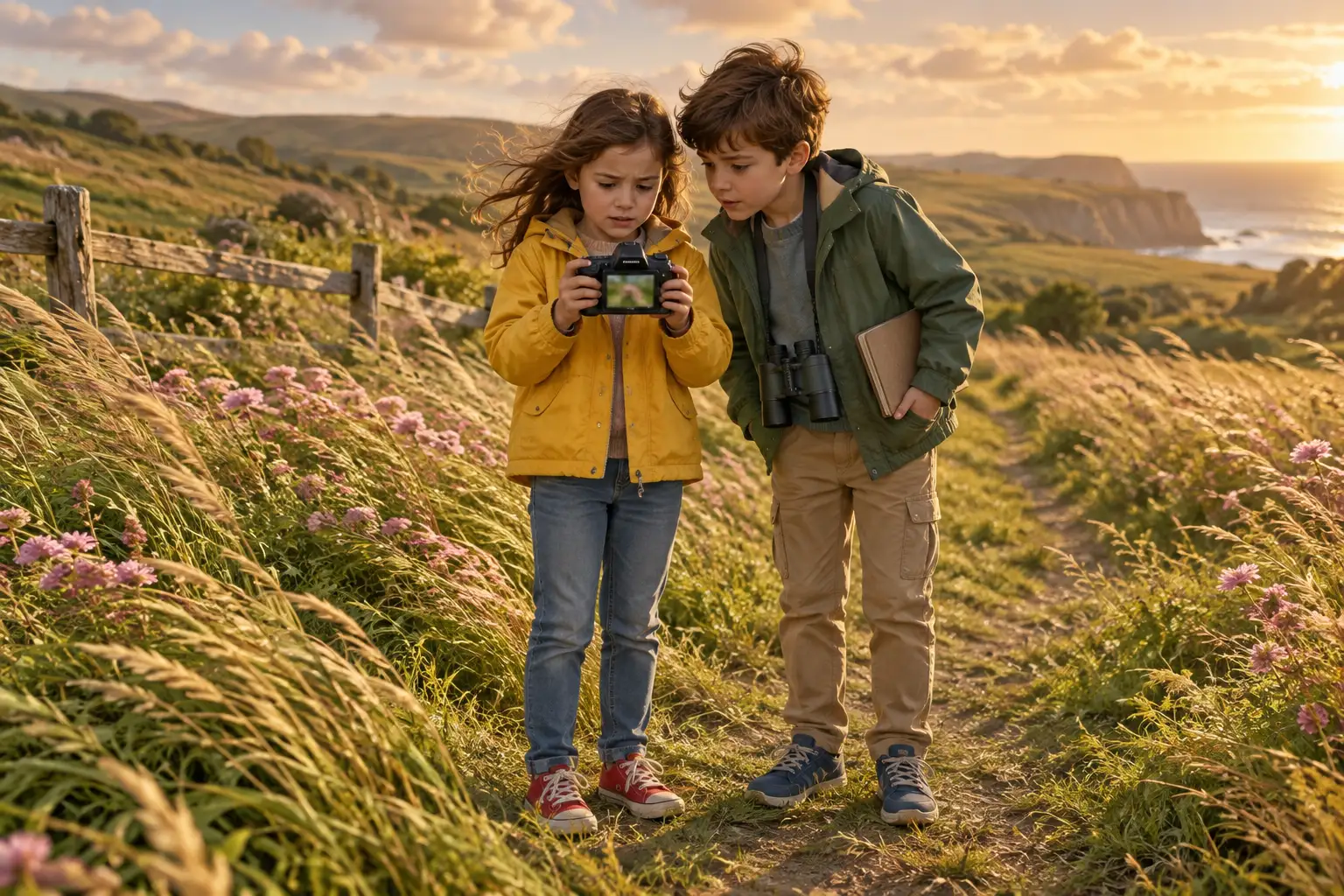
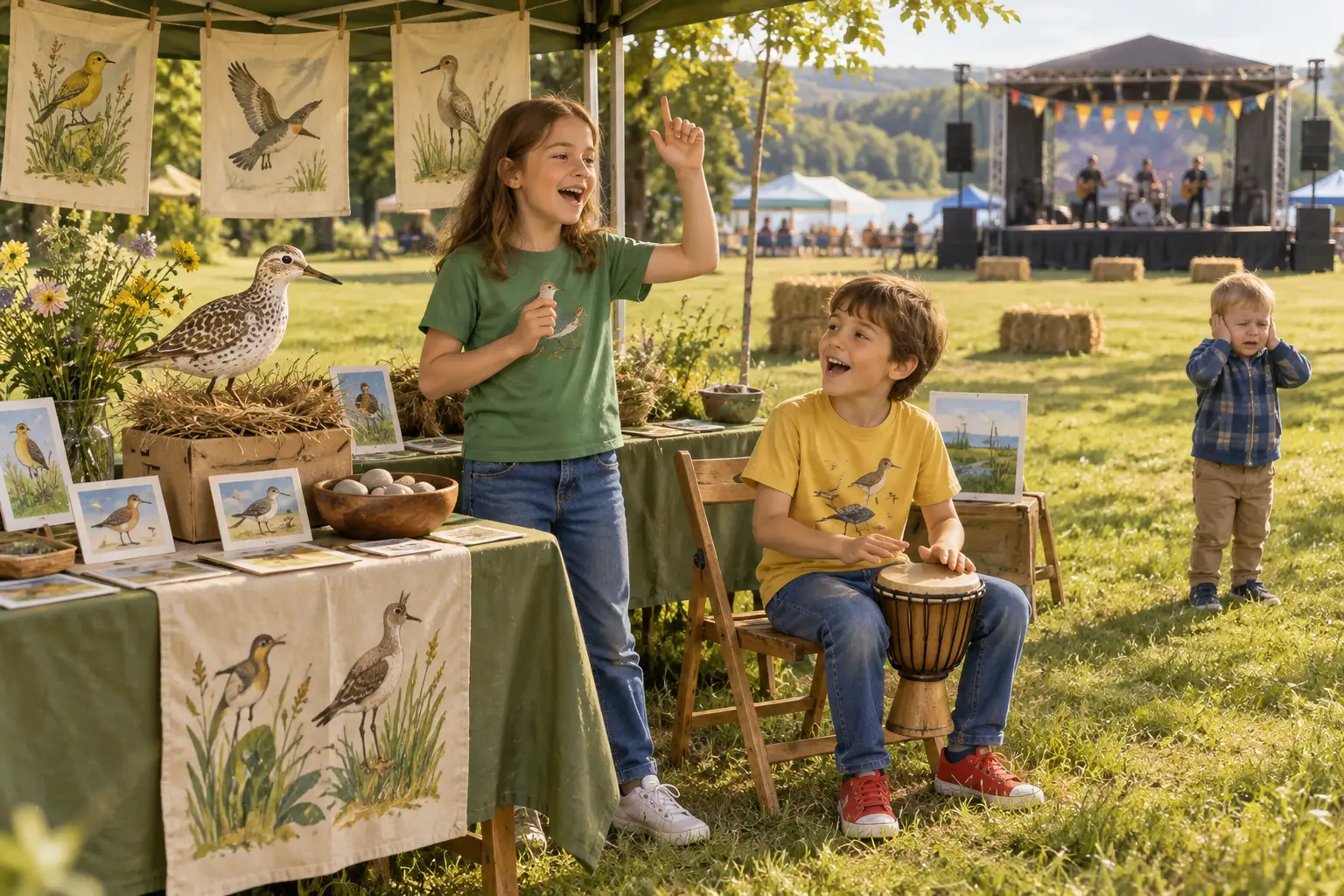
By the time the community fair opened, Esme had arranged the nature booth three times. She lined up the painted bird cards, placed a bowl of smooth stones beside them, and set out a small wooden sign that read, “Listen for the Wild.” Next to the sign, Daniel balanced a paper-mâché upland sandpiper on a cardboard nest.
“Does the beak look right?” Daniel asked.
Esme leaned closer. “It looks ready to sing.”
Daniel grinned, but his grin faded when a bright burst of music came from the stage across the fairground. A drumbeat rolled through the grass. Then a trumpet joined in, loud enough to make the paper bird tremble.
Their mother, who was helping families make leaf rubbings at the booth, glanced toward the stage. “The children’s band is warming up,” she said. “They may play for a while.”
Daniel looked at the little hand drum beside his chair. “How will anyone hear our song?”
Esme touched the page of music clipped to their display board. They had practiced their upland sandpiper song all week. It told how the bird flew over open grasslands, called from the sky, and returned to the wide, quiet places it liked best.
“We’ll try anyway,” Esme said. “Maybe the music will stop soon.”
When a family approached the booth, Esme raised her hand to count them in. Daniel tapped the drum, and together they began.
“Across the grass, above the plain—”
A drum from the stage boomed.
“—the sandpiper calls again—”
A trumpet blared, and the family’s toddler covered both ears. Daniel stopped singing. Esme finished the verse softly, but no one could hear her except Daniel.
“Let’s wait,” their mother suggested.
They waited beside the booth while people wandered past with lemonade, paper fans, and colorful ribbons. The stage music ended, but a speaker near the food trucks began playing a fast tune. It filled the space where their song had been.
Daniel folded the music page in half. “Maybe I can sing louder.”
Esme imagined him shouting until his voice turned scratchy. She shook her head. “That would only make our booth noisy too. We need to find a place where the sounds have room.”
Their mother pointed toward a grassy strip at the back of the fairground. “You can look from here, but stay together. I’ll watch the booth. Come right back if you need me.”
Esme tucked the song page into a folder. Daniel carefully lifted the paper sandpiper with both hands. They walked along the edge of the fair, where taller grass grew beside a row of young trees. The fair sounded different there. The music became softer, and they could hear leaves rustling overhead.
Then something small moved near a clump of grass.
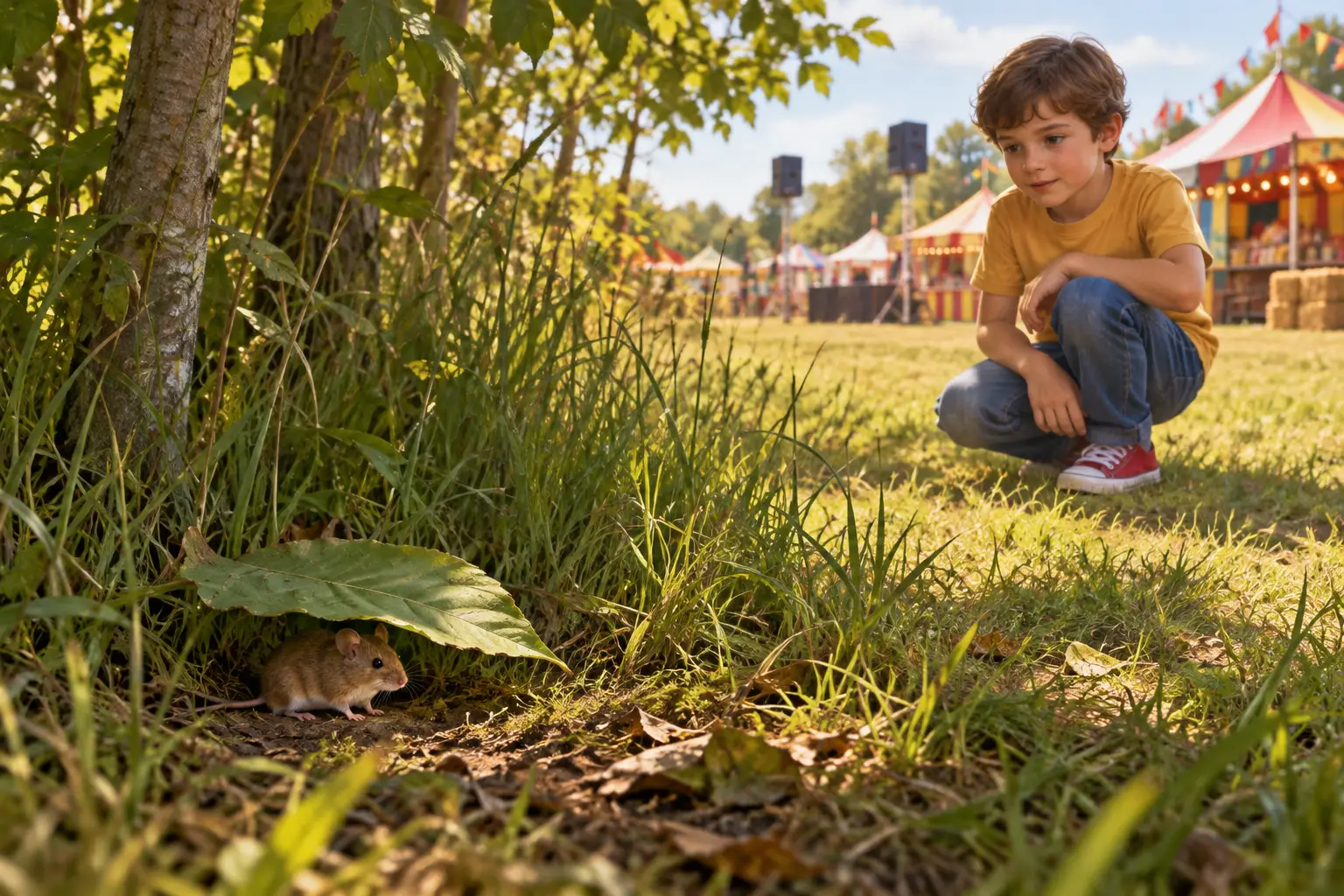
Pepper, a real field mouse, slipped from one stem to another. Its brown back nearly disappeared against the earth, and its whiskers quivered as it paused. Pepper did not hurry into the open space near the speakers. Instead, it followed the grassy edge, stopping whenever a shadow crossed its path.
Daniel lowered the paper bird. “Pepper’s going somewhere.”
“Let’s see where,” Esme whispered.
They stayed several steps away and watched. Pepper traveled beside the grass rather than through the open patch near the speakers. When the food-truck music swelled, it paused beneath a broad leaf. When the music softened, it continued toward the trees.
Esme took out a pencil and drew a tiny line on the back of an old fair map. “Pepper is choosing the quietest edge.”
Daniel looked toward the booth. “Maybe we should do that too.”
They followed Pepper’s path with their eyes until it reached a shaded place behind the last row of booths. A low wooden fence separated the spot from the fairground. Beyond the fence lay a patch of meadow grass. The place was still close enough for visitors to find, but far enough from the speakers that the music sounded faint.
Esme turned to Daniel. “We have two choices. We can keep our booth where it is and try to sing over the music, or we can move the display to the meadow edge.”
Daniel glanced at the paper sandpiper. “But Mom said we were in charge of the booth. We can’t just leave it.”
“We won’t leave it,” Esme said. “We’ll ask Mom, and we’ll compare both spots first.”
They returned to their mother and explained what they had noticed. She listened, then walked with them to the original booth. Esme stood beside the nature display while Daniel sang one verse at his usual volume. The food-truck music rose halfway through the song, and Daniel’s voice vanished beneath it.
Next, they carried only the song page and the paper bird to the meadow edge. Their mother stayed with them. Daniel sang the same verse again.
This time, his voice traveled over the grass. It did not sound huge, but it sounded clear. Esme could hear every word, and so could their mother.
“I think Pepper found something,” Daniel said.
Their mother smiled. “Pepper found a good path. You found a good place to listen.”
Moving the booth took more work than Esme expected. The display board was wide, and the bowl of stones was heavier than it looked. Their mother carried the board. Esme carried the bowl, while Daniel held the paper sandpiper and the folder of music.
At the meadow edge, they set the board against the fence and spread the grass-colored cloth beneath it. Esme arranged the bird cards again. Daniel placed the stones in a neat circle. The booth looked smaller there, but the open meadow behind it made the whole display feel bigger.
For their first practice, Esme tapped the beat on her palm. Daniel tapped his palm too. They sang without the drum.
“Across the grass, above the plain—”
Their voices matched.
“—the sandpiper calls again—”
A few people at the next booth turned to listen. Daniel’s shoulders lifted, and he sang the next line with more confidence.
Then a gust of wind swept across the meadow and flipped three bird cards from the display board. One card skittered beneath the fence. Another landed near a picnic table.
Daniel hurried after the card near the table, while Esme caught the one by her shoe. Their mother pinned the remaining cards beneath smooth stones.
“We need something to hold the display down,” Esme said.
Daniel looked at the bowl. “We could use more stones.”
Their mother pointed toward the craft table. “I’ll ask for a few clips.”
While she went, Esme searched beneath the fence for the missing card. She found it beside a patch of bent grass. The stems made a narrow, curving line that led toward the shade.
“Daniel,” she called. “Look.”
Daniel crouched beside her. The trail was not a road or a tunnel. It was simply a place where something small had passed through. A few tiny pawprints dotted the soft soil.
“Pepper,” Daniel whispered.
Esme followed the trail with her finger without touching the marks. It curved away from the loudest part of the fair and ended near a flat stone under the fence.
“Let’s add it to the display,” she said. “Not the real marks. We can draw the path so people understand how we noticed the quiet edge.”
Daniel’s face brightened. He took a pencil from the folder, and Esme found a clean sheet of paper. Together they drew the fence, the grass, the shade, and a dotted line showing Pepper’s route. Daniel added a tiny field mouse at the beginning of the trail.
Their mother returned with several wooden clips. “That’s a wonderful discovery,” she said. “Just remember to leave the grass as it is.”
“We will,” Esme promised.
They clipped the bird cards to the board and placed the new drawing beside the paper sandpiper. Under it, Esme wrote, “A quiet path can help you notice more.” She read the words aloud, then looked at Daniel. “Too much like a grown-up sign?”
Daniel shook his head. “No. It sounds like Pepper.”
Soon, visitors began stopping at the new location. Esme explained that the upland sandpiper was a grassland bird and showed them the painted card. Daniel pointed to the paper bird’s long wings. When it was time for the song, Esme asked everyone to clap softly with their hands.
“After each verse,” she said, “we’ll pause. See if you can hear a bird call.”
The first group clapped quietly. Daniel sang the opening line. His voice wobbled, and he glanced at Esme.
She kept the beat against her palm. “Keep going.”
Daniel sang the second line. A real bird called from somewhere beyond the trees, a quick, bright note that seemed to answer him. The visitors grew still.
Between verses, nobody spoke. They listened to the wind moving through the grass. A mourning dove called from the far side of the fair. Then a small bird chirped twice from the young trees.
“Did you hear that?” a girl asked.
Daniel nodded. “That one came from the trees.”
For the next verse, he sang more steadily. The music from the food trucks continued, but it was distant now. His song crossed the little booth, passed the paper sandpiper, and reached the visitors gathered by the fence.
At the final verse, Esme and Daniel sang together. Their mother joined in softly. When they finished, the visitors answered with gentle applause, careful not to cover the sounds beyond the fence.
Daniel looked surprised. Then he smiled so widely that Esme could see the dimple in his cheek.
“I could hear myself,” he said.
“And everyone else could hear you too,” Esme replied.
As the afternoon light turned golden, more visitors joined the quiet listening game. They listened for doves, crickets, and the faint rustle of grass. No one saw Pepper again, but the little field mouse’s trail remained on the drawing, curling away from the noise and toward the shade.
Before the fair closed, Esme and Daniel placed the drawing in the center of the nature display. Daniel set the paper sandpiper beside it, facing the dotted trail.
Their mother gathered the song pages. “Ready to pack up?”
“Almost,” Esme said.
She and Daniel stood at the fence one last time. The fair was quieter now. Lanterns glowed above the booths, and the last visitors walked slowly across the grass. Daniel tapped a soft beat against his palm, and Esme hummed the opening line.
From the meadow came a small stirring beneath the leaves. A field mouse slipped along the edge, paused in the shade, and continued toward the trees.
Daniel watched until Pepper disappeared into the grass. Then he tucked the paper sandpiper safely under his arm, and the two siblings carried their quiet song back toward home. Behind them, Pepper’s dotted trail rested in the center of the booth, beside the bird that sang across the open plain.
Talk about the story
1.What did Daniel make for the nature booth?
2.Why was Daniel worried about singing at the original booth?
3.Where did Pepper travel when the music became loud?
4.What did Esme draw on the old fair map?
5.Where did Esme and Daniel move the display?
6.What did the visitors hear between the verses?
7.What did Esme and Daniel place in the center of the nature display?
Coloring page
Print the story’s hero and color it in together — with crayons, markers or paints.