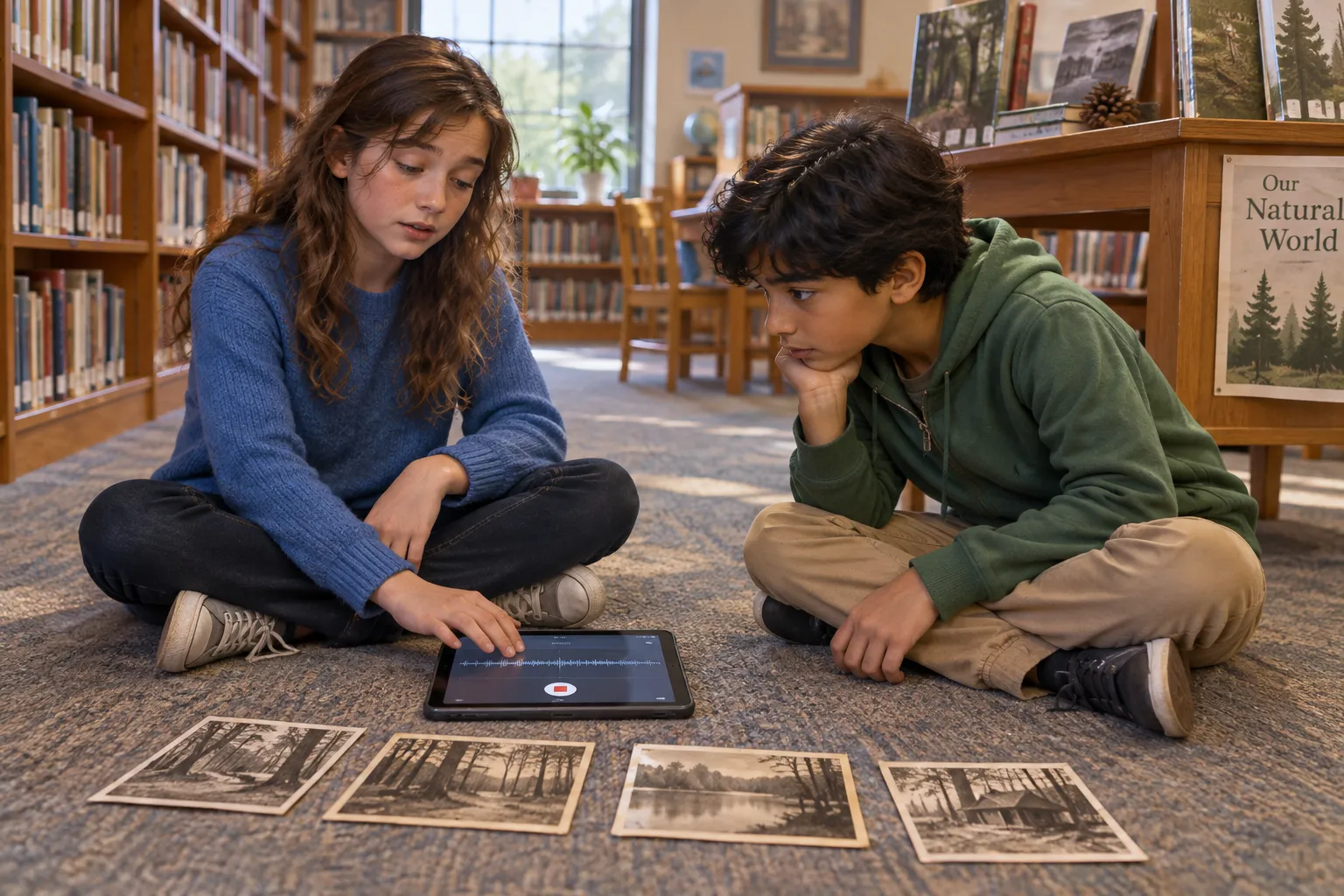
The first recording began with three long seconds of silence. Then June said, in a voice that sounded nothing like her own, “This photograph shows a woodland clearing used for community gatherings in the past.”
Dev leaned toward the tablet. “That sounds like a robot reading a report.”
June stopped the recording and sighed. “I know.”
They were sitting on the floor of the school library beside a row of old photographs. The pictures had been taken many years ago in a nearby woodland clearing, where families once gathered for picnics. In one photograph, children raced around a wide tree stump. In another, adults stood beside a hand pump with shining metal handles. A third picture showed a circle of stones where people had cooked meals together.
The history club had decided to make audio guides for the hallway exhibit. Visitors would scan a code beside each photograph and hear a student explain what they were seeing. June and Dev had written their first scripts carefully. They had checked every date and spelled every place name correctly.
But the scripts sounded as if they had been copied from a dusty book.
Dev played the next recording. “The pictured area contains a stone fire ring and several individuals positioned near a water source.”
June covered her face with both hands. “I would never say ‘individuals positioned.’”
“Neither would I,” Dev said. “I don’t even know what it means.”
Their teacher, Ms. Alvarez, came over from the display table. She listened to the recording and smiled kindly. “You have the facts, but the clearing is missing. What did it feel like? What might a visitor notice first?”
June looked at the photographs. “We could go there.”
“That’s what historians do,” Ms. Alvarez said. “They look closely. Ask your families, and we’ll plan a short visit tomorrow afternoon. Bring notebooks, but leave the scripts at school.”
The next day, June’s mother drove June and Dev to the woodland trail. June’s father came too, along with Petal, a small, floppy-eared puppy who bounced in circles the moment she saw the trees. Petal was not allowed to run ahead, so June held her leash while Dev carried a canvas bag with water bottles and notebooks.
The trail curved beneath tall trees. Sunlight slipped through the leaves in bright patches. Petal stopped every few steps to sniff a twig, a patch of moss, or a place where something small had crossed the dirt. Once, she discovered a pinecone and pranced proudly beside it until Dev crouched to admire her find.
“Petal, that is an excellent pinecone,” he told her.
Petal dropped it at his shoes, then picked it up again.
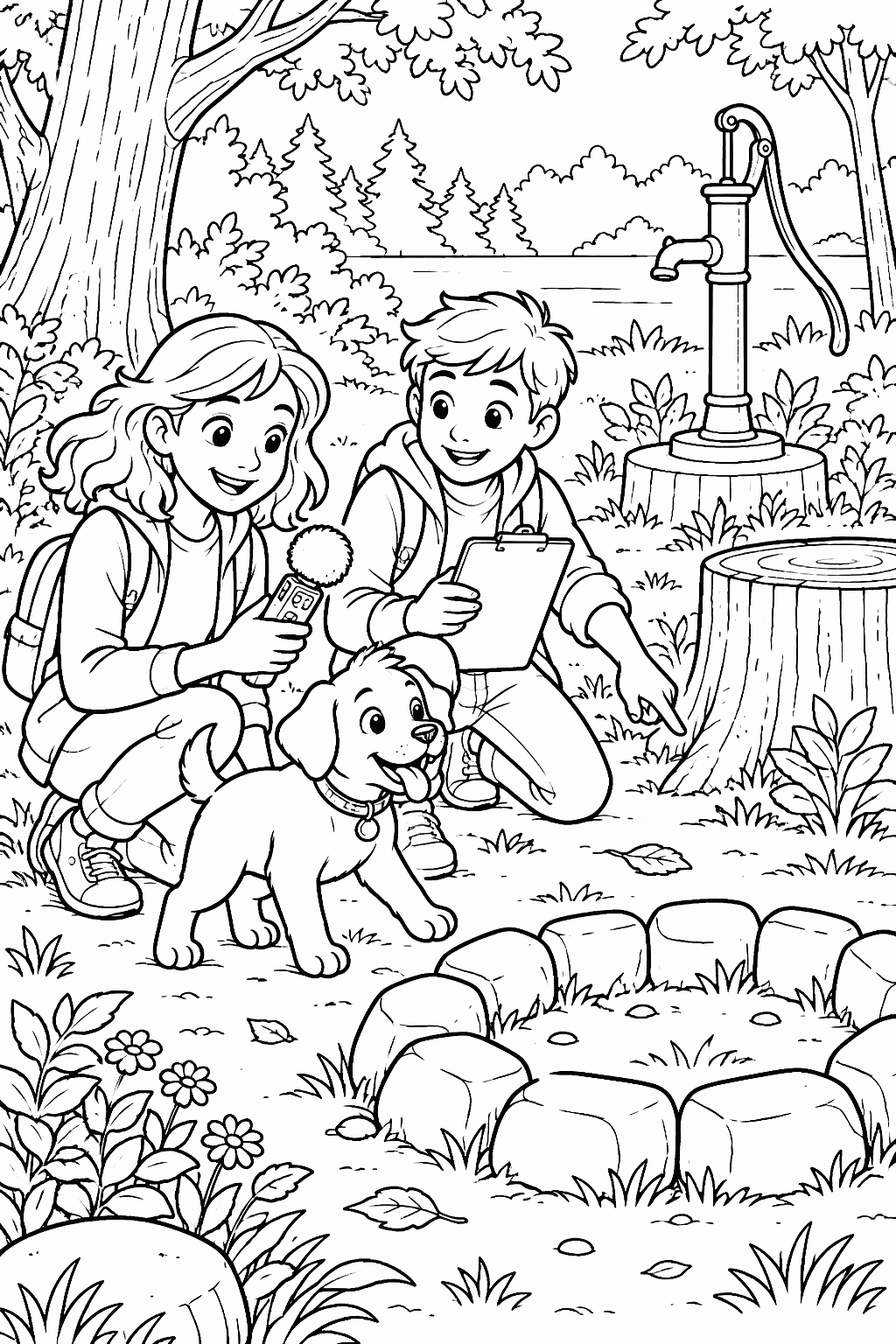
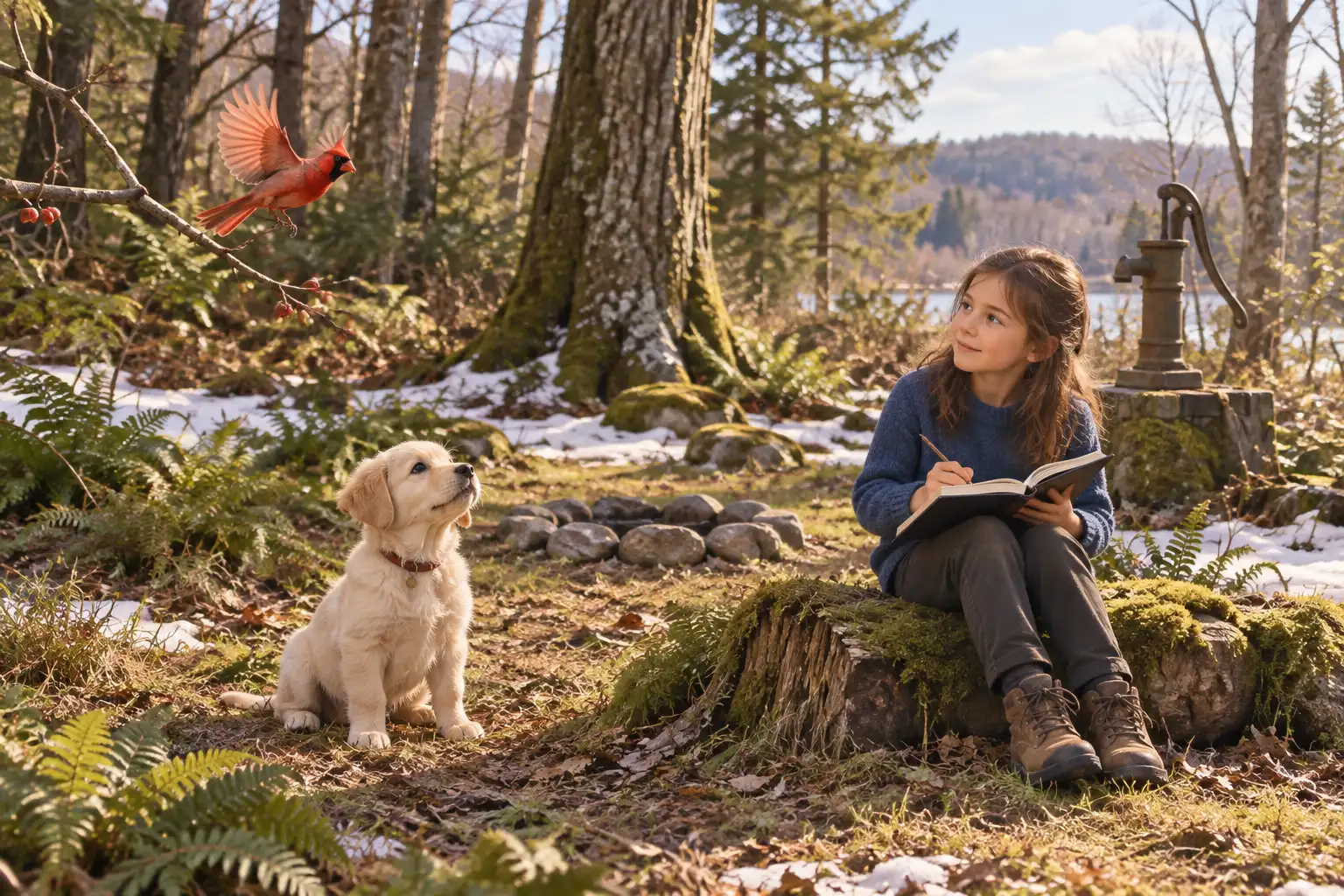
At last, the trees opened into the clearing. June recognized it from the photographs, but it looked quieter than she had expected. Grass grew around the edges, and ferns leaned beneath the trees. A weathered hand pump stood near a flat stone. The wide tree stump was still there, though its top was soft with moss. Nearby, a ring of gray stones marked the old fire area.
June took out her notebook. “There’s the pump.”
“And the stump,” Dev said. “Look at the photograph. The children are standing almost exactly there.”
Petal pulled gently toward the stump. June followed, and the puppy sniffed all around its base. She wagged her tail at the moss as if she had found something wonderful.
June studied the old picture again. “The stump looked fresh then. People must have sat on it or used it as a table.”
Dev walked to the fire ring, keeping Petal well away from the stones. “The ring is wider than I thought. Maybe several families cooked here at once.”
June’s mother pointed toward the open grass. “Imagine blankets spread out there, with baskets and jars and children running around.”
June closed her eyes for a moment. The clearing was still, but she could almost hear what her mother had described: voices calling from one blanket to another, footsteps in the grass, and laughter near the pump.
Then Petal barked once. A red cardinal flew from a low branch, and Petal sat down in surprise.
Dev grinned. “There’s a sound for the guide.”
June quickly wrote it down. “Cardinal near the clearing. Puppy surprised by cardinal.”
“Maybe don’t put the puppy part in every recording,” Dev said.
“No promises.”
They explored for another hour without moving anything or stepping inside the fire ring. June noticed a rusted hook on the pump and a smooth hollow in the stump where rainwater had collected. Dev found a row of tiny mushrooms beneath a fallen branch. Petal discovered a second pinecone, then a leaf that she carried halfway across the clearing before dropping it to chase a fluttering moth.
When June looked back at the photograph, she understood that history was not only about important names and dates. It was also about ordinary things people touched and used: a pump handle, a stump, a circle of stones, and a path worn by many feet.
On the ride home, June opened her notebook. “The beginning should say what visitors might notice. Not just what the picture contains.”
Dev nodded. “How about, ‘Look closely. Families once gathered in this clearing for food, games, and a day outdoors.’”
June wrote it down. “That sounds like a person talking.”
Petal rested her chin on June’s knee and let out a sleepy sigh.
The following morning, June and Dev asked Ms. Alvarez whether they could plant something in the school garden. They wanted the exhibit to connect the old photographs with the future.
Ms. Alvarez led them to a marked bed beside the library windows. “The garden committee saved a native oak acorn for this spot,” she said. “If you plant it, we’ll label the bed and care for it together.”
June held the acorn in her palm. It was small and smooth, with a little cap at one end. It seemed hard to believe that such a tiny seed could someday become a tree wide enough to shade a picnic blanket.
Dev used a hand trowel to loosen the soil while June made a shallow hole. Together, they placed the acorn inside. June covered it gently, and Dev pressed a wooden marker into the soil. He wrote, “Native oak seed, planted by the history club.”
Petal waited with June’s father on the path. When June came over, the puppy sniffed the fresh earth and sneezed.
“Bless you,” June said. “But no digging.”
Petal wagged her tail and leaned against June’s leg.
Back in the library, the friends rewrote their scripts. They used short sentences and left room for visitors to imagine the scene.
“Here’s the photograph with the hand pump,” Dev read. “Families came to this clearing for community picnics. The pump provided water. In the picture, people wait their turn while children gather near the tree stump.”
June tapped the page. “Add what the pump might sound like.”
Dev thought for a moment. “The handle might squeak and clank. Water might splash into a bucket.”
“Good. Say ‘might.’ We don’t know exactly what it sounded like that day.”
They worked through each photograph. For the fire ring, they described the stones and the meals people may have cooked nearby. For the wide stump, they mentioned the moss covering it now and the children who had once gathered around it. For the photograph of the open grass, they talked about blankets, baskets, games, and the sound of a cardinal in the trees.
Then June recorded the new version. Her voice sounded like herself—bright, careful, and curious.
“Look closely at the center of the photograph,” she said. “A group of children stands beside a wide tree stump. The stump is still in the clearing today, though moss now grows across its top. If you visit, you may hear birds in the branches and your own footsteps in the grass.”
Dev listened. “Much better.”
“Let’s ask the younger students,” June said. “They’ll tell us if anything is confusing.”
Ms. Alvarez invited a group of third graders to the hallway. Each child listened to one recording through headphones, then looked at the matching photograph. June watched their faces as they listened.
A third grader named Sofia raised her hand. “I liked the pump one, but I didn’t know what a fire ring was.”
“It’s a circle of stones where people once built cooking fires,” June explained. “We should say that in the recording.”
Another student said, “The tree stump part made me want to see it. But I didn’t know if the stump was still there.”
“It is,” Dev said. “We’ll make that clearer.”
The students’ questions helped, but one problem remained. When June tried to record the photograph of the picnic blankets, the hallway door squeaked loudly behind her. On the second try, a cart rattled past. On the third, Petal—who had come with June’s family to pick her up—gave a joyful bark from outside the library.
June listened to the recording and frowned. “I can’t get the sound right.”
Dev tried next, but his voice came out too softly. He moved closer to the microphone, and the recording became loud and scratchy.
They tried again and again. Each version had a different problem.
Finally, June carried the tablet to Ms. Alvarez. “Could you help us? We know what we want to say, but the recording keeps turning strange.”
Ms. Alvarez showed them how to place the tablet on a stack of books, away from the wall and the noisy hallway. She reminded them to pause before speaking and leave a moment of quiet at the end. Then she asked June to read as if she were talking to one visitor standing beside her.
June took a slow breath. She pictured the clearing, the old stump, and Petal’s surprised face when the cardinal flew away.
“Families once gathered here for picnics,” she began. “They brought food, blankets, and games. Listen for the small details in the photograph: children near the stump, a pump beside the path, and a fire ring built from stones. The clearing is quieter today, but the place still holds those memories.”
This time, the recording sounded clear and warm. Dev added the final sentence about the native oak seed in the school garden. He explained that the history club had planted it as a promise to keep noticing and caring for the places people shared.
Before posting the audio files online, Ms. Alvarez helped them check each one. They removed students’ last names, the name of the school, and any detail that might identify a child. The guide would be available through the exhibit, but it would not reveal personal information.
At the opening of the hallway exhibit, families and students moved from photograph to photograph. They listened to June and Dev’s voices and leaned close to the pictures. Some visitors smiled at the hand pump. Others searched the photograph for the wide stump. A little boy asked his grandmother if they could visit the clearing on the weekend.
June stood beside the picture of the stone fire ring. Dev stood beside the picture of the picnic blankets. Petal waited at June’s feet, her tail sweeping softly across the floor.
A visitor finished listening and said, “I can almost hear the people there.”
June looked through the hallway window toward the marked garden bed. The oak acorn was hidden beneath the soil, doing its quiet work.
Outside, evening light rested on the schoolyard. Petal curled beside June’s shoes while Dev checked the final recording one more time. From a nearby tree came the clear call of a cardinal.
June smiled. “That belongs in the guide, too.”
Petal lifted her head, listened, and settled back down as the last golden light touched the little wooden garden marker.
Talk about the story
1.Why did June and Dev visit the woodland clearing?
2.What did the wide tree stump look like when June and Dev visited?
3.What did Petal find beside the trail?
4.What did June and Dev plant in the school garden?
5.How did Ms. Alvarez help them make clearer recordings?
6.What is a fire ring?
7.What sound did June decide belonged in the guide?
Coloring page
Print the story’s hero and color it in together — with crayons, markers or paints.