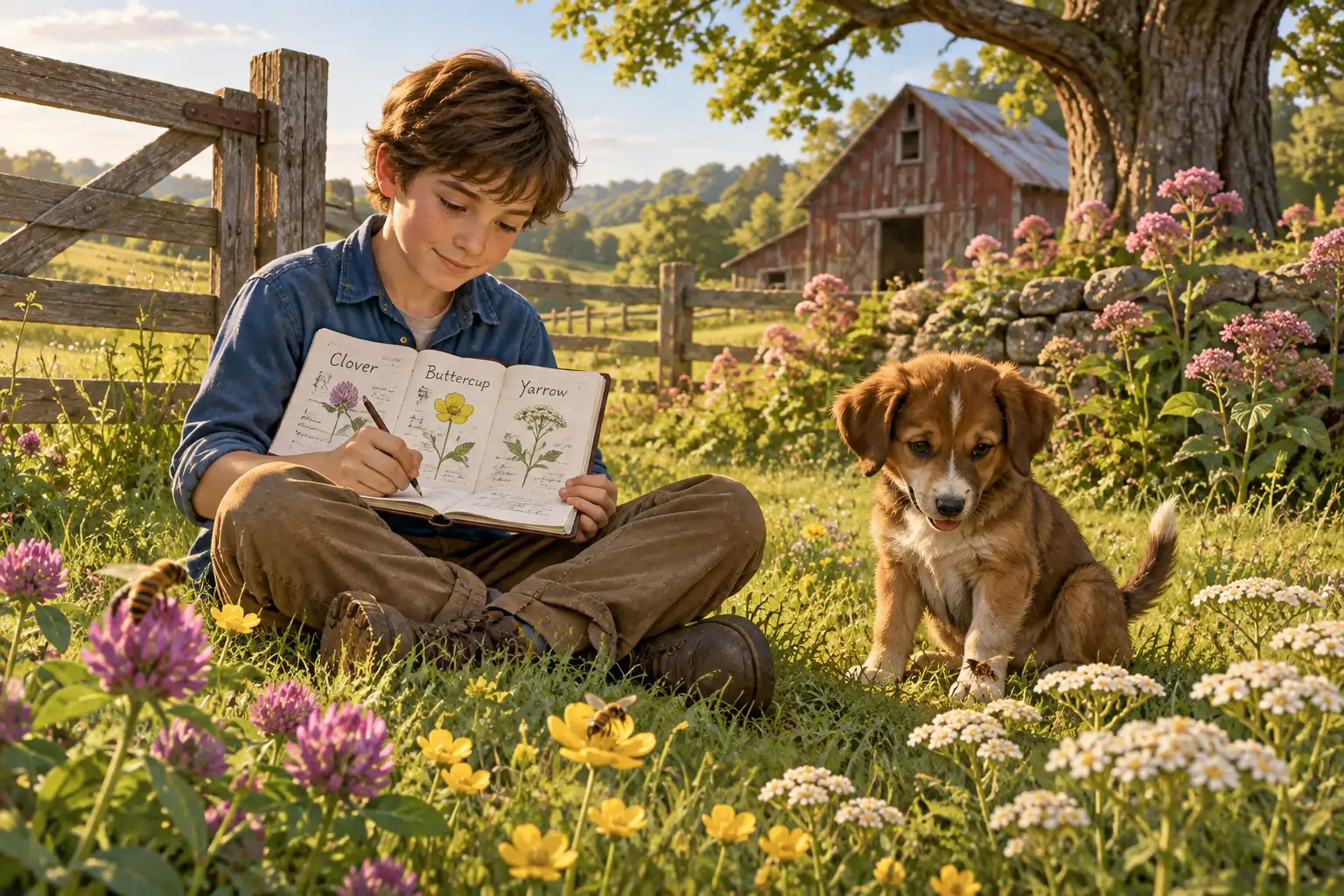
On a bright Saturday morning, Elliot carried a sketchbook across his family’s farm while Pepper bounced beside him. Pepper was a young puppy with soft brown ears, a white spot on his chest, and a tail that wagged at every new idea.
The meadow stretched beyond the barn, sprinkled with purple clover, yellow buttercups, white yarrow, and tall pink milkweed. Bees hummed from flower to flower. Elliot had come to the farm with a special job from the school reading club: he wanted to make a handmade bedtime story that younger students could read at night.
His mother had suggested writing about the meadow. As she packed paper, pencils, and a few recycled envelopes into a canvas bag, she said, “You already know so many of its little neighbors. Look closely, and the story will show you where it wants to go.”
Elliot liked that idea, although he wasn’t sure a story could show anyone anything. He tucked the bag under his arm and followed Pepper through the gate. Pepper trotted ahead, then hurried back, as if he wanted to make sure Elliot hadn’t wandered off.
“Stay near me, Pepper,” Elliot said. “We’re working today.”
Pepper sat down at once. A tiny bee landed on a clover blossom beside his paw. Pepper watched it carefully, then looked at Elliot with wide, curious eyes.
Elliot opened his sketchbook. Before he could draw, three bees lifted from the clover and buzzed toward the buttercups. One settled on a yellow flower. Another flew to a tall blue flower near the fence. The third paused over a white yarrow bloom, circled once, and dipped into the center.
Elliot followed them with his eyes. “They don’t all choose the same flower,” he whispered.
He made three quick notes: clover, buttercup, and yarrow. Then he wrote, “The meadow has many doors, and every bee knows which one to visit.”
Pepper sniffed the ground and sneezed. Elliot laughed so hard that his pencil rolled into the grass.
He found it beneath a buttercup, but the moment gave him an idea. In his story, the bees could be tiny travelers searching for the best door in a meadow house. The flowers would welcome them with different colors and scents. Maybe the story could show that a place was strongest when all its parts had room to grow.
Elliot sat beneath an old maple tree and began to sketch. He wanted three real meadow animals to appear in the story. The first was a frog that lived near the shallow pond. Elliot had seen it there many times, resting on a flat stone with only its bright eyes above the water.
The second animal was a groundhog. A burrow opened near the far edge of the meadow, below a patch of goldenrod. The groundhog sometimes came out in the late afternoon and stood very still before waddling toward the grasses.
For the third animal, Elliot chose a red-tailed hawk. He had watched one circle high above the fields, its broad wings steady against the wind.
He drew the frog with smooth, round eyes, the groundhog with a sturdy body, and the hawk with wide wings spread across the top of the page. Pepper leaned over the sketchbook and sniffed the drawings.
“Those are not treats,” Elliot told him.
Pepper gave a pleased little wiggle and rested his chin on Elliot’s knee.
The story began to take shape. A frog would listen to the flowers. A groundhog would search for a quiet place to rest. A hawk would watch the meadow from above. The bees would visit each blossom and carry the meadow’s news from one living thing to another.
But Elliot had another problem. He wanted to make the booklet from recycled paper so it would feel like a real handmade gift. His mother had brought sheets from old school projects, paper bags, and envelopes that had been opened carefully instead of thrown away. Some pieces were brown and rough. Others were pale and smooth.
Elliot chose a green pencil and drew a small bee on the first page. Then he held the page up proudly. When his thumb brushed the bee’s wing, the green smudged across the paper.
“Oh, no.”
Pepper lifted his head.
Elliot tried again on a piece of paper from an old envelope. This time, he used a blue pencil for the wings and a yellow pencil for the body. The colors looked clear until he added a line around the flower. The paper bent beneath the pencil, and the yellow spread into a cloudy patch.
He tested a third sheet, this one from the back of an old school worksheet. It held the lines better, but the gray paper made the colors look dull.
Elliot leaned back against the tree. The sun moved across the grass. Bees hummed, and Pepper rolled onto his back and waved his paws in the air.
“I can’t use paper that ruins the drawings,” Elliot said. “But I don’t want to give up on recycled paper.”
His grandfather, who was repairing a gate nearby, heard him. He walked over carrying a small wooden box of farm supplies.
“What have you discovered?” Grandpa asked.
“Not all recycled paper works the same way. Some smears, some bends, and some makes the colors look sleepy.”
Grandpa smiled. “Then you’re not stuck. You’re testing materials. Try the smoothest side of each piece, and give the pencil marks a little time before you touch them.”
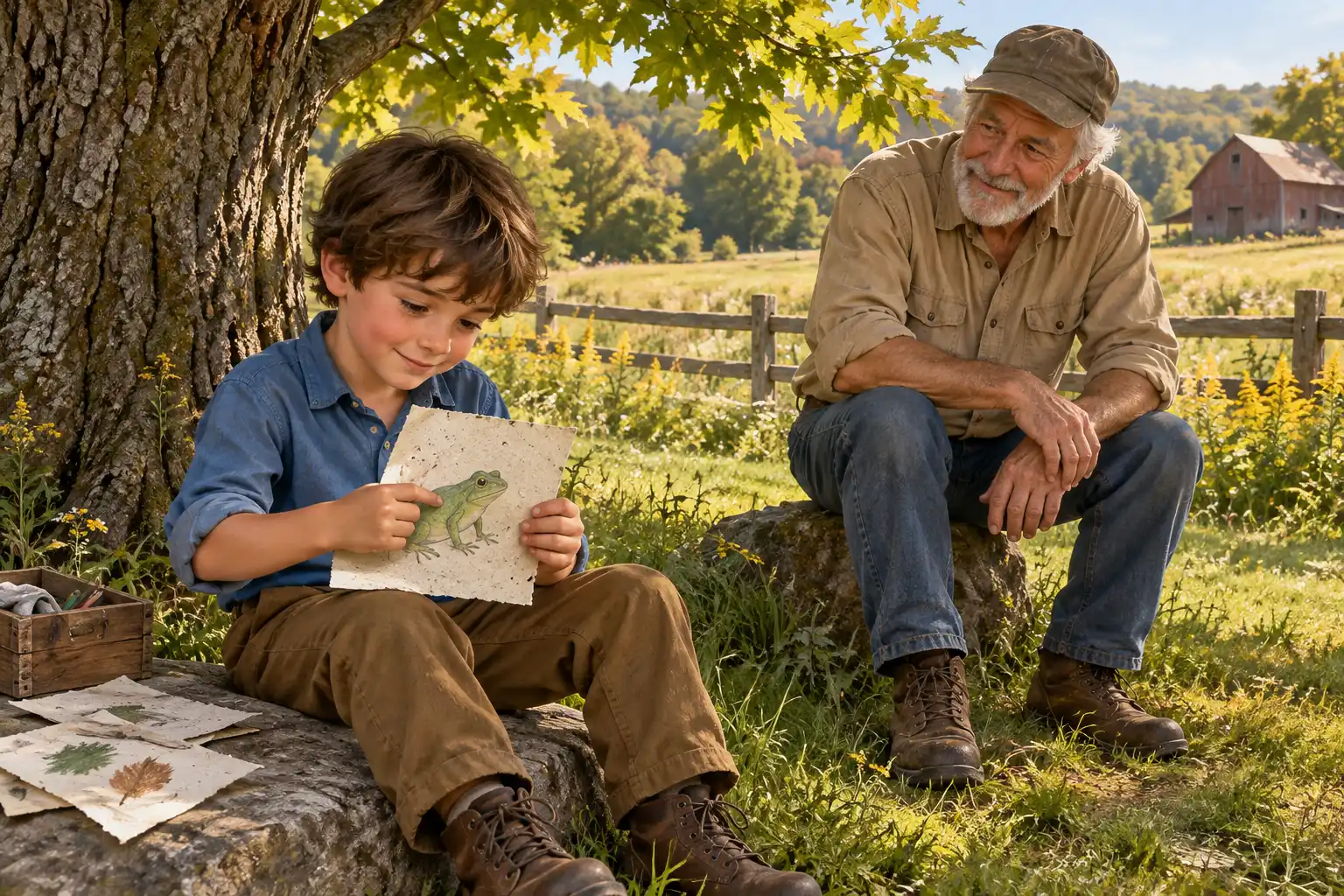
Elliot looked at the pages again. He had been rubbing each drawing right away because he was eager to see how it looked. He chose the smooth side of the envelope paper, sharpened his pencils, and made three small tests: a flower, a frog, and a line of bees. Then he set the pages on the flat stone beside him.
For a while, he worked on the words instead. He wrote, “The frog heard the clover’s soft bell.” He crossed that out. Frogs did not hear flowers ringing. He tried again: “The frog rested beside the clover while bees hummed above him.” That sounded more like the meadow he knew.
Next, he wrote about the groundhog finding shelter beneath the goldenrod. Then he described the hawk gliding over the field—not hunting in the story, but watching the changing light on the flowers.
When Elliot returned to his test pages, the pencil marks were dry. He pressed his thumb gently against the frog’s back. The green stayed where it belonged.
“Grandpa, it worked!”
“Looks like your patience helped,” Grandpa said.
Elliot didn’t say that patience had been his least favorite part. Still, he carefully chose the paper that held the drawings and set aside the pieces that did not. With his mother’s help, he cut the good sheets into matching rectangles. Then he stacked them in the order of his story. The booklet would have a cover, four story pages, and a final page where readers could draw their own meadow.
By late afternoon, Elliot had written the first version. He read it aloud beneath the maple tree while Pepper listened.
“In a meadow filled with many kinds of flowers, a bee named Dot searched for a blossom that smelled like warm sunshine. She visited the clover, the buttercups, and the yarrow. Along the way, a frog, a groundhog, and a hawk helped her notice that every part of the meadow had something to offer.”
Pepper’s tail thumped against the grass.
Elliot turned the page. “The frog showed her the cool pond. The groundhog showed her the quiet grass near his burrow. The hawk showed her how the meadow looked from the sky. Dot returned to the flowers and carried a little news from each one.”
Pepper thumped harder.
Elliot smiled, but when he reached the last page, he stopped. The ending was only one sentence: “And the meadow was happy.”
“That’s not enough,” he said.
Pepper sat up, as if he agreed.
Elliot read the story again. He noticed that Dot had traveled through the meadow, but she hadn’t done anything with what she learned. She needed to bring the different pieces together.
He thought about his own day. The bees had chosen different flowers. The animals each belonged to a different part of the meadow. The papers had all been different, too, and only some were ready to hold the drawings. The story needed a gathering.
Elliot added a new scene. Dot invited the frog, the groundhog, and the hawk to meet near the tallest milkweed. The frog brought a cool pond breeze. The groundhog brought a seed tucked safely in the grass. The hawk brought a view of the whole meadow. Dot brought the colors and scents of every flower.
Together, they made a picture of the meadow that no one animal could have made alone.
When Elliot read the ending aloud, Pepper wagged so hard that his whole body wiggled.
“That’s better,” Elliot said. “You knew it needed something.”
The booklet still needed a cover. Elliot drew a bee above three flowers, with the frog near the pond, the groundhog by the goldenrod, and the hawk high in the sky. He wrote the title in careful letters: “The Meadow’s Many Doors.”
That evening, Elliot carried the finished booklet into the farmhouse. He wanted to show it to everyone, but he also wanted to keep it for himself. He imagined placing it on his bedroom shelf, where he could read it whenever he wished. He had made the drawings, tested the paper, and fixed the ending. The booklet felt like a small piece of the farm that belonged only to him.
At dinner, his mother asked, “Are you ready to bring it to the reading club on Monday?”
Elliot looked at the cover. “Maybe I’ll just show it to the group and take it home again.”
“That’s your choice,” she said. “But remember, the younger students are making a shelf of stories they can share with one another.”
Elliot nodded, though he still wasn’t sure.
On Monday, he brought the booklet to school in a folder. At reading club, the younger students gathered on the rug. A student named Maya sat in front with her hands folded in her lap. Several children leaned closer when Elliot opened the cover.
He read the story aloud. His voice shook at first, especially when he reached the page about the frog. Then Pepper’s happy tail came back to him, thumping against the grass, and Elliot found his steady voice.
When he finished, Maya raised her hand. “Can I look at the pictures again?”
Another student asked, “Does the groundhog really live near your farm?”
“Yes,” Elliot said. “If you’re quiet, you might see him near the goldenrod.”
The children passed the booklet carefully from one pair of hands to the next. No one bent the pages or rubbed the pencil marks. They treated the story like something worth taking care of.
Elliot felt a small tug inside him. He had wanted to keep the farm story close, but now he could see it traveling from reader to reader without leaving the meadow behind.
His teacher, Ms. Alvarez, came over after the meeting. “The school has a free online collection for seven-year-olds,” she said. “With your family’s permission, we could scan your booklet and submit the story. Then children who aren’t in this reading club could enjoy it, too.”
Elliot thought about the recycled paper, the patient pencil tests, and the pages passing gently across the rug. He thought about Pepper listening under the maple tree.
“Could we do that?” he asked.
“With an adult’s help,” Ms. Alvarez said. “We’ll make sure the words and pictures are clear before we send anything.”
That afternoon, Elliot and his mother sat at the kitchen table. She placed each page beneath a small scanner while Elliot checked the images on the screen. The first scan made the green pencil look faint, so they adjusted the light and tried again. The second scan showed every line clearly, including the little frog beside the pond.
Elliot typed the title and his name with his mother beside him. Before they submitted it, he read every page one more time. Then he clicked the button.
A few days later, the school collection showed “The Meadow’s Many Doors” beside stories written by other families. The farm’s story had become one of several free bedtime stories children could read before sleep.
On Saturday, younger students visited the farm with their parents for a reading club picnic. Maya spotted the clover first. Another child found the shallow pond. Elliot led them to the goldenrod and pointed out the groundhog’s burrow from a respectful distance. Pepper padded among the group, greeting each child with a wagging tail.
As the sun lowered, the bees moved from the buttercups to the yarrow. Elliot sat beneath the maple tree with a blank sheet of recycled paper on his knees. Nearby, Maya drew a flower while Pepper rested his chin on her shoe.
Elliot opened his original booklet, now kept in a clear folder, and read the last page to the children. Then he placed it in the center of the picnic blanket so everyone could see it.
Above them, a hawk glided over the meadow. A frog called softly from the pond. The grasses stirred around the groundhog’s burrow, and the flowers leaned together in the evening breeze.
Pepper’s tail tapped a quiet rhythm against the blanket as the children listened. Elliot picked up his pencil and began to write another page.
Talk about the story
1.What special job did Elliot have from the school reading club?
2.Which three flowers did Elliot write in his notes?
3.What three animals did Elliot choose for his story?
4.Why did Elliot test different kinds of recycled paper?
5.What did Grandpa tell Elliot to do with the pencil marks?
6.What did Dot bring to the gathering near the tallest milkweed?
7.Where did Elliot and his mother submit the scanned booklet?
Coloring page
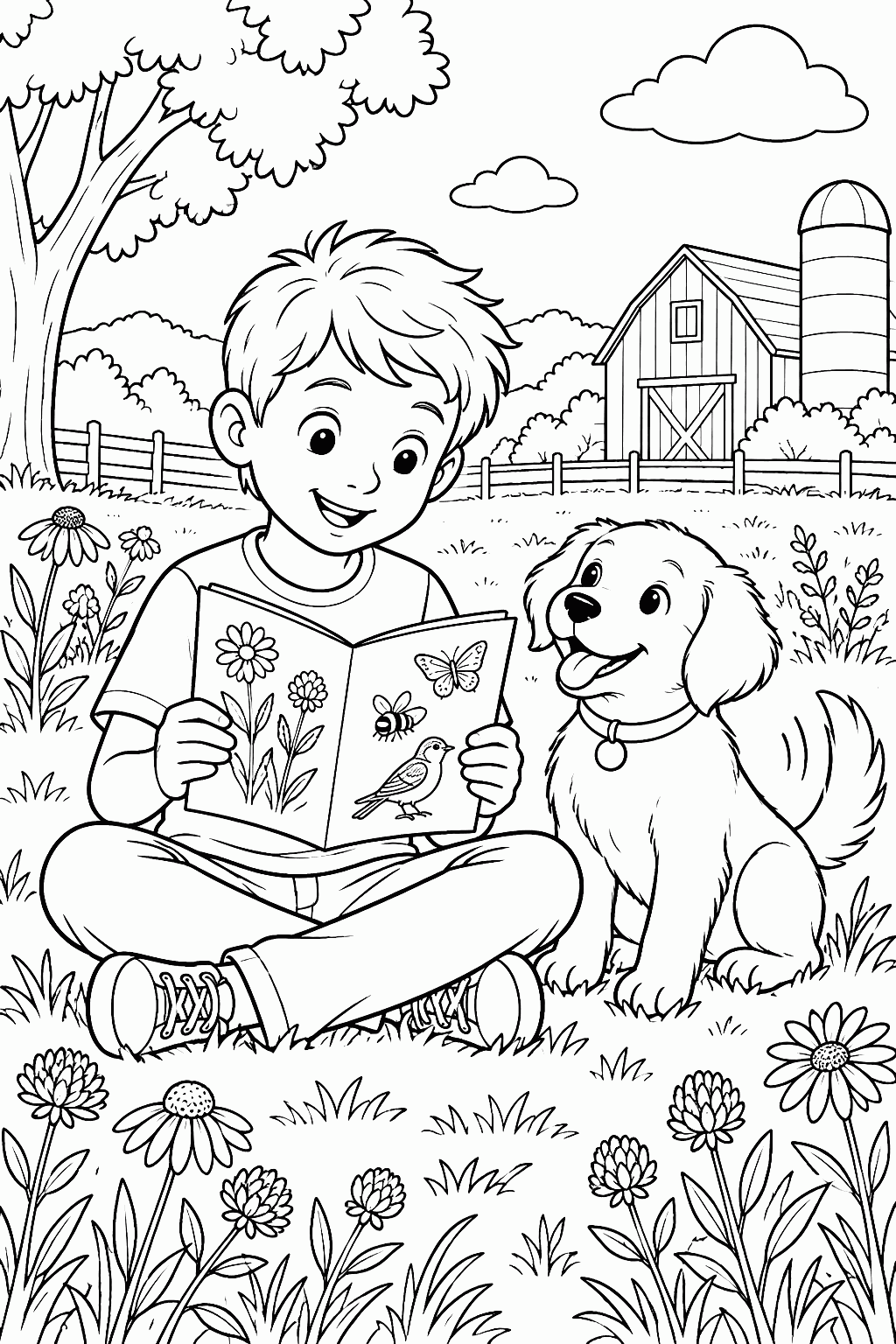
Print the story’s hero and color it in together — with crayons, markers or paints.