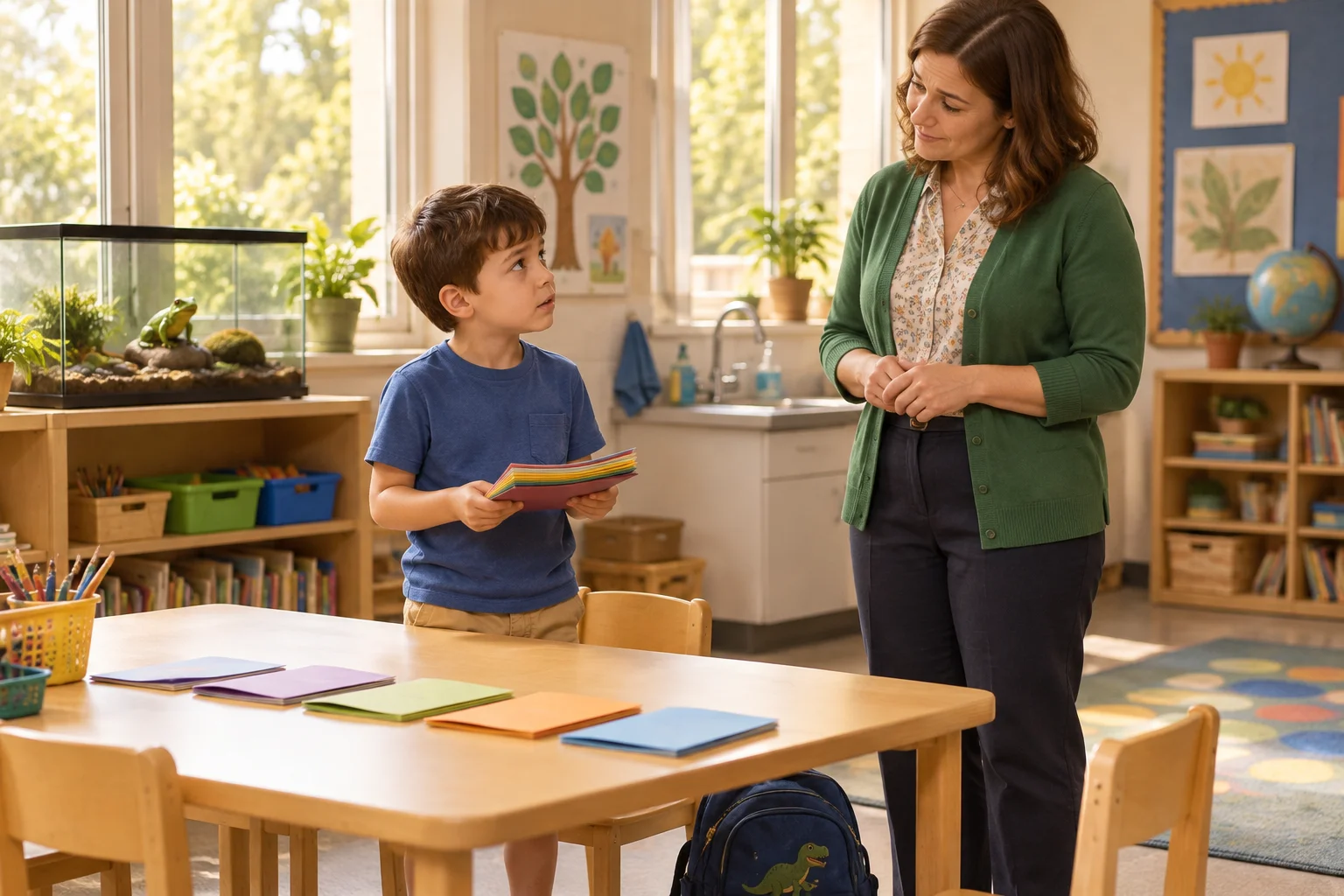
On a bright morning, Kiran carried his small backpack into the preschool classroom where he had once learned to tie his shoes, paint clouds, and return every block to the right basket. He was seven now, and standing beside the low tables made him feel very grown-up. The chairs looked tiny, and the sink seemed much lower than he remembered.
His old teacher, Ms. Elena, greeted him with a hug. “I’m glad you came, Kiran. We have a special project today.”
At the far side of the room stood a wide glass tank with smooth stones along the bottom. A green frog rested beneath a patch of moss, so still that Kiran almost mistook him for a leaf.
“Is that Puddle?” Kiran asked.
“It is,” said Ms. Elena. “Puddle is still the class frog. The children have been learning how to watch him carefully. Today, we’re going to make a little gift for each child—a booklet about Puddle.”
Kiran set his backpack beneath a table. “I can help with the folding.”
“That’s exactly what I hoped you’d say.”
Soon, the preschoolers gathered around the tables. Diego had a laugh that bounced like a rubber ball. Mae carried three purple crayons in one hand. Luis kept glancing toward the tank to see whether Puddle had moved. A few children were still washing paint from their fingers, and one little boy was carefully lining up the glue sticks.
Ms. Elena placed a stack of colored paper in the center of the table. “Each booklet will have pictures of Puddle resting under the moss, eating, and swimming in his water dish. When we give the booklets to the children, they can look at the pictures while they watch him.”
Kiran picked up two sheets of paper. The first plan was to fold one sheet into pages and use the other as a cover. He folded the paper in half, pressed the crease with his thumb, opened it, and folded it in half the other way. The pages looked neat and sturdy.
The children tried their own folds. Mae’s paper became a little fan. Diego’s turned into a long strip. Luis folded his into a square that opened in four directions.
Kiran counted the remaining sheets. Then he counted the children. He counted both again, just to be sure.
His stomach gave a small squeeze. There weren’t enough colored sheets for every booklet if each one needed two.
Ms. Elena noticed his worried face. “What did you find?”
“We don’t have enough,” Kiran said quietly. “If we make them the way we planned, some children won’t have a cover.”
The room, which had been full of folding and giggling, grew still.
“Maybe we could make only a few,” Diego suggested.
“Or draw on plain paper for the covers,” Mae said.
Kiran looked at the sheets in his hands. He didn’t want anyone to be left without a booklet, and he didn’t want the project to end before they had even watched Puddle. He smoothed one of his folds and began testing other designs.
He folded a sheet in half, then in half again, making four panels. When he opened it, the creases crossed like a window. He tried folding the paper into a long strip and then turning the strip into pages, but the paper buckled and would not lie flat.
“That one looks like an accordion,” Diego said.
“It does,” Kiran agreed. “But it doesn’t make a very good book.”
He tried once more. This time, he folded the sheet into a rectangle and opened it again. With Ms. Elena’s help, he made a short cut along the center crease. Then he folded the paper the other way and gently pushed the ends together. The middle opened into a little diamond. Kiran pressed the sides until the paper became a tiny booklet with a front, a back, and several narrow pages.
He held it up. “One sheet makes the whole inside.”
Ms. Elena leaned closer. “And we can use scraps for the covers.”
Kiran turned to the children. “Do you have any colored pieces you’d be willing to share? They don’t have to be big. We can make every cover different.”
Mae opened her art folder. “I have purple scraps. Purple is my favorite.”
Diego found a bright orange triangle. “I like this one because it looks like sunshine.”
Luis brought over a strip of blue paper. “This can be the water.”
One by one, the children searched their folders and the shared scrap basket. They chose pieces they wanted to share and placed them in the center of the table. No one had to give away a favorite scrap, but everyone who wanted to help found something.
Kiran arranged the pieces by color. There were purple corners, blue strips, yellow moons, green triangles, and one small red square left over from a paper house.
“Now we have enough,” he said.
The preschoolers cheered softly, as if Puddle might hear them through the glass.
Kiran made another sample booklet, this time more slowly. He showed the children where to fold and where to make the short cut. Ms. Elena handled the scissors for anyone who needed help, while Kiran pressed each crease with the side of his thumb.
“Don’t press too hard,” he told Diego. “Just enough to help the paper remember the fold.”
“Paper can remember?” Diego asked.
“Maybe not the way we do,” Kiran said. “But it stays where you teach it to bend.”
Before they drew anything, Ms. Elena brought everyone near Puddle’s tank. She lowered her voice. “We’ll watch first. We won’t tap the glass or reach into the tank. Puddle needs quiet places, just like we sometimes do.”
The children settled on the rug. Kiran sat in the back so the preschoolers could see around him.
For a while, Puddle did not move. His green body rested beneath the moss, and one golden eye showed between the leaves.
“Maybe he’s asleep,” Luis whispered.
“Maybe he’s resting,” Ms. Elena said. “We can watch without guessing too quickly.”
Kiran noticed a tiny movement. Puddle’s throat puffed and relaxed. Then one back foot shifted beneath him.
“He’s breathing,” Kiran whispered. “And he moved his foot.”
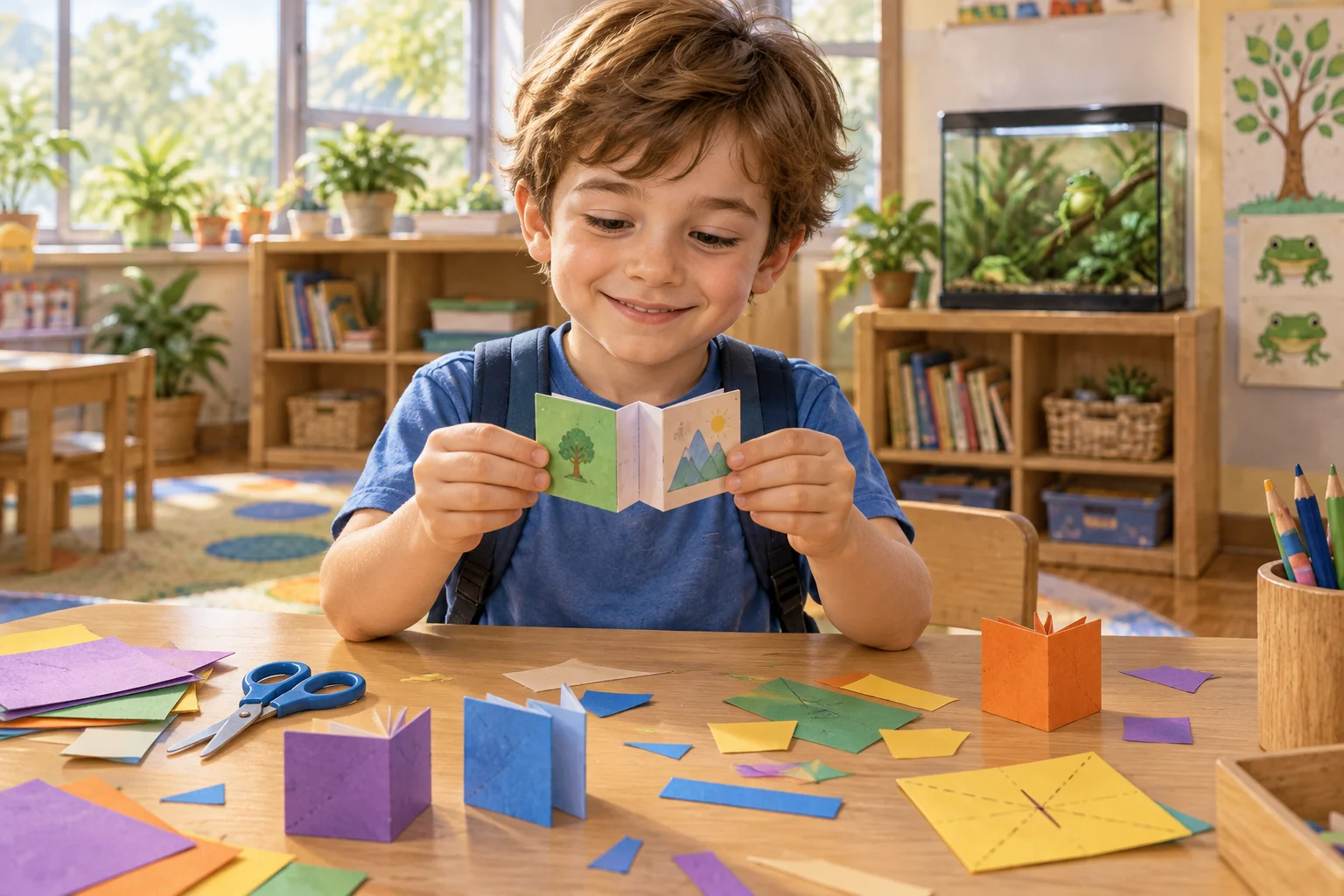
Mae drew a patch of moss on her booklet cover. Diego drew a round green frog with one eye peeking out. Luis glued his blue strip along the edge of his cover and left the middle blank for a picture.
After a few quiet minutes, Puddle lifted his head. A tiny insect had landed near the edge of the tank. The frog stayed still for one moment. Then he sprang forward with a quick flick of his tongue. The insect was gone, and Puddle settled beneath the moss again.
Several children opened their mouths in surprise, but Kiran raised one finger to his lips. The children watched silently.
“He waited,” Mae whispered when Puddle was still again.
Kiran nodded. “Let’s draw that part.”
At the tables, the children made the first inside page about resting. They drew moss, stones, and Puddle’s round eyes. Kiran reminded them to leave room for words, but Ms. Elena said pictures could tell plenty, too.
The second page showed Puddle eating. Some children drew his tongue as a straight line. Others drew a little star where the insect had been. Diego wanted to draw the insect with a happy face, but Kiran helped him make it look more like the tiny insect they had actually seen.
“I like your funny one,” Kiran said, “but this page is for showing what Puddle really did.”
Diego thought about it. “I’ll put the funny insect on the back cover.”
“That works.”
The children returned to the tank for the last picture. This time, Puddle moved toward a shallow water dish. He lowered his front feet, eased his body into the water, and floated with only his eyes and the top of his head above the surface.
The room filled with soft whispers.
“He disappeared!”
“I can still see his eyes.”
“Look, he’s swimming.”
Kiran watched carefully. Puddle moved his legs in slow, steady strokes. The water trembled around him. When the frog reached the other side, he climbed onto a smooth stone and rested there, shining with tiny drops.
Kiran sketched the water dish before returning to the table. He drew Puddle with his eyes above the water and added curved lines to show the gentle ripples.
When the children began coloring, another problem appeared. Several booklets would not close. A few covers were too large. One blue scrap had been glued upside down, covering half of a picture.
“I think we rushed,” Kiran said.
He picked up the blue booklet and studied it. “We can fix this without starting over.”
With Ms. Elena’s help, he carefully lifted the loose corner and trimmed the scrap. Then he glued it back along the edge and placed a heavy picture book on top while the glue dried.
For the booklets with stubborn pages, Kiran ran his thumb along the folds again. He showed the children how to close each booklet gently instead of pressing the middle flat.
“Books need time to settle,” he said.
While they waited, the children added tiny details. Mae drew the thin fibers of the moss. Luis added a ring of blue water around the dish. Diego placed his cheerful insect on the back cover, where it peeked around the corner.
At last, Kiran lifted the picture book. The repaired cover stayed in place. He opened the booklet and turned the pages.
Resting. Eating. Swimming.
The pictures followed Puddle’s morning just as the children had seen it.
Ms. Elena helped the preschoolers write their names inside. Some children wrote every letter themselves. Others made careful marks while an adult wrote their names underneath.
When the booklets were finished, each child held one with both hands. The paper scraps made a bright little collection. No two covers matched, but every booklet had the same three pictures inside.
Before handing them out, Kiran gathered the children near Puddle’s tank once more. He opened a booklet to the first page.
“We can use these to remember what we saw,” he said. “But we still have to watch quietly. The picture can’t tell us what Puddle is doing today.”
Just then, Puddle climbed out of the water dish and tucked himself beneath the moss again. The children looked from the real frog to the picture in their hands.
“He’s resting now,” Luis said.
“And he waited before he ate,” Mae added.
“His eyes stayed up when he swam,” Diego said.
Ms. Elena smiled. “You noticed a lot.”
The children carried their booklets to the preschoolers who had been painting at another table. Each child received a tiny book with a different colored cover. Mae gave a purple one to a girl named Sofia. Diego gave his orange-covered booklet to a boy who had been waiting beside the window. Luis carefully handed over the blue one.
Kiran watched the preschoolers open the pages. At first, they wanted to turn quickly from picture to picture. Then one child noticed Puddle beneath the moss and lowered the booklet to look into the tank. Another child sat beside him. Soon, several children were checking the pictures and then looking back at the frog.
Puddle lifted one eye.
No one tapped the glass. No one called out. The room grew peaceful enough for everyone to notice the small sounds: paper turning, a chair sliding softly, and the faint splash of water as Puddle moved one foot in his dish.
Kiran slipped the last scraps into the art folder. A purple corner, a thin blue strip, and the red square from the paper house remained. He placed them in the shared scrap basket for the next project.
Ms. Elena walked him to the door. “You solved a big problem today,” she said.
Kiran looked back at the table, where the tiny booklets rested in the children’s hands. “We all did.”
Before he left, he took one final look at Puddle. The frog had settled beneath the moss, with just one golden eye showing. Beside the tank, a preschooler held open a little booklet to the matching page.
Kiran smiled, shouldered his backpack, and stepped into the quiet hall while the children continued watching their green frog, one gentle page at a time.
Talk about the story
1.Why did Kiran count the paper and the children twice?
2.What problem did Kiran discover?
3.How did Kiran make the booklet’s inside using one sheet?
4.What did the children use for the booklet covers?
5.What did Puddle do when the tiny insect landed near the tank?
6.What three things did the children draw inside their booklets?
7.Why did the children watch Puddle quietly?
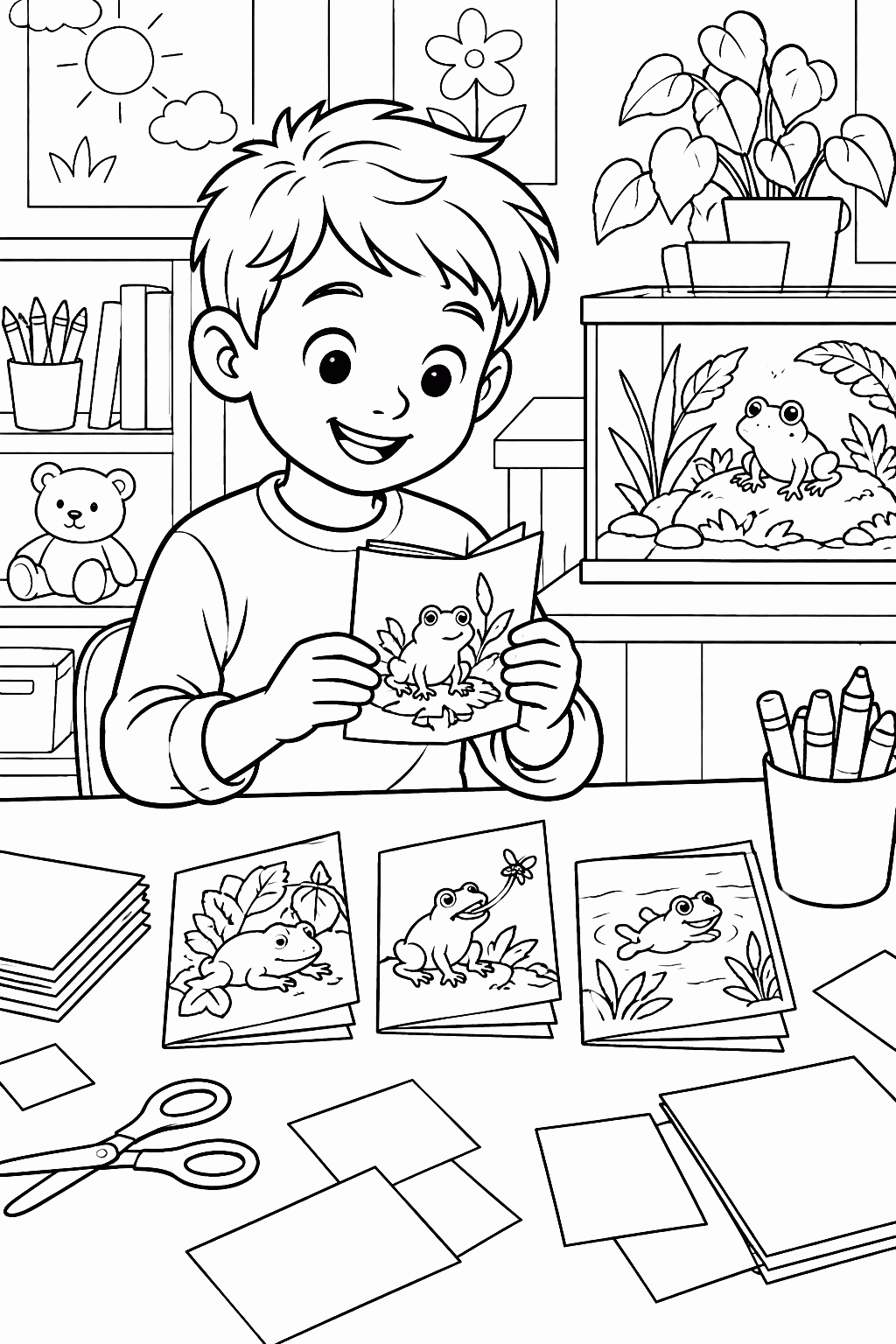
Coloring page
Print the story’s hero and color it in together — with crayons, markers or paints.