Zara began her project with a question written in large blue letters across the top of her notebook: Where does our town’s tap water come from?
She had expected the answer to be simple. Maybe the water came from a river, a lake, or a pipe hidden under the streets. Her teacher, Ms. Patel, had said that each student could choose one question about the town for the class nature project. Zara wanted hers to be about water because water seemed to be everywhere and nowhere at the same time. It ran from faucets, slipped beneath bridges, gathered in puddles, and disappeared down storm drains.
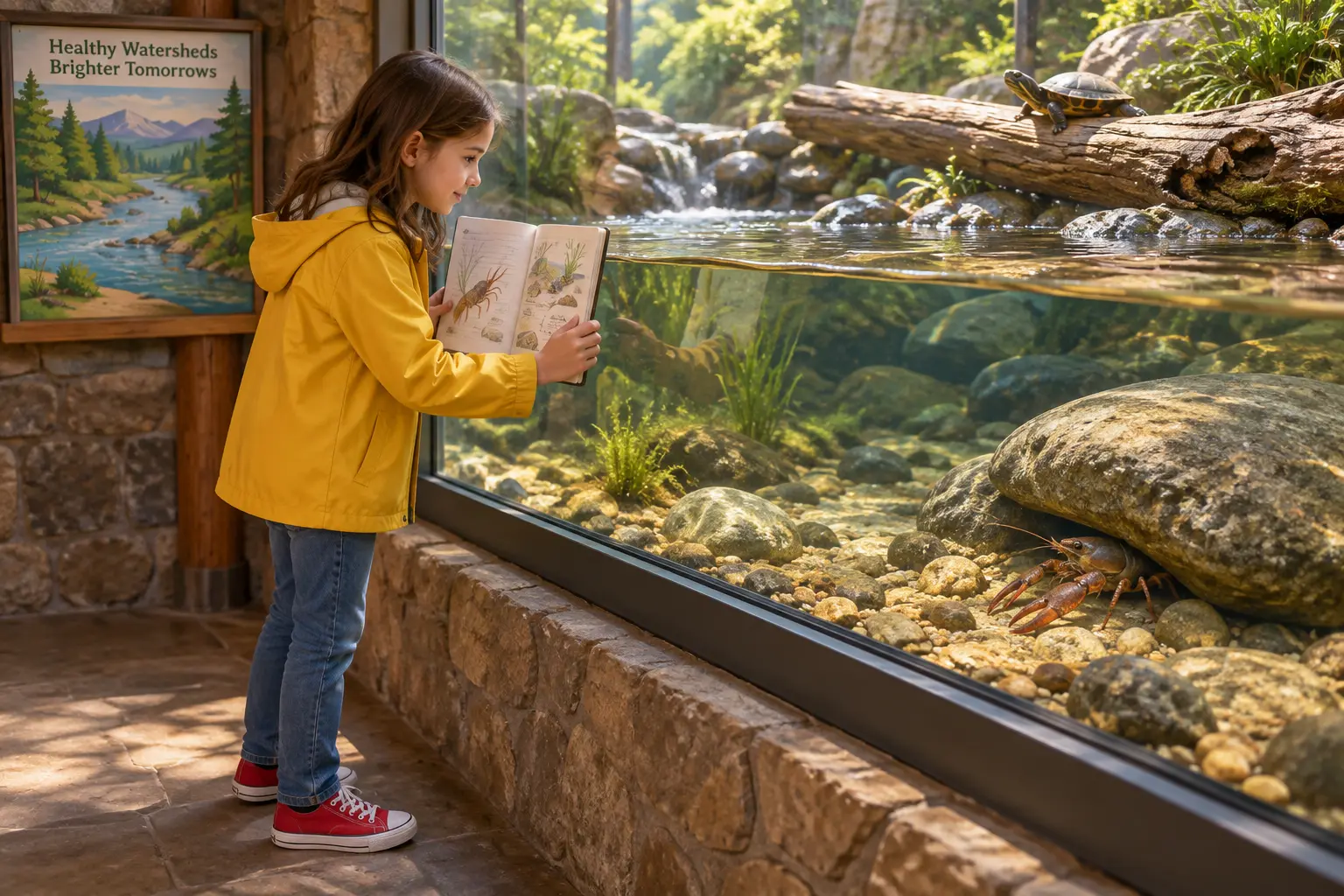
On Tuesday afternoon, Ms. Patel took the class to the aquarium’s viewing room. Wide windows looked into a carefully built creek habitat. Clear water moved over smooth stones. A small turtle rested on a sun-warmed log, and silver minnows flickered through the shallows. Near the back, a painted sign showed how rain traveled over hills and through forests before joining the town’s watershed.
Zara pressed her notebook against the glass and watched a crayfish tuck itself beneath a rock.
“Try looking for connections,” Ms. Patel told the students. “A watershed is a whole area of land where water flows into the same creek, river, or lake. What happens in one part can affect another part.”
Zara wrote down the word watershed and drew three arrows beneath it. Then she took out her camera. She photographed the creek habitat, the turtle on the log, and the minnows shining like bits of moving metal.
As the afternoon light softened, something bright blinked outside the viewing-room window. Zara lifted her camera again. A firefly rose from the grass, flashed once, and vanished into the dimness. A moment later, it blinked again just above the creek bank.
“Did you get it?” asked her classmate Camila.
“I think so,” Zara said. “But it might have moved before the picture was taken.”
She checked the screen. The firefly was there, a tiny golden-green spark against the darkening grass.
That evening, Zara showed the picture to her family at the kitchen table. Her younger brother leaned close to the screen, and her grandmother smiled.
“It looks like a little star,” her brother said.
“Tomorrow we’re visiting the real creek,” Zara replied. “Maybe I’ll find out whether the creek is where our tap water begins.”
The next morning, Ms. Patel led the class along a paved trail that followed the creek through town. The water was narrower than Zara had imagined, but it moved steadily between banks lined with willow trees and tall grasses. A great blue heron stood near a bend, perfectly still except for the slow turn of its head.
The class stopped to watch. The heron stepped carefully through the shallows, then lifted into the air with broad, quiet wings. It flew to the other side of the creek and settled among the reeds.
“Look at that,” Camila whispered.
Zara raised her camera, but the heron was already partly hidden. She took a picture anyway. In it, the bird’s blue-gray shape blended with the shadows while the creek shone around its feet.
Farther along, the class found water striders skating across a calm pool. A frog sprang from the bank and made a neat splash. Zara knelt beside the trail to photograph a patch of moss and a curled sycamore leaf.
When she stood up, she noticed a storm drain near the sidewalk. A little stream from the morning sprinklers was trickling toward it.
“Where does that water go?” she asked.
Ms. Patel pointed toward the creek. “Some storm drains lead there. That’s one reason people need to be careful about what goes onto the ground. Water carries things with it.”
Zara looked from the drain to the creek, then to the trees and houses beyond it. The watershed suddenly seemed larger than the creek itself. It stretched under streets, behind backyards, and over the hills at the edge of town.
At school, Zara went straight to the library. She found a book called Our Town and Its Waterways. A drawing of the creek appeared on the cover, with arrows pointing toward the treatment plant.
Zara opened the table of contents and searched for water. There it was: “How the Town Gets Its Tap Water.”
She read the chapter once, then read it again.
“Most of the town’s tap water is drawn from the creek,” she said quietly.
The book explained that water was collected, cleaned at a treatment plant, and sent through pipes to homes and schools. Zara copied the sentence into her notebook. At the bottom of the page, she noticed a small date: 2008.
She frowned. The book was older than she was.
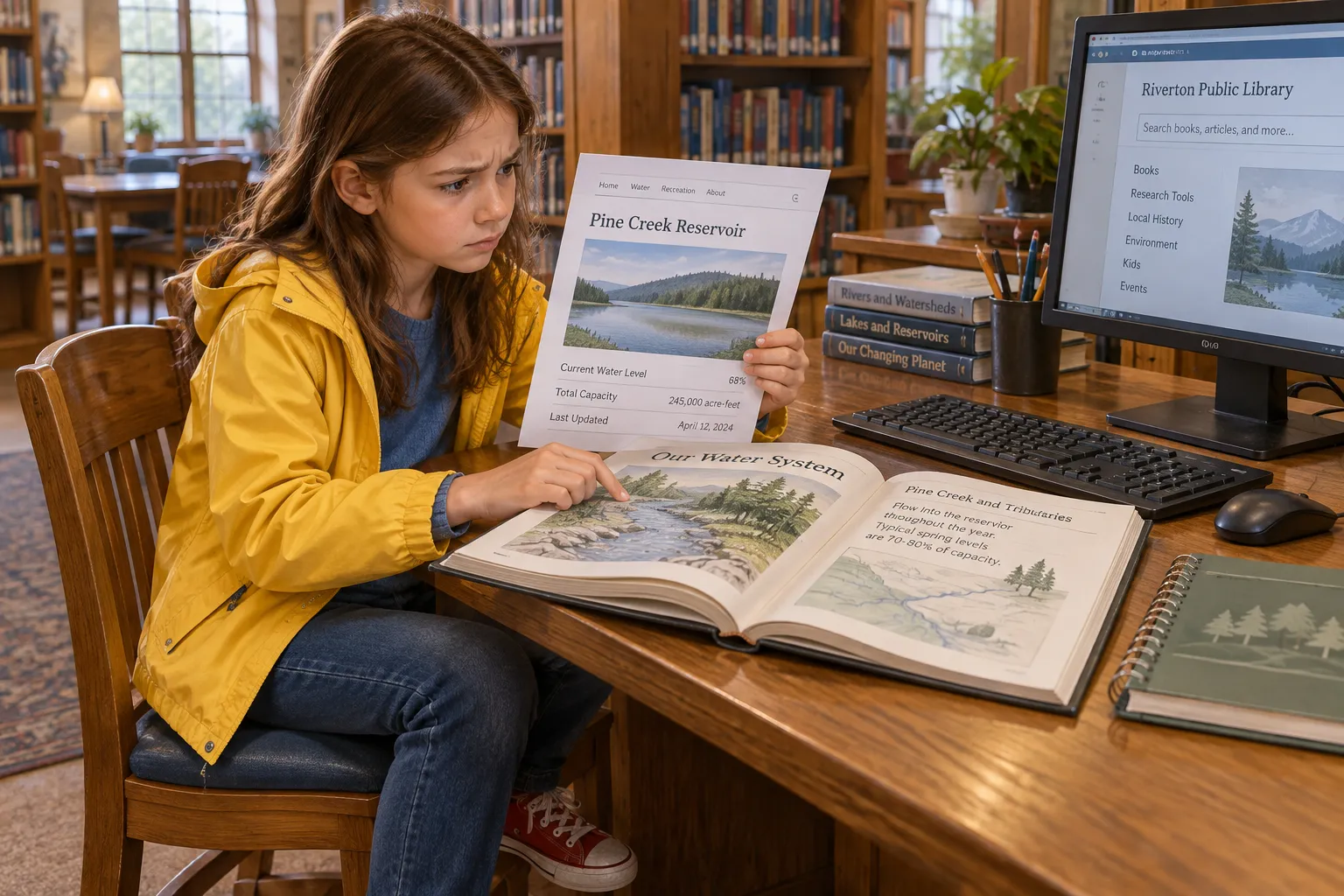
That afternoon, Zara searched for the town’s water system on one of the library computers. She found a website with a bright picture of a reservoir behind a low green hill. The page said, “The town receives its water from the North Reservoir.”
Zara sat back in her chair.
“Wait,” she murmured. “Which one is it?”
She printed the page and looked for a date. At the very bottom, in pale gray letters, it said, “Updated 2012.”
That did not make things clearer. The library book said creek. The website said reservoir. Both sounded official. Both had explanations. Zara imagined standing in front of the class with two different answers and no way to know which one was right.
She tried searching again. One page mentioned a water main project but did not explain what had changed. Another page showed a map with blue lines, but the labels were too small to read. After a while, Zara closed her notebook.
“I’ll have to ask Ms. Patel,” she decided.
The next day, Zara brought the book and the printed webpage to her teacher’s desk. She placed them side by side.
“I found two answers,” she said. “The book says the town uses creek water, but the website says the water comes from the reservoir. I checked the dates, but I still don’t know which source to trust.”
Ms. Patel did not simply choose one. Instead, she pulled a folder from a shelf and opened a recent report from the town’s water department.
“Let’s compare all three,” she said. “A source can be useful and still be out of date. The date matters because towns can change their systems.”
Zara read the report carefully. It explained that, in 2015, the town had begun drawing its drinking water from the North Reservoir. The reservoir water was treated before it traveled through the town’s pipes. The creek was still part of the same watershed, but it was no longer the town’s direct source of tap water.
Zara traced the sentence with her finger.
“So the book was correct when it was written,” she said. “But the town changed the system later.”
“That’s right,” Ms. Patel said. “And the old website should have been updated more clearly. You did an important piece of research by checking the dates instead of guessing.”
Zara felt a small knot in her chest loosen. She had not made a mistake. She had found a change.
Still, she had one more question. If the creek did not supply the town’s tap water now, why did the watershed matter?
Ms. Patel turned the report to a map. The North Reservoir sat beyond a line of wooded hills. Rain fell on the hills, flowed into small streams, and collected in the reservoir. Other rain traveled through the same watershed toward the creek.
“The reservoir and the creek are connected by the land around them,” Ms. Patel explained. “The creek is still part of the water story. It provides habitat for fish, frogs, insects, and birds. It carries water through town. What happens in the watershed can affect both the creek and the reservoir.”
Zara thought about the heron lifting from the shallows and the firefly blinking beside the aquarium window.
“I need to show my class the whole story,” she said.
For the next two evenings, Zara prepared her presentation. She printed the firefly photo in color, though the tiny insect looked more like a soft green dot than a star. She chose the picture of the heron, the aquarium’s creek habitat, and the turtle resting on its log. She drew a simple map with the reservoir on one side and the creek on the other, joined by the hills and streams of the watershed.
Then she made three large cards. On the first, she wrote, “The old book: creek water.” On the second, she wrote, “The older website: reservoir water.” On the third, she wrote, “The current report: reservoir water today.”
At first, Zara worried that the cards made the answer look too complicated. She wanted everyone to understand it right away. But when she practiced explaining it to her brother, she found the words.
“The town changed its water system in 2015,” she told him. “Now our tap water comes from the reservoir. The creek still matters because it is part of the same watershed and it supports living things.”
Her brother nodded solemnly. “And the firefly matters because it’s shiny.”
Zara laughed. “That too.”
On presentation day, Zara carried her photographs to the front of the classroom. Her hands felt warm, and she held the edges of the pictures tightly so they would not shake.
She began with the creek habitat at the aquarium. Then she showed the class the real creek, the heron, and the firefly.
“This is where I got confused,” she said, holding up the library book and the printed webpage. “They gave different answers about where our tap water comes from.”
Several students leaned forward.
“I checked the publication dates,” Zara continued. “The book was from 2008, and the website was updated in 2012. Then Ms. Patel helped me find the town’s current water report. It said the town changed its system in 2015. Today, our tap water comes from the North Reservoir.”
Camila raised her hand. “So does the creek have anything to do with our water?”
“Yes,” Zara said. She pointed to her map. “The creek and the reservoir are both connected to the watershed. The creek is home to animals, and the land around it helps move and hold water. The reservoir is our town’s current source for tap water, but the creek is still part of the bigger water system.”
Ms. Patel added, “Good research often means asking a second question after you find the first answer.”
The class looked again at Zara’s photographs. The turtle’s shell was bright beneath the aquarium lights. The heron seemed to be listening from the creek bank. In the firefly picture, the tiny glow floated above the grass like a held breath.
Then Rafael raised his hand.
“If water has to be cleaned before we drink it,” he asked, “can we help save some before it goes down the drain?”
The class began offering ideas. Someone suggested shorter showers. Someone else mentioned fixing dripping faucets. Camila glanced toward the classroom sink.
“What about here?” she asked. “We leave the faucet running while we soap our hands.”
Everyone looked at the sink. It was a small faucet, but it ran many times each day.
Zara imagined all those thin streams joining storm drains, creeks, and other parts of the watershed. She picked up one of her cards and turned it over. On the blank side, she wrote, “Turn off the faucet while soaping.”
“Let’s try it,” she said.
The class made a simple plan. They would wet their hands, turn off the faucet while they used soap, and turn it back on to rinse. One student would check the sink after morning handwashing, and another would check it after lunch. They would take turns so no one had to remember alone.
The first day, the faucet was still running when Zara came back from lunch. Water swirled around the drain.
She reached over and turned it off. Then she placed a small paper sign beside the sink: “Soap first. Water after.”
The next day, Camila noticed the faucet before it had been left on for long. On Friday, Rafael reminded everyone as they lined up. By the following week, turning the faucet off and on had become as ordinary as putting away pencils.
Every afternoon, Zara checked the little chart taped beside the sink. A blue mark meant the class had remembered. There were a few blank spaces at first, but soon the marks filled the rows.
On the last day of the project, Zara and her classmates walked outside with Ms. Patel. The creek moved quietly beneath the willow trees. A frog slipped from the bank, and a heron crossed the sky with slow, steady wings.
Zara looked toward the hills beyond town. Somewhere past them, the reservoir held the water that flowed from the classroom faucet. Here, the creek carried its own bright thread through the watershed.
As evening came, a firefly blinked above the grass.
Zara lifted her camera, but this time she did not hurry to take a picture. She watched the small light appear, disappear, and appear again while the creek whispered over the stones. Behind her, the classroom faucet waited for morning, dry and quiet, beside the blue chart filled with marks.
Talk about the story
1.What question did Zara write at the top of her notebook?
2.What did the aquarium’s painted sign show?
3.What did the town’s current water report say about its tap water?
4.Why did Zara check the dates on the book and website?
5.How are the creek and the reservoir connected?
6.What did Zara’s class do to save water at the classroom sink?
7.What did Zara do when she saw the firefly at the end of the story?
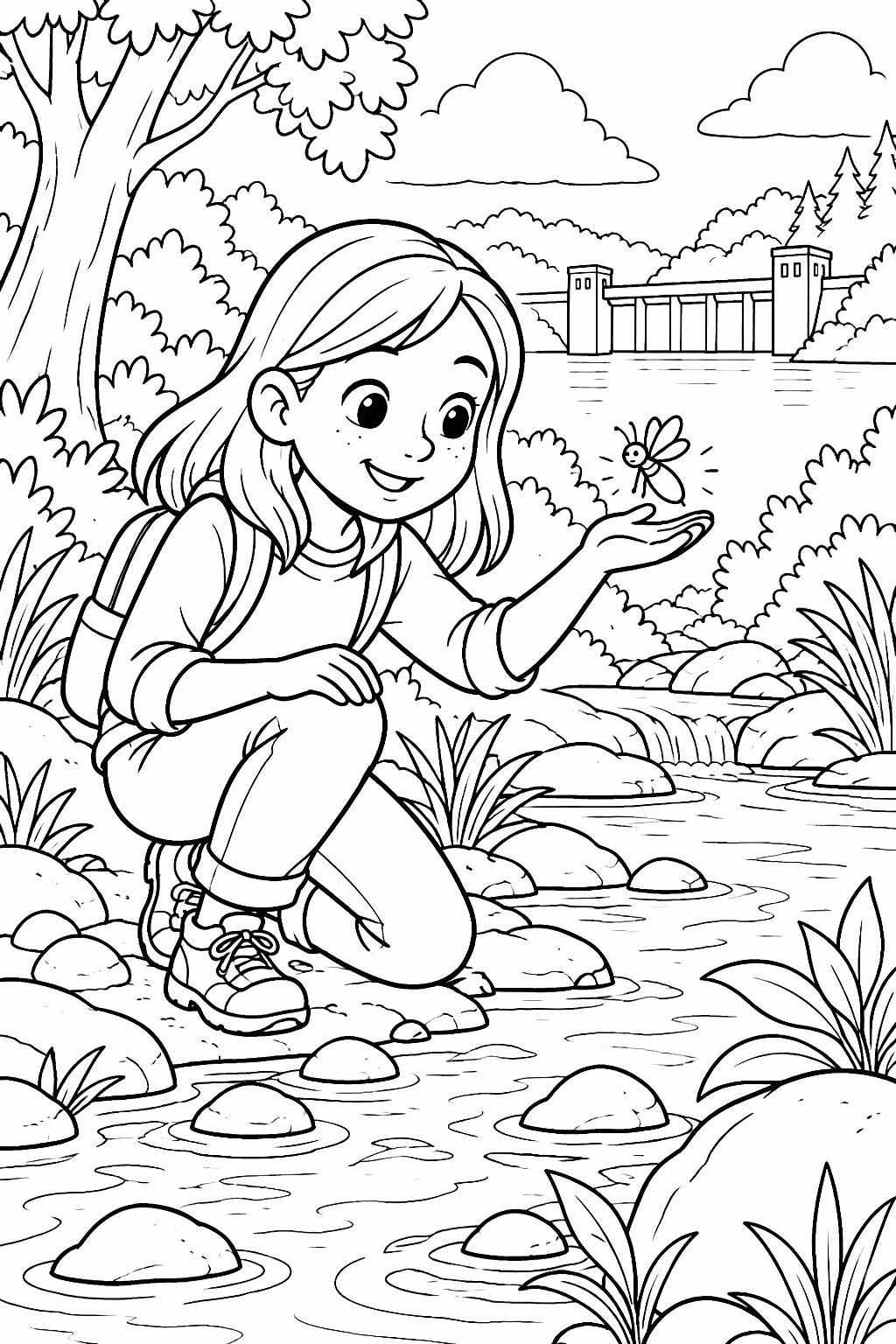
Coloring page
Print the story’s hero and color it in together — with crayons, markers or paints.