The woodland clearing was quiet except for the soft tap-tap of a woodpecker somewhere beyond the garden fence. Sunlight slipped between the tall trees and made bright patches on the path. In the cooler spaces beneath the leaves, everything looked green and silver.
Quinn walked beside Aunt Lena, the adult gardener who cared for the clearing’s vegetable beds. Quinn carried an empty basket with both hands. She was nine, old enough to help with the school cooking club, but the basket still bumped lightly against her knees as she walked.
Behind them rolled Dot, a small classroom robot with two round wheels, a square body, and a color sensor above its blinking eyes. Poppy, Quinn’s black-and-white cat, followed at the end of a comfortable harness and leash. Aunt Lena held the leash loosely while Poppy paused beside the garden path to watch a robin hop through the grass.
“There you are,” Aunt Lena said when they reached the vegetable beds. “The tomatoes, beans, and cucumbers are ready to be checked. Nothing gets picked until we look closely.”
Quinn set the basket beside the first row. “Our club is making a big salad today. Mr. Chen said we could bring enough for everyone to taste.”
Dot rolled forward and gave a cheerful beep. “I am prepared to identify ripe vegetables.”
“And we’re prepared to help you,” Quinn said.
The garden had been planted in a sunny clearing, but the trees had grown tall around it. By late morning, a wide patch of shade covered one side of the tomato bed. The tomatoes there hung beneath their leaves like little red lanterns.
Quinn pointed to a tomato near the edge of the shade. “Let’s start with this one.”
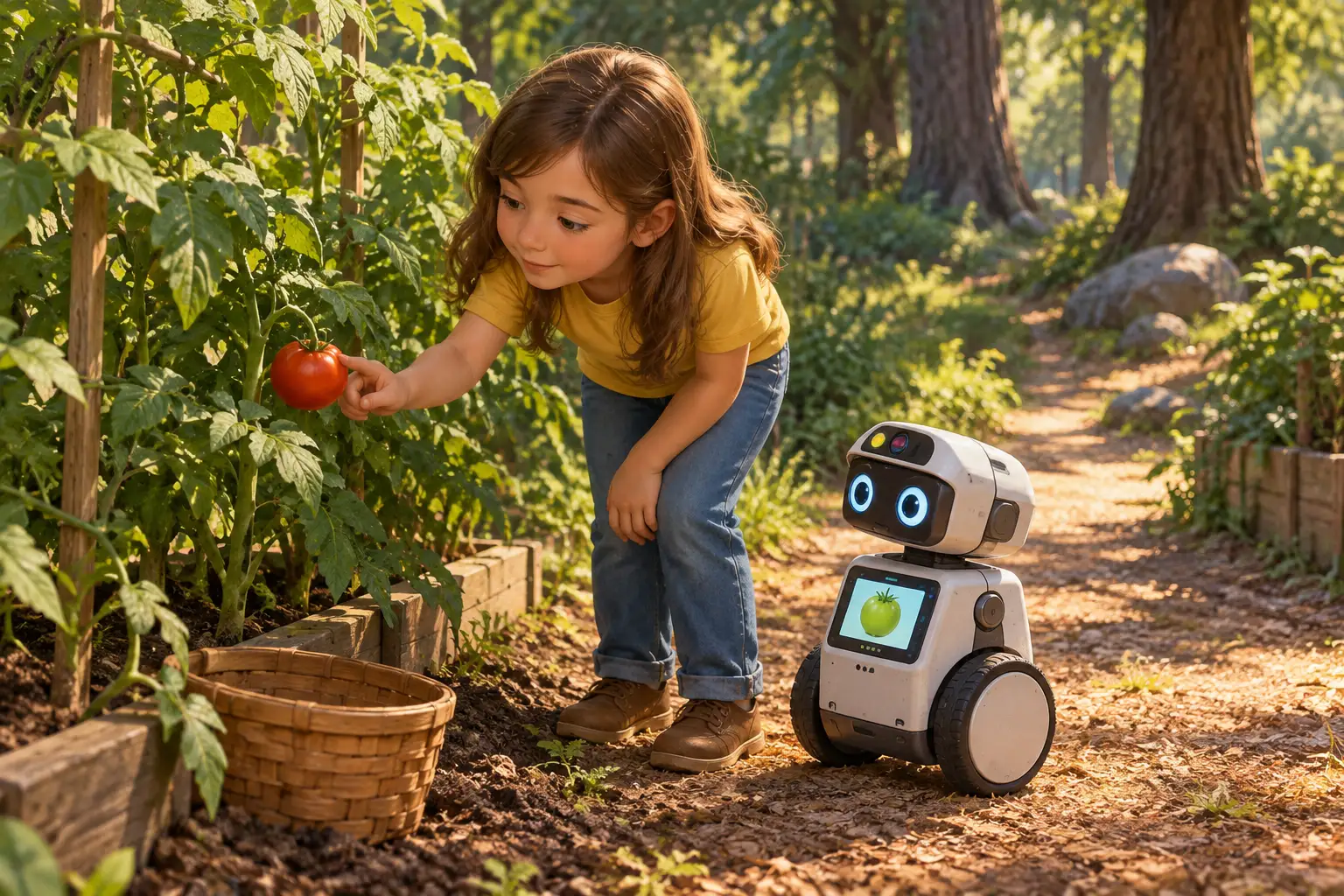
Dot rolled close. Its sensor blinked blue, then yellow. A tiny screen on its front displayed a message.
“Unripe,” Dot announced.
Quinn leaned nearer. The tomato was deep red, with smooth skin and a round, full shape. “That doesn’t look unripe.”
Dot blinked again. “The color is not bright enough. Sunlight level: low. Ripe status: uncertain.”
Aunt Lena smiled. “The sensor is seeing the shadow along with the tomato.”
Quinn touched the tomato gently with one finger. It gave a little beneath her touch, not hard like a green apple and not soft enough to bruise. She bent close and smelled it. The tomato had a warm, leafy scent.
“Red color, a little springy, and it smells like a tomato,” Quinn said. “I think it passes.”
“Let’s compare it with one in the sun,” Aunt Lena suggested.
Quinn and Dot moved to a tomato glowing in a bright patch. Dot scanned it at once.
“Ripe,” Dot said proudly.
Quinn looked from the sunny tomato to the shaded one. The sunny tomato was brighter, but both were red. She gently pressed each one while Aunt Lena watched.
“They feel the same,” Quinn said. “And they smell the same, too.”
Aunt Lena nodded. “Then the shade changed the reading, but it didn’t change the tomato.”
Quinn looked at Dot’s little screen. “Could we make a new rule? If you say a vegetable is unripe because it’s shaded, we check it another way.”
Dot’s wheels turned forward and back. “New rule accepted. Human comparison is included.”
Quinn carefully twisted the shaded tomato until it came free from the stem. She placed it in the basket instead of dropping it. The basket made a soft, hollow sound.
Poppy sat beside the path with her black tail curled around her paws. A chickadee landed on a low branch above her. Poppy’s ears tipped forward, but she stayed where she was. Aunt Lena gave the leash a little more room, and Poppy watched the bird without trying to chase it.
The next tomato was half in sunlight and half beneath a leaf. Dot scanned it twice.
“Unripe,” it said.
Quinn studied the tomato. Its skin was mostly orange-red, but one side near the stem was pale. She pressed it. It felt very firm.
“This one might really need more time,” she said.
“Good noticing,” Aunt Lena replied. “We don’t have to pick every vegetable we examine.”
Quinn felt disappointed. She wanted the basket to fill quickly, but she remembered the new rule. The tomato was not ready by color, firmness, or smell, so it stayed on the vine.
Dot gave a quiet beep. “Thank you for correcting my first answer.”
“You didn’t do anything wrong,” Quinn said. “You just need more information.”
They moved down the row. Quinn scanned each tomato with Dot, Aunt Lena checked the plant, and together they decided whether it was ready. Sometimes Dot’s answer matched their checks. Sometimes it did not. Before long, Quinn could almost predict when the shade would confuse the sensor.
At the bean bed, the leaves made a thick green curtain. Slender beans hung beneath them, some easy to see and others hidden in cool shadows.
Dot rolled between two plants and scanned a bean.
“Unripe,” it said.
Quinn lifted the leaves enough to see the bean clearly. It was long, firm, and bright green. She compared it with a bean in the sun, then bent close to smell both. They had the same fresh, grassy scent.
“This one is ready,” she said.
Aunt Lena touched the stem. “Yes. Pinch near the top so the plant stays healthy.”
Quinn pinched carefully. The bean came free with a tiny snap.
She held it up. “One for the basket.”
Dot scanned the next bean. “Unripe.”
Quinn pressed it lightly. It was thick and full. Its skin was smooth, and it smelled fresh. She looked at Aunt Lena.
“Check the other side of the plant,” Aunt Lena said.
Quinn moved around the bed. The bean had been hidden in a deep pocket of shade, but it was the same green as the ones they had picked. She noticed that it had grown long enough to bend slightly beneath its own weight.
“Ready,” Quinn decided.
Dot’s sensor blinked. “My color reading disagrees.”
“Our other checks agree,” Quinn said.
Dot paused. “I will record that shade may affect bean color readings.”
They continued, but the bean plants were so full that it became difficult to remember which parts they had already checked. Quinn reached for another bean, then stopped.
“Wait. We should mark the row we finished.”
Aunt Lena handed her a small wooden garden marker from the edge of the bed. Quinn placed it in the soil beside the last checked plant. Now they would not accidentally examine the same section again or skip the next one.
Poppy suddenly lifted her head. A blue jay had landed on the fence. The bird tilted its head, then flew to a branch on the far side of the clearing. Poppy watched it go, her leash lying in a loose curve beside Aunt Lena’s shoes.
“Poppy found something interesting,” Quinn said.
“She did,” Aunt Lena answered. “Gardens have many kinds of careful watchers.”
The basket grew heavier. It held several tomatoes and a small pile of beans, each one checked and chosen. The cucumbers still waited at the back of the garden, where the tree shadows were deepest.
Quinn led Dot down the path. A cucumber lay beneath a broad leaf, cool and dark. Dot scanned it.
“Unripe,” it announced.
Quinn lifted the leaf. The cucumber was deep green, firm, and thick enough to fill her palm. She smelled the stem end. It had a clean, crisp scent.
“I think it’s ready,” she said.
Aunt Lena examined the vine. “Look at the little cucumber beside it.”
The smaller one was pale green and thin. Its skin looked dull, and it bent easily when Aunt Lena touched it.
Quinn compared the two. “The big one has a stronger color, but the shade makes it look different to Dot. The little one is actually the one that isn’t ready.”
“Exactly,” Aunt Lena said. “Size alone doesn’t tell the whole story, either. We use several clues together.”
Quinn gently twisted the large cucumber from its vine and placed it in the basket beside the tomatoes.
Dot rolled closer to the small cucumber. Its sensor flashed yellow.
“Unripe,” it said.
“This time, you’re right,” Quinn replied.
The work slowed as the day grew warmer. Quinn began to wish she could hurry. The school cooking club would start in less than an hour, and there were still many vegetables to check. She glanced at the basket. It was not full yet.
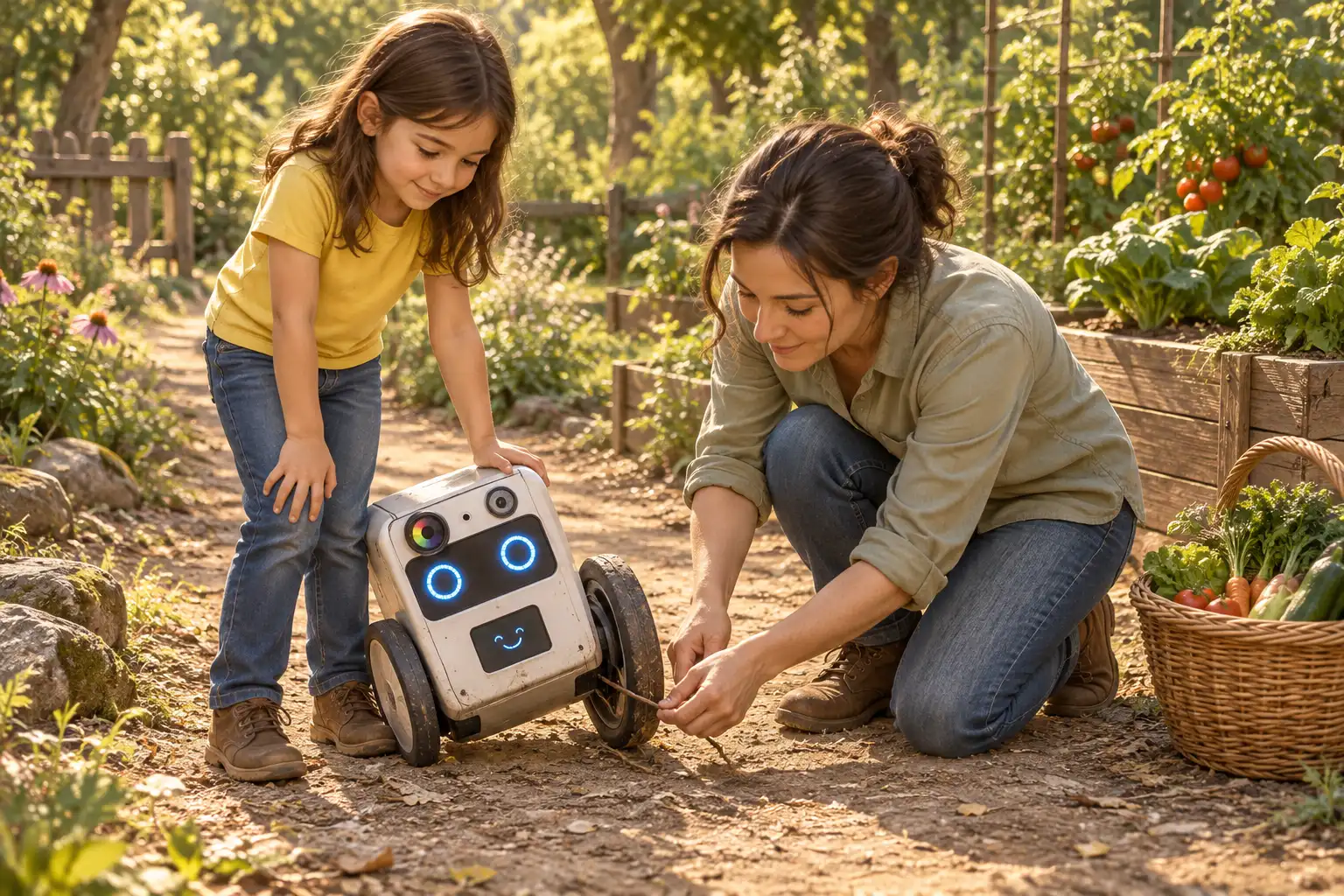
Then Dot rolled over a root and tipped sideways.
Quinn reached out and steadied it before it could bump into the cucumber vines. One wheel spun in place.
“Are you okay?” she asked.
“My left wheel needs a moment,” Dot said. “Please wait.”
Quinn wanted to keep going, but Aunt Lena was already kneeling beside the robot. She brushed dry soil from the wheel and turned it gently with her fingers.
“A small twig is caught here,” she said. “Quinn, can you hold Dot still?”
Quinn placed one hand on Dot’s square body while Aunt Lena eased the twig free. The wheel began turning again.
“Thank you,” Dot said. “I am ready, but I will move more slowly.”
Quinn looked toward the school path. For one quick moment, she thought about picking everything that looked close enough and rushing back. Then she saw the tomato they had left on the vine, still firm and pale near its stem. She thought of the classmates who were waiting for their turn at the garden club table.
“We’ll go slowly,” she said. “That way, we won’t bring vegetables that aren’t ready, and we won’t miss the good ones hiding in the shade.”
Aunt Lena gave her an approving nod. “Lead the way.”
Quinn began a steady rhythm. She scanned one plant with Dot, checked the vegetable’s color in the light and shade, pressed it gently, and smelled it. Aunt Lena checked the stem and the whole plant before Quinn picked anything. If all the clues agreed, Quinn placed the vegetable in the basket. If they did not, she left it growing.
Poppy walked beside the path, pausing whenever a bird fluttered through the branches. Once, she settled on her belly in a warm patch of sunlight, her harness bright against her fur. She watched the garden while Quinn worked.
By the time they reached the last cucumber plant, the basket was nearly full. Red and orange-red tomatoes, green beans, and firm cucumbers nestled together. One tomato near the edge was bright enough for Dot to call ripe, but when Quinn pressed it, it felt too soft.
“That one might bruise in the basket,” Quinn said.
Aunt Lena agreed. “Leave it for the birds or the garden creatures.”
Quinn set it gently beneath the plant instead of picking it. Dot scanned it again.
“Ripe,” it said.
“Your color reading is right,” Quinn told it, “but our firmness check says to leave it here.”
Dot blinked. “Ripe does not always mean ready for carrying. I will record that, too.”
At last, Quinn placed the garden marker beside the final checked plant. Aunt Lena lifted the basket, and Dot rolled alongside them. Poppy walked between them, her leash loose and her whiskers shining in the afternoon light.
At the school kitchen, Quinn’s classmates gathered around the table. Some children were still waiting for their turn to pick vegetables from the club garden, so Mr. Chen had asked everyone to share what they brought. Aunt Lena settled Poppy in a quiet, supervised spot just outside the kitchen and held her leash while the class prepared the food.
Quinn set down the basket and looked at the tomatoes, beans, and cucumbers. There were enough for the salad, but not enough for every classmate to take a piece home.
She remembered the careful work in the shaded rows. She picked up two tomatoes and a handful of beans, then placed them in a small bowl for the next group.
“These are for the classmates who are still waiting,” she said. “They should get to taste what they help grow.”
Aunt Lena smiled from just outside the kitchen. “That’s a thoughtful choice.”
Dot’s little screen glowed. “Sharing vegetables: excellent result.”
Quinn laughed. “You can record that one.”
While Mr. Chen sliced the cucumbers, Quinn told the class how the shade had confused Dot’s color sensor. She showed them how a ripe tomato could look dark on one side, how a bean could hide beneath leaves, and how firmness and smell could help tell whether a cucumber was ready.
Outside the kitchen, Poppy sat beside Aunt Lena, who kept hold of her leash while watching the class. When a sunbeam reached the floor near the doorway, Poppy stretched into it and closed her eyes.
Outside, the woodpecker tapped once more in the trees. Inside, the salad bowl filled with bright colors—red tomatoes, green beans, and cool cucumber slices. Quinn saved the first serving for the classmates who were waiting, then took a small plate for herself.
Dot sat quietly beside the empty basket, its sensor pointed toward the window. In the fading light, the glass looked blue, the leaves looked gray, and the last vegetables in the garden rested in long shadows. Quinn smiled at the little robot.
“Tomorrow,” she said, “we’ll check the color, the firmness, and the smell.”
Dot gave a soft, satisfied beep. Poppy purred beside Aunt Lena outside the kitchen, and the empty basket waited by the door for another careful trip to the garden.
Talk about the story
1.Who cared for the clearing’s vegetable beds?
2.Why did Dot sometimes call ripe vegetables unripe?
3.What clues did Quinn use to check whether a vegetable was ready?
4.What did Quinn do when a tomato was not ready to pick?
5.What did Quinn use to mark the bean row she had finished?
6.How did Quinn help Dot when its wheel stopped turning?
7.Why did Quinn put vegetables in a small bowl for the next group?
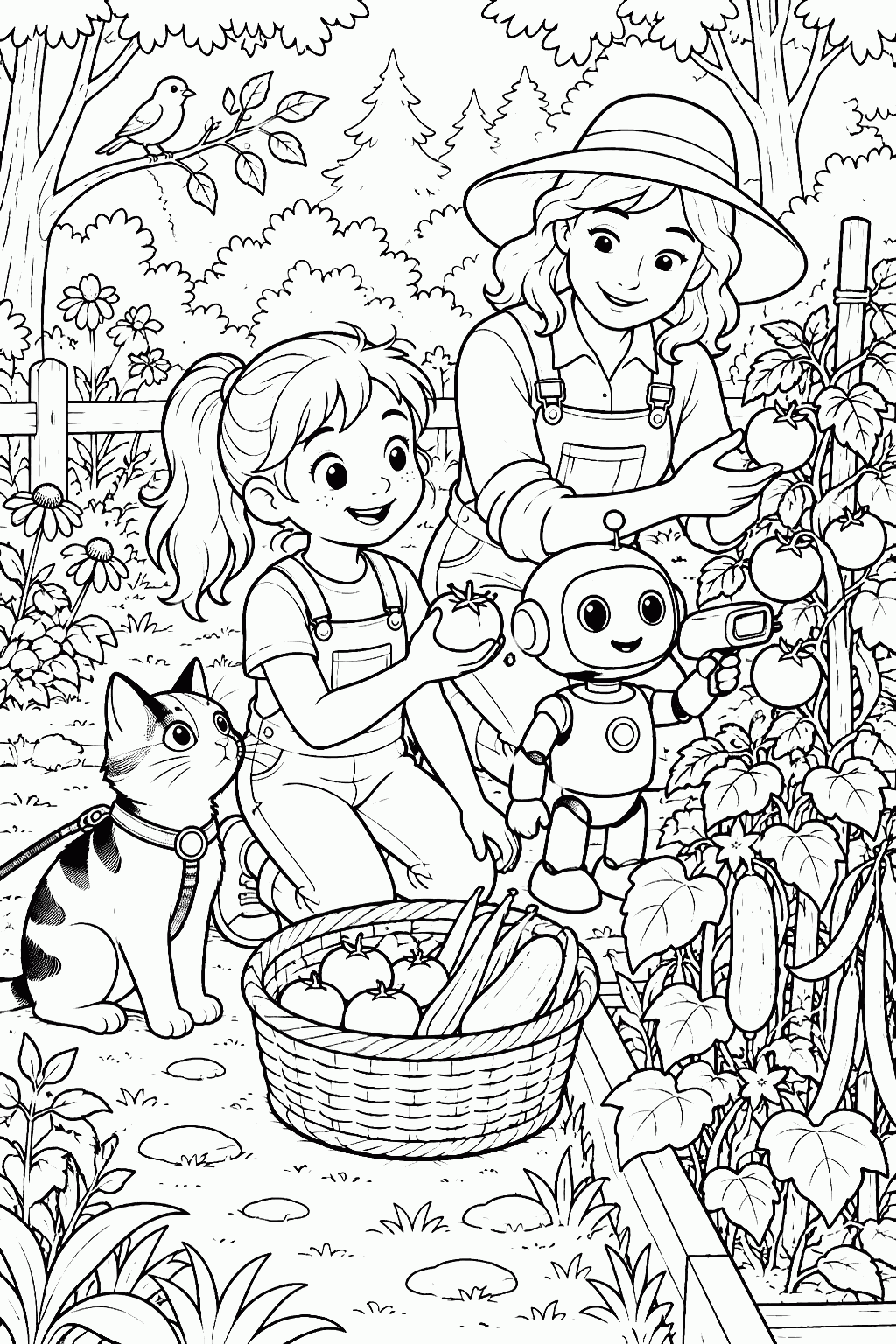
Coloring page
Print the story’s hero and color it in together — with crayons, markers or paints.