On a bright winter morning, Nora climbed onto the nature club’s small school bus with a notebook tucked under her arm. She had joined the club only a few weeks earlier, but she already liked the way its members noticed things other people hurried past: the shape of a bird’s footprint, the different sounds of leaves, and the tiny holes beetles left in fallen bark.
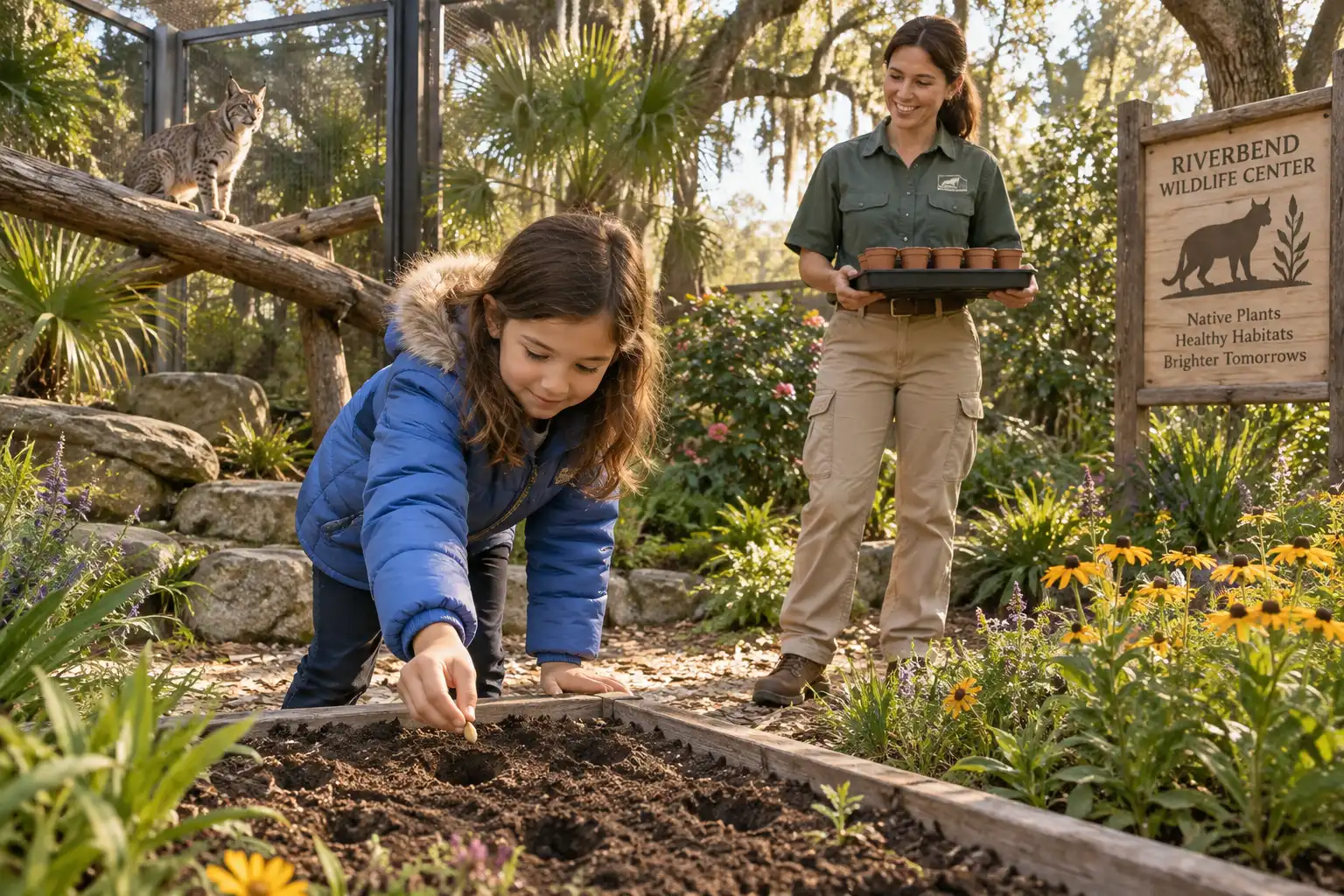
Today, the club was visiting Riverbend Wildlife Center. The center cared for native animals that needed a safe place to grow, heal, or live when returning to the wild was not possible. Its paths curved among palms, live oaks, and flowering shrubs that stayed green even in winter.
Their teacher, Ms. Patel, gathered the children near a wooden sign. Beside her stood Elena, one of the wildlife keepers, holding a tray of small clay pots.
“We’re going to help with the pollinator garden,” Elena said. “The garden gives bees, butterflies, and other helpful insects places to rest and find food. Each of you will help plant a native wildflower seed.”
Nora leaned closer to the tray. The seeds looked like tiny brown commas.
“That little thing can become a whole plant?” asked Theo, who stood beside her.
“With the right soil, water, light, and patience,” Elena said. “A seed needs more than a good wish.”
The children carried the tray to a garden bed beside Juniper’s enclosure. Juniper was a young black bear who had been born at the center. He lived in a leafy outdoor space with sturdy climbing logs, a shallow pool, and a shaded corner beneath a broad oak tree.
At first, Juniper was busy investigating a hollow log. He pushed his nose inside, sniffed carefully, and then rolled onto his back as if the morning had suddenly become too interesting to spend standing up. The children laughed softly.
Nora helped press a row of shallow holes into the soil. She placed one seed in her hole, covered it with a thin layer of earth, and used a small cup to pour water over it. The soil darkened for a moment.
“Let’s give it a good drink,” she said.
The children watered the whole bed and made a small sign that read NATIVE WILDFLOWERS. Then they went to watch Juniper climb halfway up a log and slide down again. By the time the club left, Nora felt certain that the seed would begin growing before their next visit.
But three days later, the weather turned hotter than anyone expected. A warm breeze moved through town, and the afternoon sun shone directly on the new garden bed. When Nora returned with the club the following week, she knelt beside the soil and touched it with one finger.
It was dry and crumbly.
Nora checked the spot where she had planted her seed. There was no green shoot. Not even a crack in the earth.
“I watered it,” she said quietly. “Maybe I didn’t water it enough.”
Elena crouched beside her. “You did exactly what we planned. Sometimes a plan teaches us what to try next.”
Theo poked at the soil with a twig, then quickly pulled it back. “It’s hard as a cracker.”
Ms. Patel smiled, though she looked thoughtful. “Let’s not guess. Let’s investigate.”
Before the children could begin, Juniper lumbered out from behind a leafy screen. He walked past the sunny garden bed and settled beneath the oak tree. The shaded ground there looked darker. A few leaves rested on top, and when Juniper rolled onto his side, the soil beneath him seemed soft enough to hold the shape of his fur.
Nora watched as he stretched one paw forward and scooted farther into the cool patch. The sunny part of his enclosure was open and bright, but Juniper kept choosing the damp shade.
“Look where he likes to rest,” Nora said. “The ground under the tree is different.”
Elena nodded. “Good observation. Juniper is choosing a cooler place, but that doesn’t automatically tell us where a seed should go. We need to compare the soil carefully.”
She brought two clear cups and a small hand trowel. Nora and Theo collected a spoonful of soil from the sunny edge of the garden bed. Elena collected another spoonful from the shaded ground near the oak, staying outside Juniper’s enclosure fence.
“Notice the color first,” Elena said.
The sunny soil was pale and loose. The shaded soil was darker and held together in tiny clumps.
Nora gently squeezed each sample. The sunny soil slipped between her fingers like dry sand. The shaded soil pressed into a little lump before slowly breaking apart.
“Which one holds water longer?” Ms. Patel asked.
“The shaded soil,” Nora said. “It doesn’t disappear right away.”
Elena placed the cups on a flat board. “Let’s measure instead of relying only on our hands. We’ll pour the same amount of water into each cup and watch what happens.”
Nora filled a small measuring cup to the first line. She held it carefully while Theo counted the marks.
“Ten tablespoons,” he said.
Nora poured the water into the cup of sunny soil. At once, a thin stream ran through the bottom and dripped onto the board.
The children watched the stream disappear.
Next, Nora measured the same amount of water for the shaded soil. This time, the soil darkened slowly. The water stayed near the surface, and no stream appeared beneath the cup.
“Juniper’s shady corner isn’t just cooler,” Nora said. “The ground there keeps the water nearby.”
“Exactly,” Elena said. “Plants have different needs, but careful observations help us make better choices.”
The club members gathered around the first seedbed. A few children wanted to pour water on it immediately. Others thought they should move the entire bed under the oak tree. Nora looked at the hard, dry soil and remembered how quickly the first water had run through it.
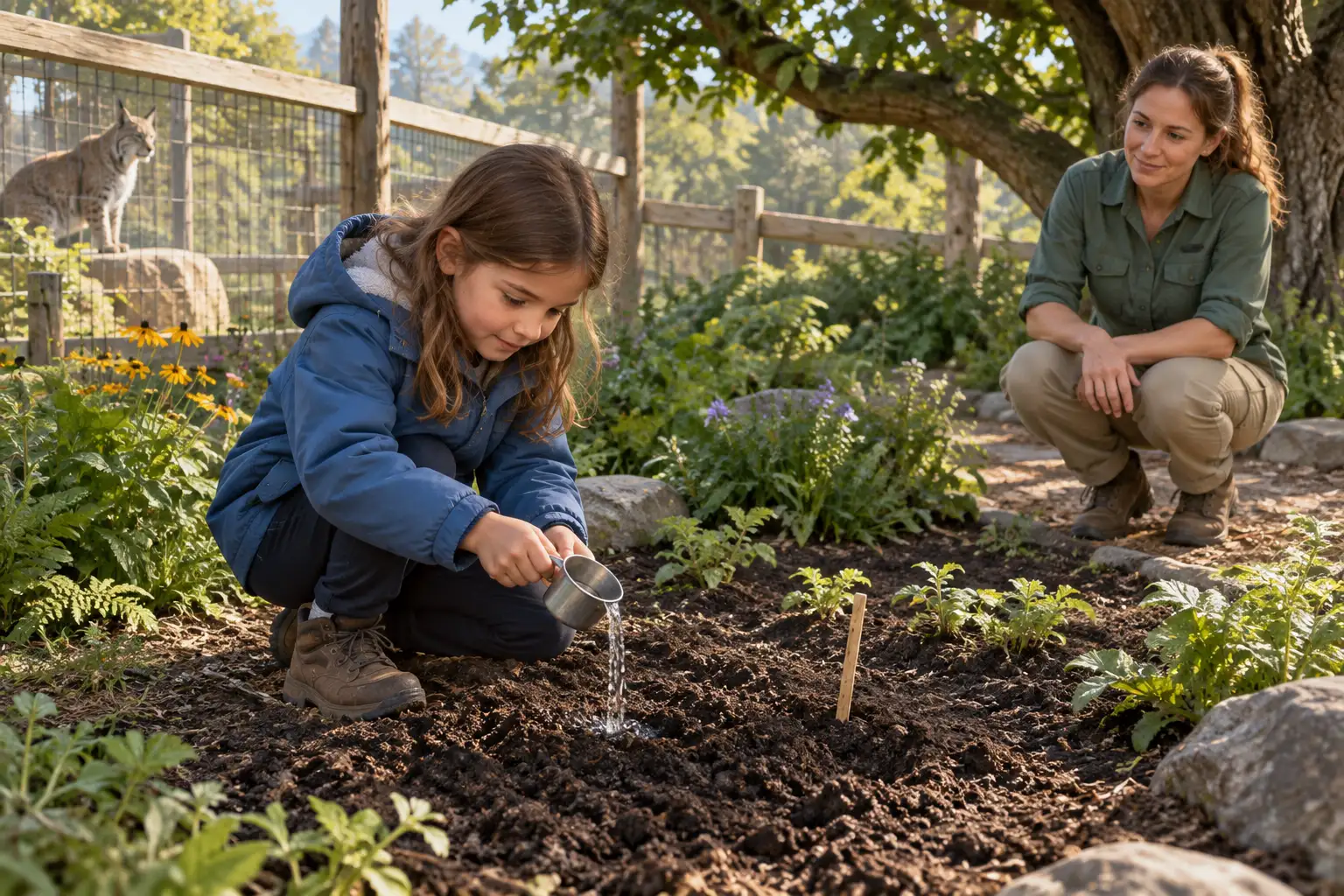
“What if we make a new, smaller bed on the shaded side of the garden?” she asked. “We can mix in some of the darker soil from the garden’s compost area. Then we can measure the water instead of guessing.”
Elena considered the idea. “That could work. We’ll also check with the horticulture team to make sure the new spot gets enough light. A wildflower needs both water and sunlight.”
They chose a place that received gentle morning sun and afternoon shade. Elena loosened the soil with the trowel, and Nora used a small wooden stick to make a hole.
“How deep?” Theo asked.
Elena placed a seed beside the stick. “About twice as deep as the seed is wide. If we plant it too deeply, the young shoot may have trouble reaching the surface.”
Nora measured the seed with her eyes. It was tiny, so she made a shallow hole and checked it twice. Then she placed a new seed inside.
This time, she covered it lightly and pressed the soil only enough to keep it from blowing away. She measured ten tablespoons of water and poured slowly, stopping when the soil was damp but not puddled.
The children made a second sign: MORNING SUN, AFTERNOON SHADE. Nora added a small drawing of the seed beneath the ground.
“Now we wait,” Elena said.
Waiting turned out to be harder than planting. Nora wanted to lift the soil and peek at the seed, but she knew that would disturb it. Instead, she began keeping a small observation record in her notebook.
On the first day, she wrote, “A bee hovered near a yellow flower by the path.” She drew two quick wings and a round body.
On the second day, she wrote, “The warm breeze made the tall grasses bend in the same direction.”
On the third day, Juniper rolled in a pile of dry leaves. The leaves fluttered around his broad back, and when he sat up, one leaf rested between his ears. Nora wrote, “Juniper chose the leaves instead of the sunny dirt.”
“He looks like he knows where the comfortable places are,” Theo said.
“Maybe he’s a very good observer too,” Nora replied.
The club visited every few days. Each time, Nora checked the soil with one finger at the edge of the bed, never right on top of the seed. Once, the soil felt almost too dry, so she asked Elena whether it needed more water.
Elena brought the small cup. Together, they measured five tablespoons and poured them around the seedbed. The water sank in instead of running away.
The next visit brought a disappointment. A sudden shower had fallen overnight, and rain had washed a little channel through one side of the bed. The sign leaned crookedly, and the top layer of soil had shifted.
“Oh no,” Theo said. “The seed could have moved.”
Nora knelt beside the bed. She could not see the seed, and she did not want to dig for it.
“Let’s look at what stayed in place,” she said. “The center is still covered, and the soil there is damp. Maybe the seed is still underneath.”
Elena agreed. She helped Nora press the loose soil back around the edges without disturbing the center. Then Nora pushed a short twig into the ground beside the bed as a marker.
“We’ll watch for a sprout near here,” she said.
That afternoon, while the children waited, Nora noticed something else. The little bee from her notebook hovered over a purple flower near the fence. It landed, lifted off, and returned to another flower nearby.
“Maybe our garden will help bees like that one,” Nora said.
“It might,” Ms. Patel replied. “Gardens begin with one small place and one small plant.”
The following week, the nature club arrived under a pale blue sky. Juniper was asleep beneath the oak, his paws folded loosely against his chest. A soft breeze stirred the leaves above him.
Nora hurried to the seedbed, then stopped before she reached it.
A green shoot had pushed through the soil.
It was no taller than her fingernail, with two tiny leaves opening toward the morning light.
For one quiet second, nobody spoke. Then Theo whispered, “It grew.”
Nora crouched so close that her shadow nearly covered the shoot. She moved back at once, letting the sunlight reach it.
“Elena,” she called. “Come look!”
The keeper joined them and smiled. “There it is. You gave it a good beginning.”
Nora looked at the first dry bed, then at the new shoot. The seed had not needed a grand garden or a perfect day. It had needed the club to notice what was happening, change their plan, and try again with care.
The children gathered around the little plant, leaving plenty of space for its leaves and light. Ms. Patel recorded the observation in the club notebook, and Nora added one final line beneath her drawings: “Today, the seed became a plant.”
Afterward, they sat near the path and shared snacks while Juniper rolled lazily through the leaves. A bee hummed over the flowers, and the warm breeze carried the scent of damp earth across the garden.
Before the bus came, Nora checked the young plant one more time. Its leaves trembled in the breeze but stayed open to the light. Beside it, the crooked sign had been straightened, and the soil remained cool and dark beneath the afternoon shade.
Juniper sighed contentedly under the oak. The new plant lifted its green leaves, and Nora tucked her notebook safely under her arm as the children headed home.
Talk about the story
1.Where did Nora and the nature club go?
2.What did the seeds look like?
3.Why did the first seedbed dry out?
4.How did Nora and the others compare the two kinds of soil?
5.Where did the children make the new seedbed?
6.How much water did Nora use for the new seedbed at first?
7.What did Nora see when the seed finally grew?
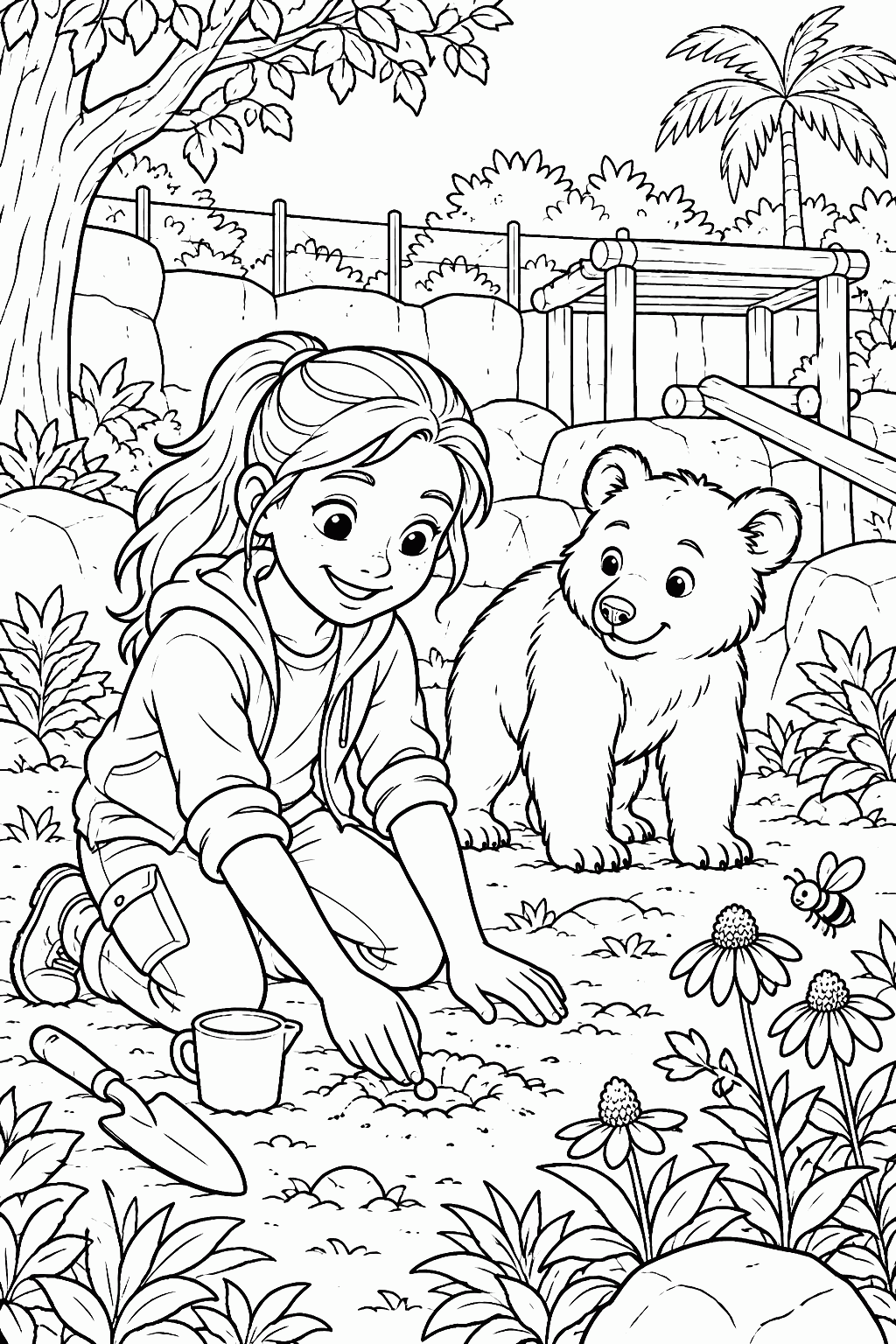
Coloring page
Print the story’s hero and color it in together — with crayons, markers or paints.