The spacecraft in Mia’s museum painting seemed to be moving, even though it was perfectly still.
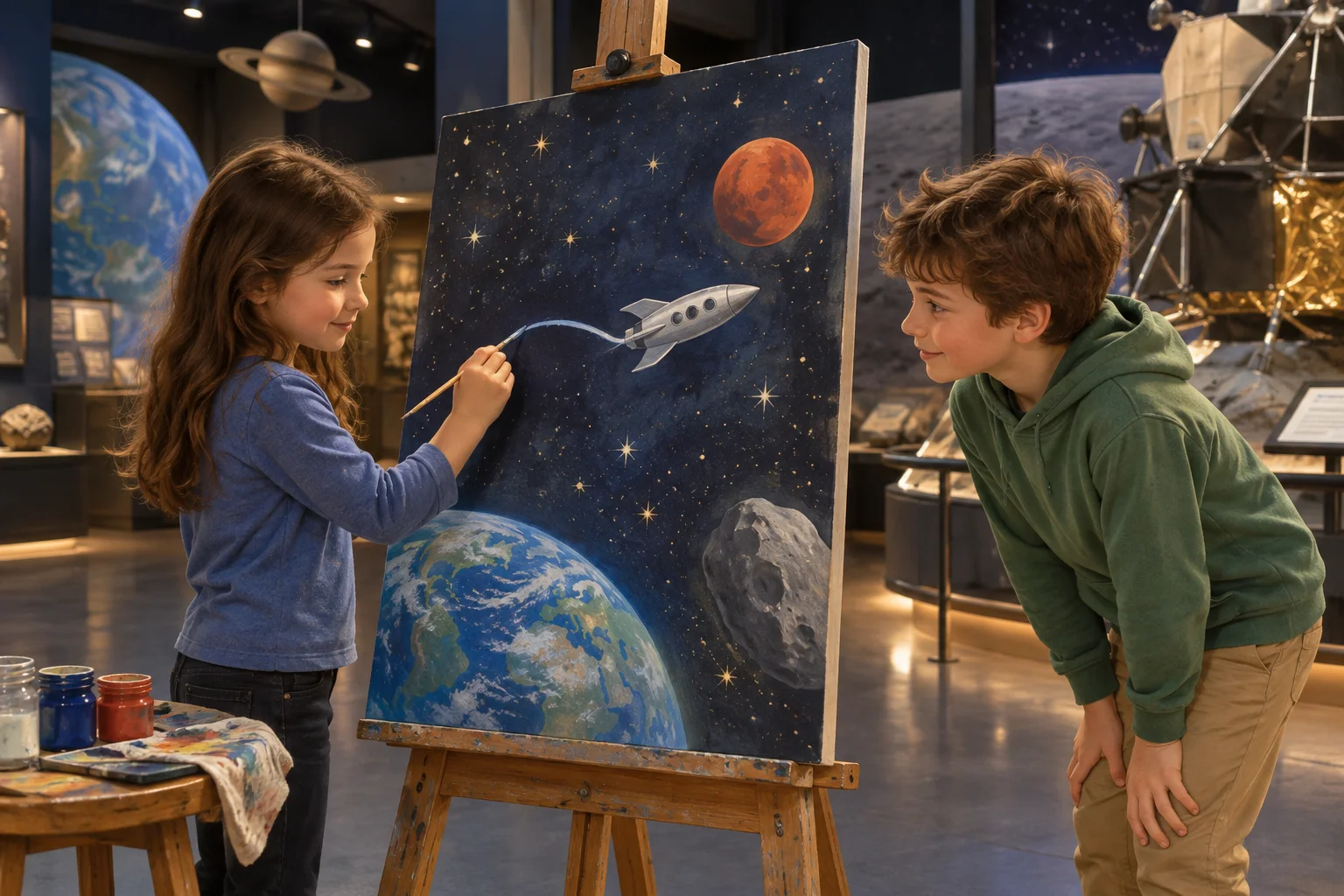
Mia stood in front of the picture with a paintbrush in her hand. She had mixed deep blue for the space around the ship, pale gold for the stars, and bright silver for the spacecraft itself. Instead of painting the ship straight across the paper, she drew a smooth line behind it.
The line curved gently toward a red planet and then continued through a field of tiny white stars. It never wobbled. It never made a sudden turn.
“That path looks like it knows exactly where it’s going,” Jude said.
Jude was Mia’s classmate and the sort of person who read every button at a museum exhibit, even when the button said, “Please do not press.” He leaned closer to Mia’s painting without touching it.
“I want the spacecraft to look as if it’s following a plan,” Mia said. “If it wandered around, it might miss the planet.”
Jude nodded. “Maybe a path can help you figure out what something will do next.”
Their class had come to the science museum that morning. Ms. Alvarez led them past models of planets, maps of the moon, and photographs taken by telescopes. At the space exhibit, Mia and Jude watched a small model spacecraft glide along a clear track. It traveled straight and turned in exactly the same place each time.
Mia painted until the museum lights glowed against the dark walls. When she finished, she carried her picture to the drying rack. The silver spacecraft shone in its blue-and-gold world.
“Tomorrow,” Jude said, “we should make a paper airplane and give it a path.”
Mia smiled. “A path on the floor?”
“Maybe. Or a path on a chart. We could see what it does every time.”
The next afternoon, Ms. Alvarez made an announcement just before the last bell.
“We have permission to use the gym for a paper-airplane test,” she said. “We’ll work in pairs, stay behind the starting line, and collect each plane before the next one flies.”
A cheer rose from the class.
Mia and Jude hurried to the gym with a stack of plain white paper. Sunlight streamed through the high windows and made bright rectangles on the floor. Near one wall, the school’s guinea pig, Pepper, rested in his travel carrier. Ms. Alvarez had brought him back from a checkup, and he was spending the afternoon beside a pile of hay.
“Pepper looks ready for science,” Jude whispered.
Pepper rustled the hay as if he had heard, then settled down again.
Mia folded her paper carefully. She pressed the first crease with her thumbnail, folded the second side to match it, and made the wings even. Jude made a plane with a wide nose and narrow wings.
“What should we call yours?” he asked.
“Silver Star.”
“Mine is the Comet.”
Ms. Alvarez raised her hand. “First flight!”
Mia stepped to the starting line. She took a small breath and sent Silver Star sailing.
The plane flew beautifully at first. It rose above the blue center line painted on the gym floor and traveled farther than Mia expected. A few children began to clap.
Then Silver Star turned sharply left.
It swooped toward the folded bleachers and landed with a soft skitter nearly halfway across the gym.
“Whoa,” Jude said. “That was a long flight and a sudden turn.”
Mia hurried to collect the plane. One wing had bent slightly when it landed, but the sharp turn had started before that.
She tried again. This time the plane flew straight for a while, then veered left even sooner.
Mia looked at the spacecraft in her painting, which she had tucked inside her notebook. Its path was smooth and predictable. Silver Star’s path looked more like a crooked scribble.
“Maybe I folded one side too tightly,” she said.
“Or maybe the nose is pulling it,” Jude replied. “We could change everything and try again.”
Mia held the plane between both hands. Changing everything sounded tempting. If the next plane flew well, she would never have to know what had helped.
Then she remembered her painted path. The spacecraft had followed one clear line. It had not changed direction five times at once.
“Let’s change one fold,” Mia said. “Then we’ll know what made a difference.”
Jude grinned. “One fold at a time.”
They made a chart on a clipboard. The first row said, “Original Silver Star.” In the next boxes, they wrote “far,” “left,” and “sharp turn.” Jude drew a little arrow pointing toward the bleachers.
For the second version, Mia opened the wings and refolded only the right wing. She made it match the left one more closely.
Silver Star Two flew farther than the first plane, but it still drifted left. The turn was gentler, though, and the plane landed near the basketball hoop.
Mia wrote the result on the chart. “Long flight. Left turn. Less sharp.”
Jude tested the Comet beside her. It flew in a wide curve to the right and landed near the wall.
“That’s interesting,” he said. “Our planes are doing different things.”
“They don’t have to be the same,” Mia said. “We can compare them.”
Their classmates tested planes too. Some rose high and dropped quickly. Some spun in circles. One flew backward for a moment before settling onto the floor. The gym filled with the gentle flutter of paper and the squeak of sneakers.
Mia and Jude kept working. For the third version, Mia folded the nose a little more firmly but left both wings alone. The plane traveled straight for several feet, then turned left again.
“For a different reason,” Jude said.
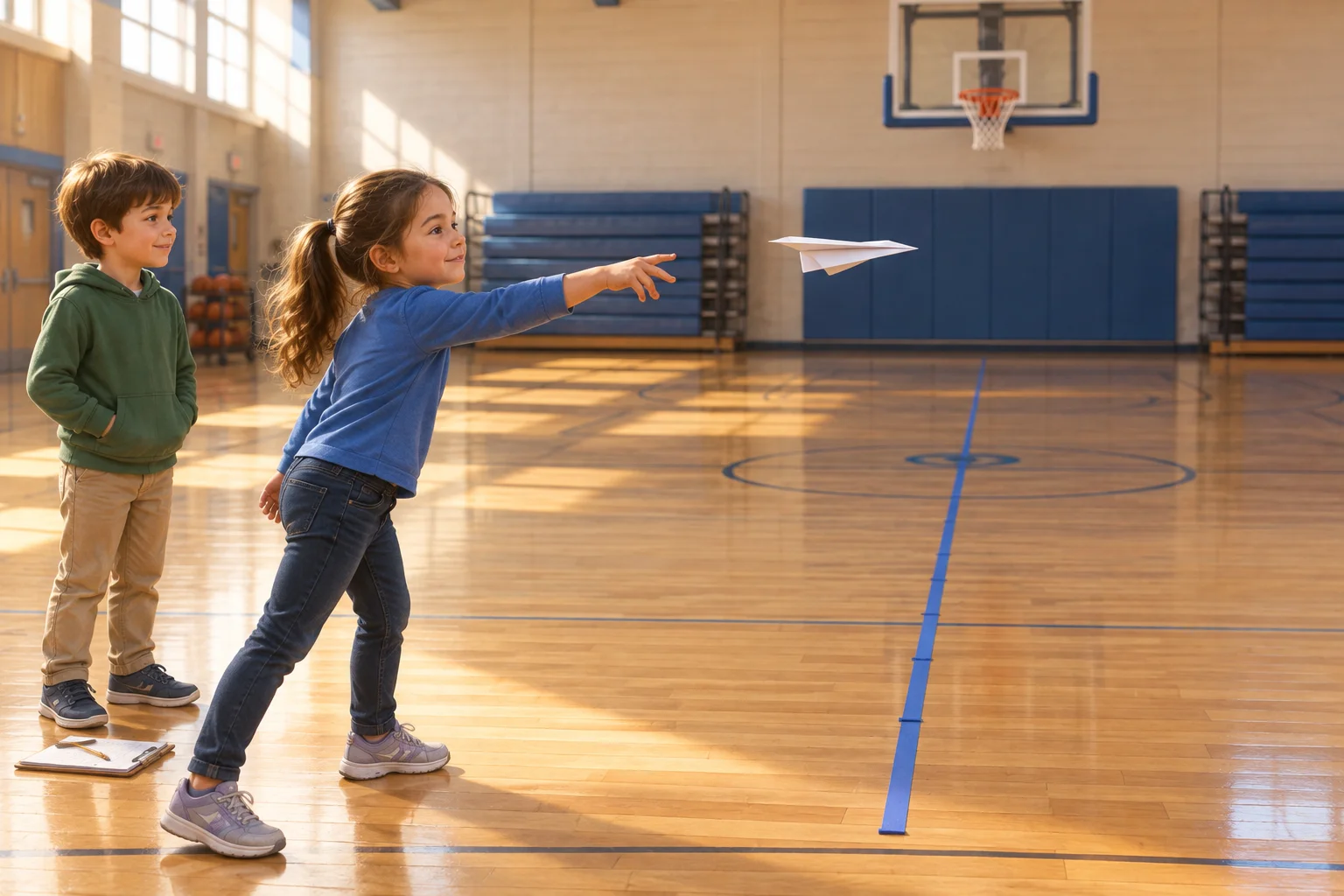
Mia frowned at the chart. Three flights, three left turns. The path in her painting seemed simple, but the real plane refused to follow it.
“Maybe it isn’t the fold,” she said. “Maybe I’m throwing it crooked.”
That possibility made her cheeks grow warm. She had been so careful with the paper. What if the problem was her hand?
Ms. Alvarez came over and looked at the chart. “You can test that, too,” she said. “Try standing with both feet pointed toward the center line. Keep your arm level. Use the same gentle throw each time.”
Mia nodded. She stepped back to the line and placed her shoes beside the blue stripe. She held the plane at the same height as before and sent it forward.
Silver Star Three flew straight for almost the entire length of the gym. Then it dipped left, but only a little.
Mia stared after it.
“I changed the throw, not the plane,” she said.
Jude added a note to the chart. “Same fold. Better path.”
Mia felt a small spark of pride, followed by a pinch of disappointment. She had wanted the paper airplane to be the whole answer. Instead, her own careful movement mattered, too.
The following day, they returned to the gym for more testing. Ms. Alvarez had placed a long strip of tape on the floor, starting at the launch line and ending beneath the far basketball hoop. It was not a promise that every plane would follow the tape. It was a way to notice where each plane traveled.
Mia brought her painting and set it on a bench where she could see the spacecraft’s steady line while she worked.
For the fourth version, she made one small, brave change. She folded the left wing just a tiny bit lower than the right. The difference was so small that Jude had to tilt the plane toward the window to see it.
“You think lowering the left wing will stop the left turn?” he asked.
“I don’t know,” Mia said. “That’s why I’m trying it.”
She placed her feet beside the blue line, held the plane level, and threw it gently.
Silver Star Four sailed down the taped path. It rose a little, dipped a little, and landed just to the right of the tape near the end of the gym.
Mia ran to get it. Her hands trembled with excitement.
“It stayed almost straight!” she said.
Jude pointed to the chart. “And we know why we think it happened. We changed one fold and kept the throw the same.”
They tested the plane again. It followed nearly the same path. On the third flight, it drifted a few inches farther right, but it did not make the sharp turn that had bothered Mia.
Across the gym, Pepper shifted in his carrier. He sniffed the air as another paper plane floated past, then tucked his nose beneath a piece of hay.
Mia laughed softly. “Pepper seems to like steady things.”
“Pepper likes hay,” Jude said.
“That’s steady, too.”
On contest day, the gym buzzed with excitement. Each student could enter one plane. The contest had two parts: longest distance and steadiest path. Ms. Alvarez placed measuring tapes on the floor and asked the judges to watch from behind the starting line.
Mia looked at Silver Star Four. Its wings were a little rumpled from testing, and the silver star she had drawn on the side had faded where her fingers had held it.
“Maybe I should make a new one,” she said. “A fresh plane might fly farther.”
Jude looked at their chart. “It might. But would you know what made it better?”
Mia glanced toward her painting. The spacecraft still followed its smooth line through the stars. She took a deep breath.
“I’ll use this one,” she said.
The longest-distance flights came first. Some planes flew all the way to the far wall. One sailed nearly to the folded bleachers, and its owner clapped with delight. Silver Star Four traveled a respectable distance, but it landed several feet short of the winner.
Mia felt her shoulders sink.
Then Ms. Alvarez called for the steady-path flights.
Mia stood at the launch line. Around her, the gym grew quiet. Even the children who had been whispering watched the blue tape on the floor. Pepper rustled once in his carrier.
Mia placed her feet carefully. She held the plane level, just as she had during the tests. For one moment, she wondered whether the first flight had only been luck.
Then she let go.
Silver Star Four glided forward. It followed the tape, dipping gently and rising again. It stayed within the same narrow path as its last two flights and landed near the end of the gym.
The class clapped, not loudly at first, but warmly. Jude added his applause with both hands above his head.
Ms. Alvarez measured the path and checked the chart. “Mia’s plane did not travel the farthest,” she announced. “But it stayed the most predictable over three flights.”
Mia felt her disappointment about the distance loosen inside her. In its place came something steadier.
Jude held up their clipboard. “The chart helped us figure it out.”
“And Mia was willing to change one small fold,” Ms. Alvarez said. “That made a big difference.”
Mia looked at the paper plane in her hands. She thought about the sharp left turn, the crooked throws, and the flights that had not worked the way she hoped. None of them had been wasted. Each one had shown her where to look next.
After the contest, Mia placed the chart beside her painting on the classroom display table. Under the spacecraft, she added a small note: “A steady path can begin with one careful change.”
Jude set the Comet beside it. His plane still curved to the right, but now they understood its pattern. Pepper rested in his carrier nearby, making a soft, sleepy rustle in the hay.
As afternoon light spread across the floor, Mia watched Silver Star’s shadow stretch beside the painted spacecraft. The shadow stayed still, but in her mind the plane moved smoothly through the blue gym, following its calm, dependable path.
She folded the chart and tucked it into her notebook. Then she carried the plane to the windowsill, where it rested beneath the quiet stars she had painted, ready for the next careful test.
Talk about the story
1.What did Mia paint behind the spacecraft?
2.Why did Mia want the spacecraft to follow a clear path?
3.What happened to Silver Star during its first flight?
4.What did Mia and Jude change one thing at a time?
5.How did Mia change her throw after talking with Ms. Alvarez?
6.What did Silver Star Four win on contest day?
7.What did Mia place beside her painting on the classroom display table?
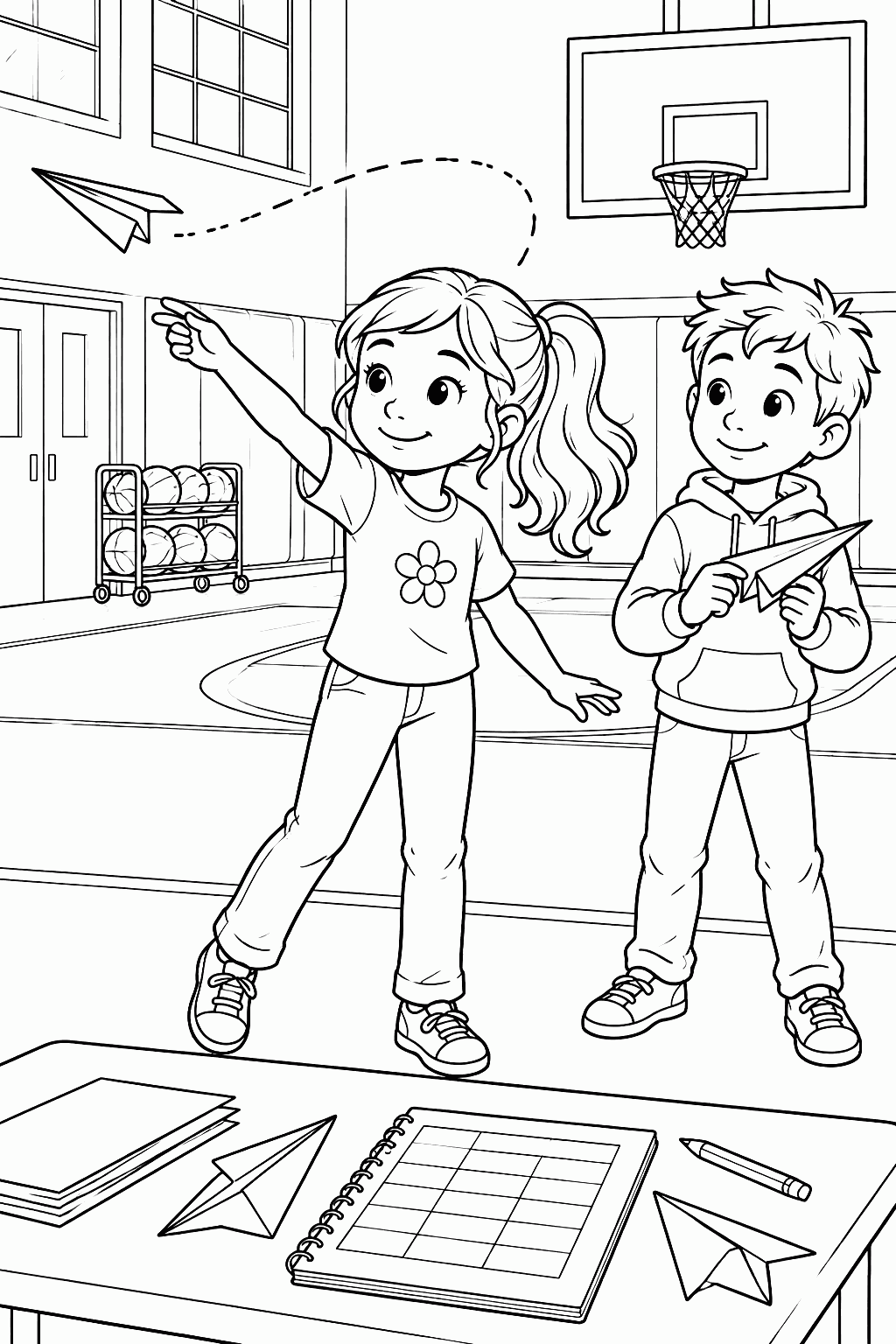
Coloring page
Print the story’s hero and color it in together — with crayons, markers or paints.