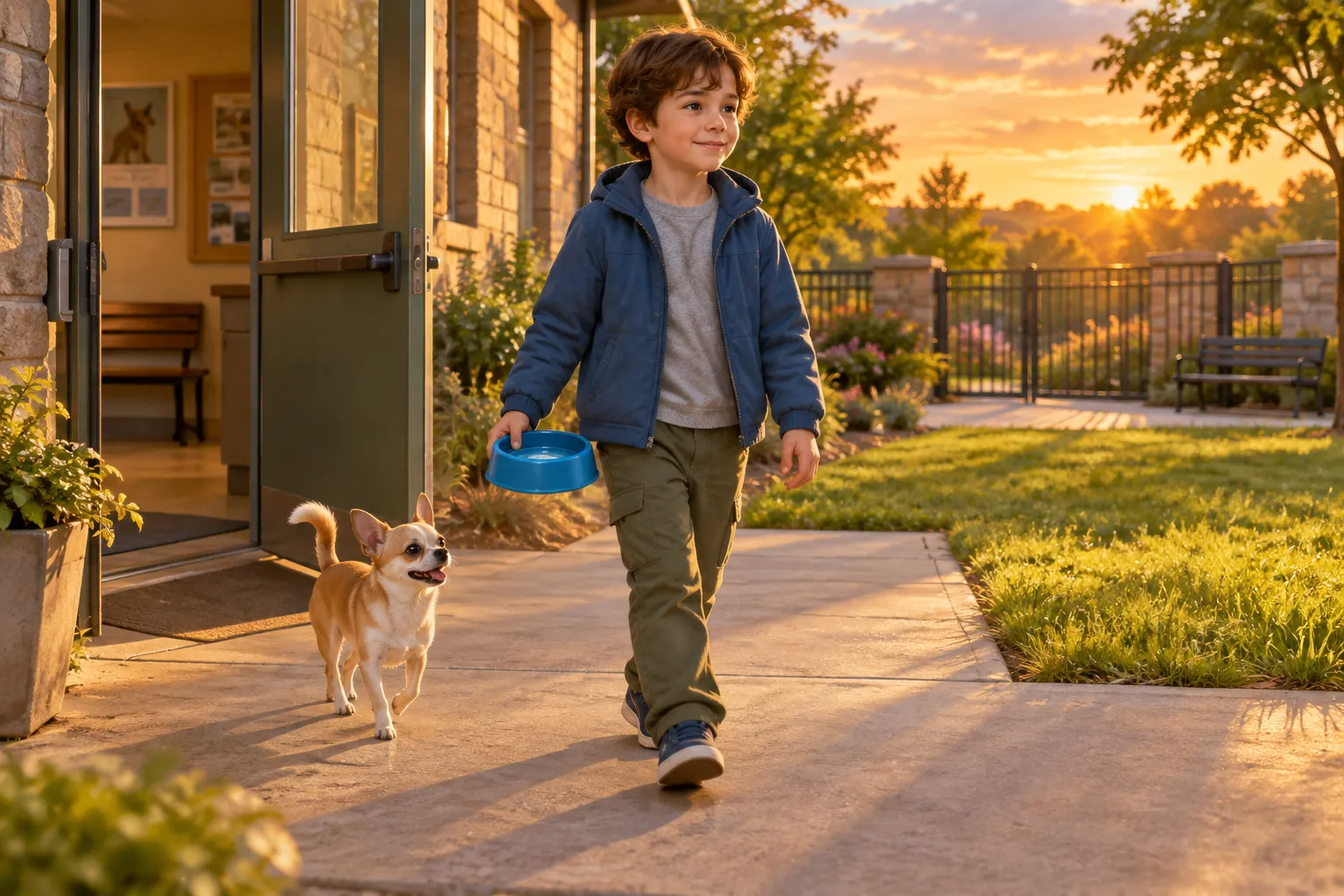
Hudson carried Biscuit’s blue water bowl through the side door of the recreation center. Biscuit, his short-haired Chihuahua, trotted beside him with his ears perked and his little paws moving quickly.
“Slow down, Biscuit,” Hudson said. “We’re going to the pet-care club, not a race.”
Biscuit paused to sniff a patch of grass, then hurried after him. At the courtyard gate, Ms. Rivera waved from a folding table covered with brushes, clean towels, small bowls, and a basket of dog treats.
“Welcome, Hudson,” she called. “And welcome, Biscuit. Did you remember the water bowl?”
Hudson held it up proudly. “I did.”
“That’s an important part of caring for a dog,” Ms. Rivera said. “Fresh water first, then brushing.”
The evening pet-care club met twice a month. Neighborhood children brought their dogs when they could, and Ms. Rivera, an adult volunteer, showed them how to care for their animals with gentle, careful hands. Three other children were already there. Amir was filling a pitcher at the outdoor faucet. Sofia was spreading towels across the table. Priya was helping her grandmother’s calm brown dog settle beside a chair.
Hudson placed Biscuit’s bowl on the ground and poured in fresh water. Biscuit leaned forward and drank. His tail tapped happily against Hudson’s ankle.
“Now brush from the shoulders toward the tail,” Ms. Rivera explained. “Use steady strokes, and pay attention to any place that feels tender.”
Hudson rested one hand lightly on Biscuit’s back and moved the soft brush through his short coat. At first, Biscuit stood very still. Then he closed his eyes and lifted his chin, as if he had discovered a brand-new kind of comfort.
“You found his favorite spot,” Sofia said.
“Maybe he’s pretending to be a fancy show dog,” Hudson replied.
Biscuit opened one eye, as if he had heard the joke, and leaned against Hudson’s leg.
After brushing, Hudson checked Biscuit’s paws. He looked between each pair of toes for bits of gravel or burrs, then gently rubbed the pads with his thumb. Biscuit lifted one paw at a time and placed it down again when Hudson finished.
“Good job,” Ms. Rivera said. “Careful hands help animals trust us.”
Hudson smiled, but before he could reach for a towel, he noticed something moving beside the garden bed.
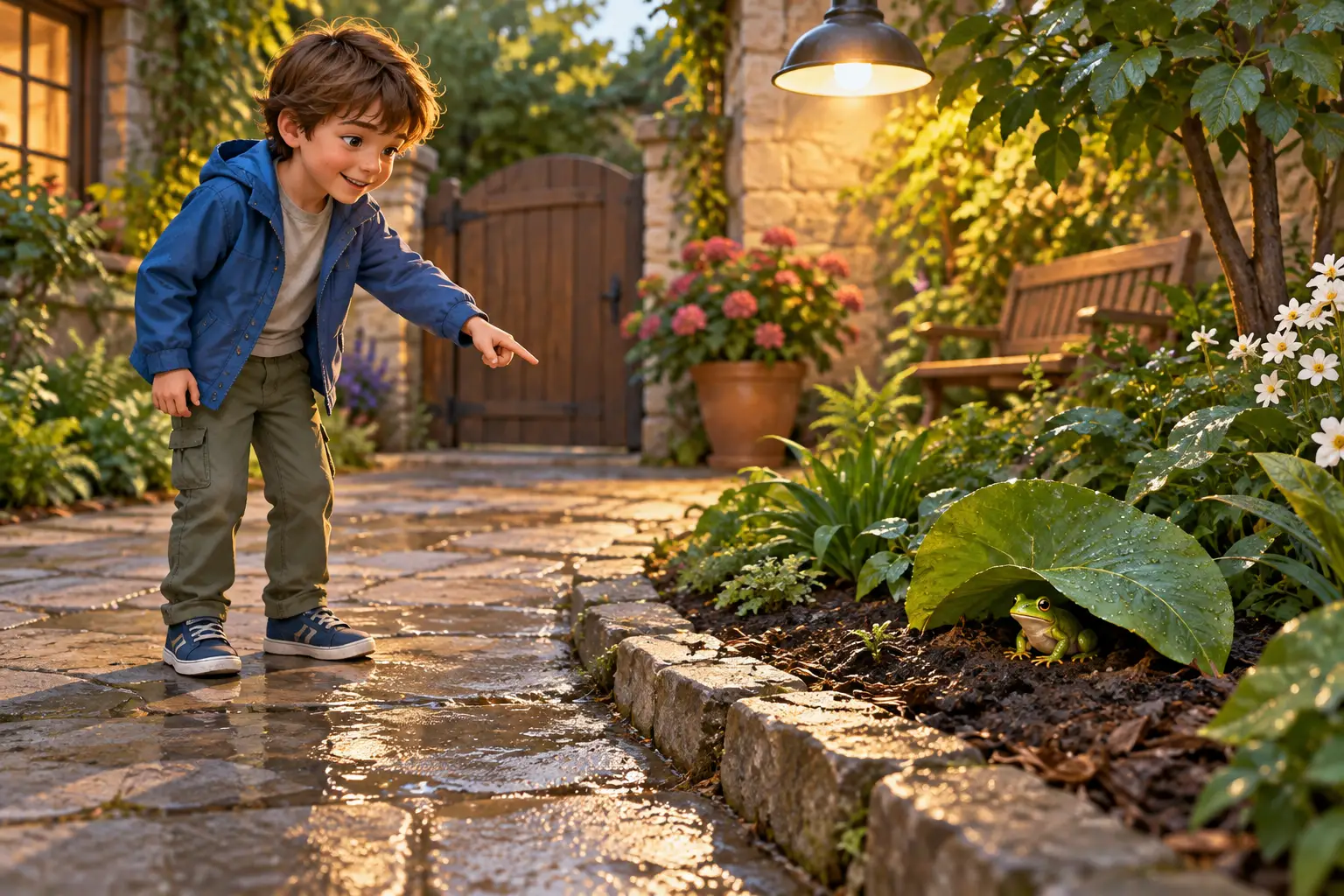
A small green frog had crept out from beneath a broad leaf. Reed was no bigger than Hudson’s palm. He sat at the edge of the damp soil, his round eyes shining as he looked toward the courtyard.
Then the overhead light buzzed brightly.
Reed tucked his legs beneath him and hopped back under the leaf.
Hudson stopped. “Did you see that?”
“See what?” Amir asked.
“The frog. He came out, but when the light got bright, he went back under the leaf.”
The children gathered near the garden bed, keeping a respectful distance. Biscuit watched them with his head tilted. His leash was looped around the leg of Hudson’s chair, and he stayed where Hudson had asked him to stay.
Ms. Rivera crouched beside the path. “Let’s observe without touching Reed. What do you notice?”
Hudson pointed to the wet soil. “He stays in the shadow of the leaves.”
Sofia looked across the courtyard. “The corner beneath the bench is dark, too.”
“But the middle of the courtyard is warm,” Priya said. She held her hand above the paving stones. “The light reaches all the way there.”
Amir walked to the other side of the courtyard and looked near the wall. “There are a few insects here, but not many.”
“Let’s compare instead of guessing,” Ms. Rivera said. “We can look at the sunny places and the shaded places. We can also notice where Reed chooses to rest.”
Hudson found a pencil and a scrap of paper on the club table. He drew a quick map of the courtyard. He marked the bright lamp with a yellow circle, the damp garden bed with a blue line, and the shaded corner with a dark square.
For the next few minutes, the children watched quietly. Reed stayed beneath the leaf. Biscuit rested his chin on Hudson’s shoe. A moth fluttered around the lamp, while a tiny beetle crawled along the edge of the garden bed and disappeared into the mulch.
“Maybe Reed doesn’t like the light,” Hudson whispered.
“Maybe,” Ms. Rivera said. “But one observation is only the beginning. We need to see whether a pattern appears.”
Hudson nodded and added a small mark to his map. He decided to check again after the children finished their pet-care jobs.
The first idea for helping Reed did not go as planned. Hudson thought a towel might make a good little shade, so he carried one toward the garden bed. Before he could set it down, a breeze lifted the towel and sent it skimming across the courtyard.
Biscuit sprang up with a surprised bark and chased after it.
“Biscuit, wait!” Hudson called.
The Chihuahua stopped beside the fence. Hudson hurried over, picked up the towel, and brought Biscuit back to the table. Reed remained hidden beneath the leaf.
Ms. Rivera folded the towel and placed it where the breeze could not reach it. “It was kind of you to think of shade,” she said, “but a loose towel could blow into the garden or startle an animal. Let’s find something that belongs outdoors.”
Hudson looked toward the supply shed. Several empty plant pots stood near the door. One had a faded label showing a plant with tiny white flowers.
“Could we use a plant?” Hudson asked. “Something that can live here and give Reed more cover?”
Ms. Rivera checked the label. “This is a native plant. It grows well in part shade and moist soil. I have a healthy one in a pot near the greenhouse.”
“Could we move it beside the garden bed?” Priya asked.
“First, we’ll ask the recreation center director,” Ms. Rivera said. “Then we’ll make sure the pot has drainage and won’t block the path.”
Ms. Rivera went inside to speak with the director. While she was gone, Hudson returned to his map. He looked from the bright lamp to the shaded places and back to Reed’s leaf.
“The courtyard is already bright from the windows,” he said. “Maybe the lamp is not needed.”
Amir checked the wall switch beside the side door. “It might be an extra light.”
Hudson did not touch the switch. He waited until Ms. Rivera came back.
She returned with a key ring and a watering can. “The director said we can switch off the lamp during club hours,” she explained. “The path will still have enough light from the building. We’ll turn the lamp back on when everyone leaves.”
Hudson felt a small spark of hope. “Can I help?”
“You can stand with me and watch the path,” Ms. Rivera said. “We’ll make sure everyone can see while we test the change.”
Together, they switched off the unnecessary light. The bright patch beneath the lamp softened into ordinary evening shadow. The windows still cast a warm glow across the walkway, and no one had to squint or step carefully.
For a minute, nothing happened.
Reed stayed beneath the leaf.
Hudson’s shoulders drooped. “Maybe the light wasn’t the problem.”
“That’s possible,” Ms. Rivera said. “A careful observation doesn’t always give us an immediate answer. We can keep watching.”
They went back to the club table. Hudson refilled Biscuit’s water bowl and offered him a small treat. Biscuit took it gently from Hudson’s fingers and sat down.
“Check his paws once more before we leave,” Ms. Rivera reminded him.
Hudson looked at each paw. Biscuit had picked up a tiny piece of dry grass, which Hudson brushed away. Then Hudson rubbed Biscuit’s ears and made sure he had another drink of water.
When Hudson looked up again, several small insects had gathered near the darker corner. A moth drifted low over the mulch. Two tiny flies hovered above the damp garden bed. Beneath the leaf, Reed’s eyes appeared.
“Everyone, look,” Hudson whispered.
Reed slowly came forward. He paused, then hopped once into the shadow beside the garden bed. He did not go toward the bright middle of the courtyard. Instead, he settled near the gathering insects and rested beneath the edge of the leaf.
Hudson stared at his map. It suddenly seemed too small for everything they had discovered. The shaded corner mattered. The damp soil mattered. The insects mattered. Even the light switch mattered, because turning it off had changed the little corner without disturbing Reed.
Ms. Rivera brought out the native plant in its pot. Its green leaves were fresh and sturdy, and its roots were tucked safely into the soil.
“Where should it go?” she asked.
Hudson studied the path. “Near the garden bed, but not in the way. Maybe beside the old stone, where it can get morning light and afternoon shade.”
Ms. Rivera nodded. She placed the pot there, and Hudson helped guide the watering can while she poured just enough water around the soil. The plant stood beside the damp bed like a quiet green neighbor.
Reed did not hop away. He watched from beneath his leaf while the children finished.
Sofia gathered the brushes. Amir folded the towels. Priya washed the empty bowls. Hudson clipped Biscuit’s leash to his collar and made sure the Chihuahua had one last drink.
By then, Reed had settled completely in the dark corner. The insects moved around him, and the new plant cast a soft shape across the ground.
“What will you call this investigation?” Sofia asked.
Hudson looked at the notes on his map. “Maybe ‘The Frog-Friendly Courtyard.’”
“That sounds like a title,” Priya said.
Hudson’s face brightened. He took a clean sheet of paper from his backpack. He had planned to draw Biscuit that evening, but now he began writing about a small frog who needed a quiet place to rest. He wrote about the bright lamp, the towel that blew away, the careful observations, the insects, and the plant that found a home beside the garden bed.
Biscuit sat close to Hudson’s chair, his warm side touching Hudson’s ankle.
When Hudson finished, Ms. Rivera read the page over his shoulder. “This would make a wonderful bedtime story.”
“I want to read it to everyone,” Hudson said.
The children gathered in a circle. Ms. Rivera turned off the table lantern, leaving the windows to light the courtyard. Hudson held his page with both hands and began.
“Once there was a small green frog named Reed who searched for a quiet place in a busy courtyard. A boy named Hudson noticed that Reed rested beneath a leaf whenever the brightest light came on. So Hudson and his friends watched carefully instead of rushing. They found insects near the shadows, switched off a light no one needed, and placed a native plant beside the damp garden bed. Reed came out and settled beneath the new leaves, while a short-haired Chihuahua named Biscuit listened with his ears standing tall.”
Biscuit’s ears did stand tall, and everyone laughed softly.
Hudson continued. “The courtyard did not become a different place. It simply became a place where more than one kind of creature could belong.”
When he finished, the courtyard was quiet except for the faint rustle of leaves. Reed remained beside the garden bed. Biscuit leaned against Hudson’s leg, sleepy after his busy evening.
Ms. Rivera smiled. “You made a story from what you noticed.”
Hudson folded the page carefully and tucked it into his backpack. Then he picked up Biscuit’s empty bowl and walked with the group toward the recreation center doors.
Behind them, the native plant rested beside the damp garden bed. Reed rested beneath its leaves. In the gentle darkness, a few insects drifted over the soil while Biscuit’s tags gave one soft jingle and the courtyard settled into the evening.
Talk about the story
1.Who was Biscuit?
2.What did Hudson give Biscuit first at the pet-care club?
3.How did Hudson brush Biscuit?
4.Where did Reed stay when the overhead light buzzed brightly?
5.What did Hudson draw on his map?
6.Why did Ms. Rivera say they should not use a loose towel for shade?
7.What helped Reed come out of hiding later?
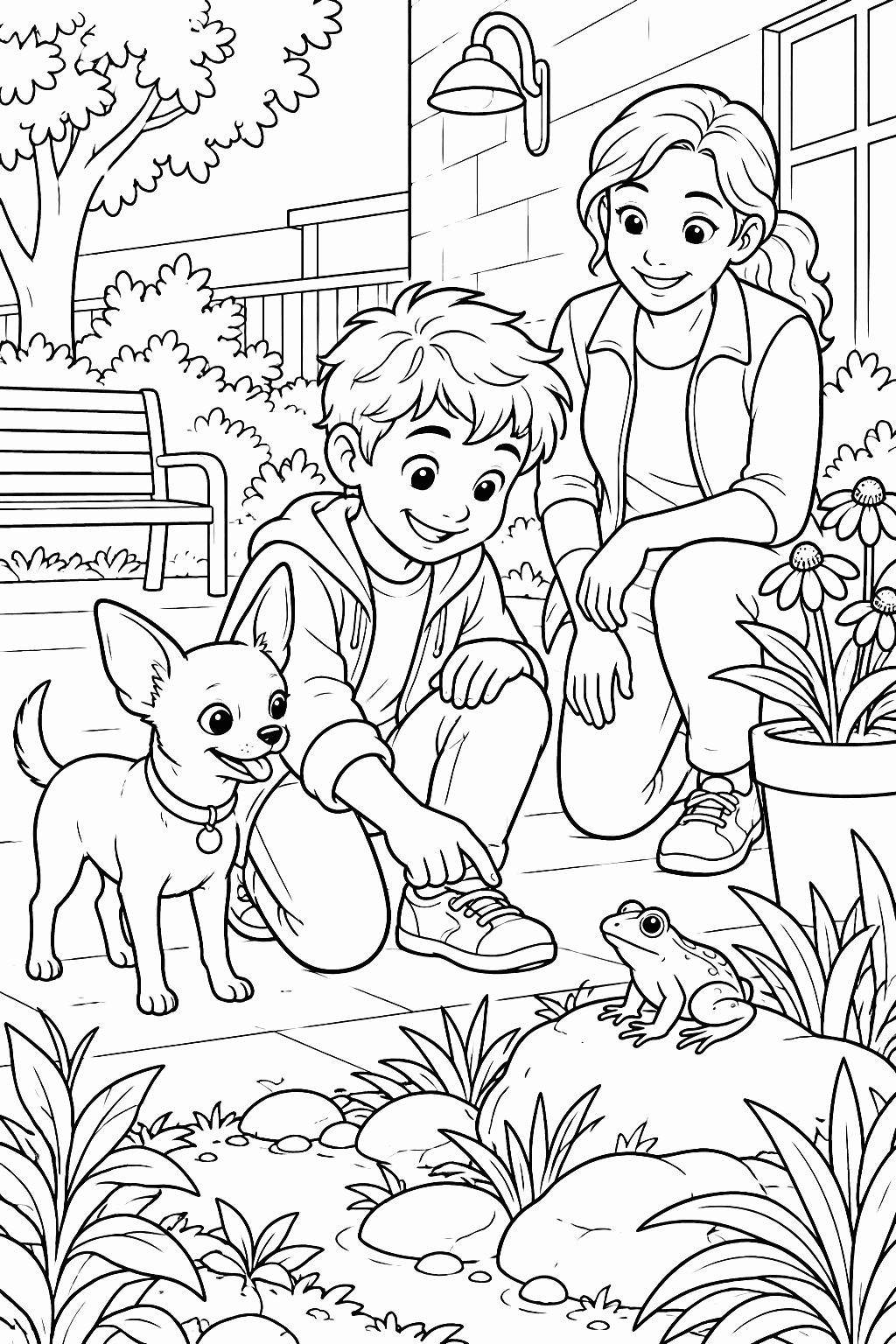
Coloring page
Print the story’s hero and color it in together — with crayons, markers or paints.