Zoë had a plan for bedtime. She wanted to make a story especially for her baby brother, who was five weeks old and loved bright shapes, soft voices, and the sound of pages turning. Whenever someone opened a book, he waved his tiny hands as if he wanted to help.
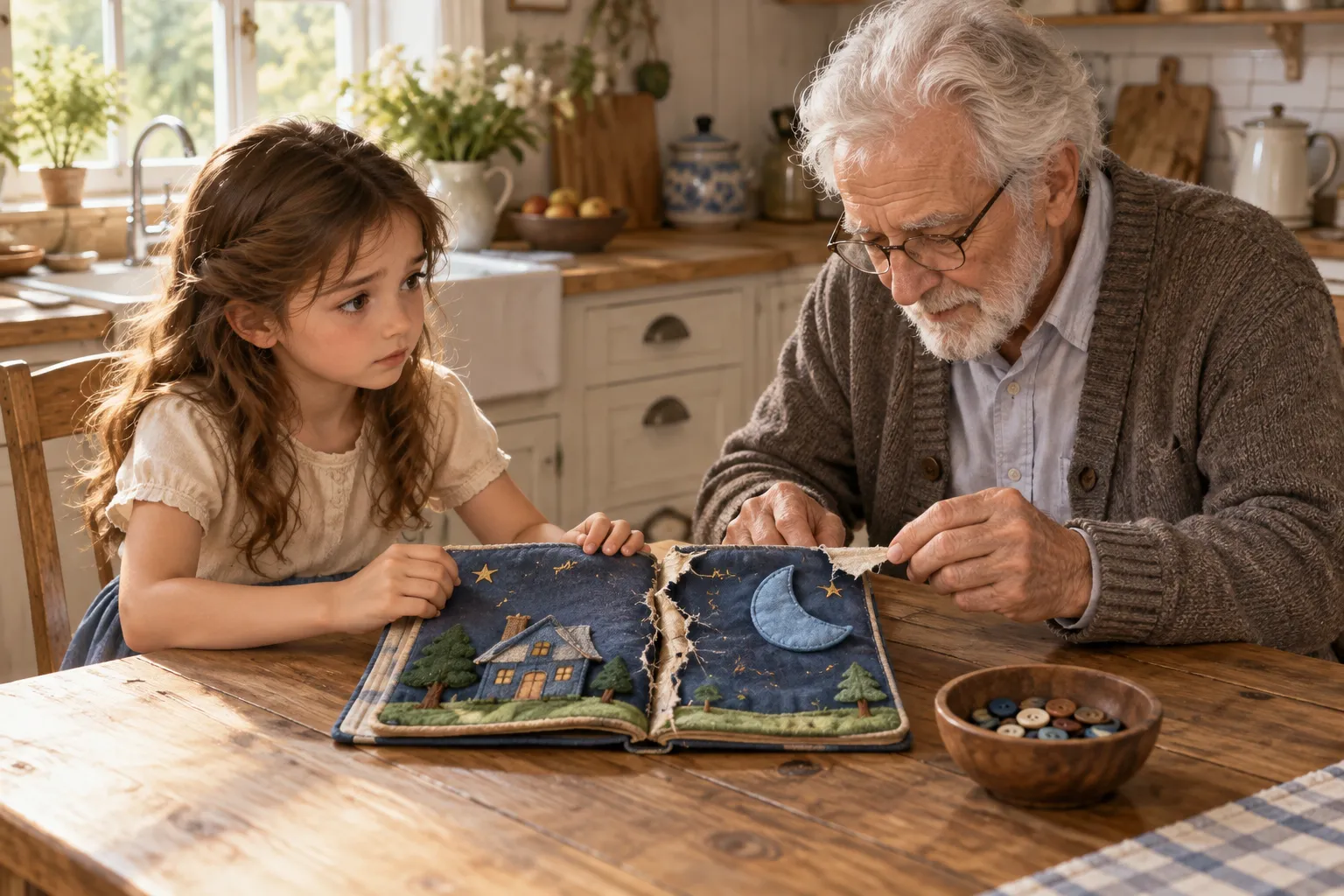
The trouble was that the best picture book in the house had a long tear across its cloth cover. One corner hung loose, and the blue moon on the front looked as if it might float away.
Zoë carried the book to the kitchen table, where her grandfather was sorting buttons into a little wooden bowl.
“Grandpa, can we fix it?” she asked. “I want to read it to the baby tonight.”
Grandpa looked over his glasses at the book. “I think we can. It may take patience, though.”
“I have patience,” Zoë said quickly.
Just then, the loose corner slipped from her fingers and flopped onto the table.
Grandpa smiled. “We’ll see.”
He brought out a needle, blue thread, and a small pair of scissors. Zoë sat beside him and held the two sides of the cover together while he threaded the needle. She watched the thread slide through the eye, disappear, and come back again.
“Why don’t I sew it?” Zoë asked.
“Because the needle is sharp, and the cloth is thick,” Grandpa said. “You can help me keep the edges lined up. That’s an important part of the repair.”
Zoë pressed the cover flat with both hands. “Like this?”
“Exactly.”
The first stitches were small and neat. Grandpa pushed the needle down through the cloth, pulled the thread after it, and brought the needle up again. Zoë kept the blue moon from shifting. The work was slow, but she liked seeing the tear grow smaller.
Then the book slid toward her elbow. Zoë reached to catch it, and the thread pulled tight with a tiny twang. One of the new stitches popped loose.
“Oh no,” Zoë said. “I ruined it.”
“You didn’t ruin it,” Grandpa said. “The stitch simply needed a stronger place to hold.”
He loosened the thread and showed her a spot where the cloth had become thin.
“Try again?” Zoë asked.
“Try again.”
This time, Zoë held the cover more carefully. She placed one finger near the edge, safely away from the needle’s path, and watched the cloth instead of the clock on the wall. Grandpa made three more stitches. The blue moon stayed in place.
When they reached the last inch, Zoë noticed something tucked between the book’s pages. It was a small square of pale paper folded in half.
“What’s this?” she asked.
Grandpa opened it. On the paper was a very old drawing of a bird with wide wings and a long, forked tail.
“That looks like a swallow,” he said.
“Could it be Arthur?”
“Maybe. Have you seen Arthur today?”
Zoë had seen him that afternoon, swooping over the backyard. Arthur was a barn swallow who appeared almost every evening. He flew so quickly that Zoë sometimes saw only a flash of brown back, pale belly, and pointed wings.
“He might be outside now,” she said. “The fireflies come out around sunset.”
Grandpa tied off the final stitch. “Then perhaps your story has found its beginning.”
Zoë hurried to the back door, but she stopped with her hand on the knob.
“What kind of animal is Arthur?” she asked. “I know he’s a bird, but what kind?”
Grandpa placed the repaired book on a chair to rest. “Let’s observe him before we decide what to write. A good story can begin with a good question.”
The backyard was turning blue with evening. The grass held the last warm light of the day, and the first fireflies blinked near the garden fence. Zoë brought her sketchbook and a pencil. Grandpa brought a small folding chair for her and sat on the back steps.
For a while, nothing happened except the blinking.
One firefly glowed near a basil plant. Another glowed beside the fence. Zoë drew two small dots and connected them with a wiggly line.
“That’s not Arthur,” she whispered.
“No,” Grandpa whispered back. “But it’s part of the setting.”
A shadow swept over the yard. Arthur darted past the porch, turned above the grass, and rose into the air. A second later, he swooped down again.
Zoë’s pencil hurried across the page.
“What did you see?” Grandpa asked.
“Fast wings. A brown back. And he caught something.”
“An insect,” Grandpa said. “Swallows are excellent insect hunters.”
Arthur curved through the air once more. He flew close to the ground, then lifted sharply, as if an invisible hill had appeared in front of him. He made a wide turn over the flower bed and vanished beyond the roof.
Zoë drew an arrow. “He goes up and down. Is that called swooping?”
“Yes.”
“Is he a barn swallow?”
“We need another clue.”
They waited. The sky deepened. The fireflies brightened, and the crickets began their steady evening music. Zoë started to feel the weight of the sketchbook in her lap. She had thought watching a bird would be easy. Instead, every time she looked down to draw, Arthur changed direction.
“I can’t draw fast enough,” she said.
“You don’t have to draw everything,” Grandpa told her. “Choose the details that help you recognize him.”
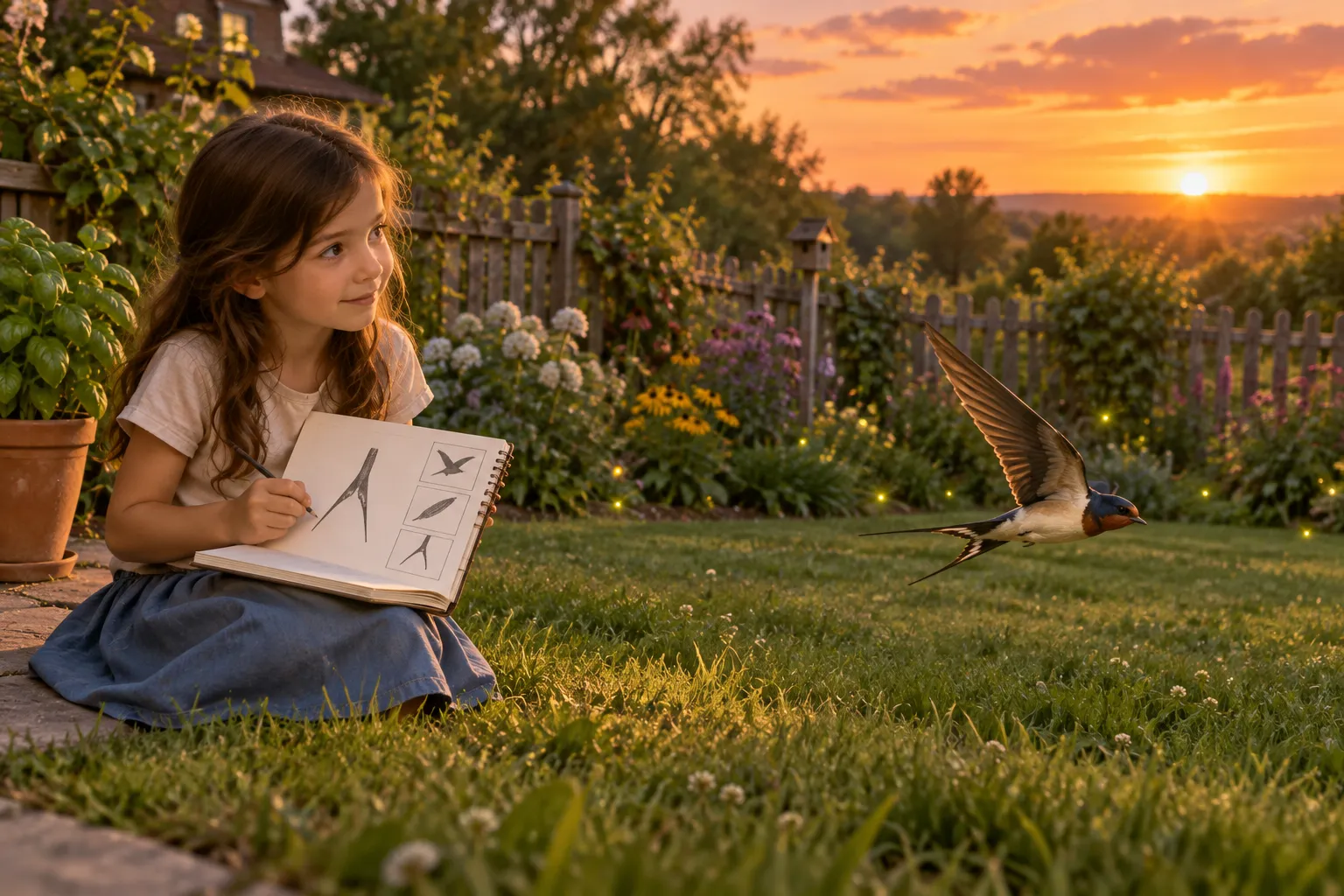
Zoë turned to a clean page. At the top, she wrote, “Arthur’s clues.” Beneath it, she made three boxes. In the first, she drew pointed wings. In the second, she drew a long tail. In the third, she left a blank space.
“What should the last clue be?” she asked.
“Wait and see.”
Arthur returned. This time he flew across the open space above the lawn, and the fading light caught his tail. Zoë saw two narrow points spreading apart like the ends of a tiny pair of scissors.
“His tail!” she whispered. “It’s split.”
“Forked,” Grandpa said. “A barn swallow has a forked tail.”
Zoë sketched it carefully. She drew one line for the left point and one for the right. Then she added a small bird body between them.
Arthur swooped after another insect. He did not land on a branch or pause on the fence. He kept moving, quick and graceful, through the air above the fireflies.
“His last clue is that he catches insects while flying,” Zoë said. “He doesn’t need to land first.”
“Now you have enough to tell the truth about him,” Grandpa said.
Zoë looked at her page. The drawing was not perfect. Arthur’s wings were too large, and his tail looked a little like a ribbon. But the three clues were clear: quick flight, insects in the air, and a forked tail.
She closed the sketchbook. “I know the story now.”
Back in the kitchen, the cloth book waited on the chair. The repaired corner was still a little wrinkled, but the blue moon no longer hung loose. Grandpa placed a clean cloth over the book and pressed it gently with his palm.
“Do you think it’s ready?” Zoë asked.
“Let’s test the cover.”
Zoë opened the book and turned the pages slowly. The cloth held. She turned another page, then another. Nothing tore.
She let out a breath. “It worked.”
“Teamwork,” Grandpa said. “You held the cloth steady, and I made the stitches.”
Zoë nodded. The word felt right. She had not repaired the book alone, and she had not discovered Arthur alone, either. Grandpa had helped her notice what mattered. Still, she had watched, drawn, and asked the questions.
She took a fresh sheet of paper and began writing. At first, she tried to make the story sound grand.
“Arthur, swift ruler of the evening sky—”
She stopped. The baby wouldn’t understand that. Even Zoë wasn’t sure what it meant.
She crossed it out and tried again.
“Arthur was a barn swallow who lived near a backyard full of blinking lights.”
That sounded better.
She wrote about the fireflies, the crickets, and the insects drifting over the grass. She wrote that Arthur flew quickly, turned without warning, and caught his dinner in the air. Then she wrote about his forked tail.
When she finished, she read the story to Grandpa.
“Arthur flew so fast that the fireflies could hardly keep up,” she read. “But when he turned, the evening light showed two points at the end of his tail. Zoë watched carefully and learned his name: barn swallow.”
Grandpa listened with his hands folded on the table.
“I like that you included what you saw,” he said. “You didn’t make Arthur do something a swallow couldn’t do.”
Zoë smiled. “He didn’t need to talk. He was interesting anyway.”
From the living room came a soft, sleepy sound. The baby was waking.
Zoë carried the repaired cloth book and her new page down the hall. Her mother lifted the baby from his bassinet and settled him against her shoulder. His eyes opened, round and curious.
“Can I read to him?” Zoë asked.
“Of course,” her mother said.
Zoë sat close beside them. She opened the cloth book first. The blue moon stayed firmly on the cover. Then she placed her new page on top and began.
“Arthur was a barn swallow who lived near a backyard full of blinking lights. Every evening, he swooped over the grass, chasing tiny insects through the air.”
The baby’s fingers curled around the edge of the blanket.
Zoë kept her voice soft. She told him about Arthur’s pointed wings and quick turns. She told him how the fireflies blinked below and how the barn swallow’s forked tail flashed in the last light.
When she reached the end, the baby had grown still. His eyes drifted closed.
Zoë looked at the page, then at the blue moon on the repaired book. The stitches were small, but they had held. Her story was short, but it had held, too, because it was made from careful looking, careful listening, and help from someone who knew how to mend things.
Outside the window, one firefly blinked near the dark garden. Farther away, a bird crossed the evening sky, too quick to see clearly.
Zoë tucked her page inside the cloth book, rested it on the table, and leaned close as her baby brother breathed softly against his mother’s shoulder. In the quiet room, the blue moon on the cover gleamed beside the last small glow in the yard.
Talk about the story
1.Why did Zoë want to fix the cloth book?
2.What tools did Grandpa use to repair the book?
3.How did Zoë help Grandpa repair the book?
4.What happened when the book slid toward Zoë’s elbow?
5.What clues helped Zoë recognize Arthur as a barn swallow?
6.What did Zoë write about Arthur in her story?
7.How did the baby respond while Zoë read to him?
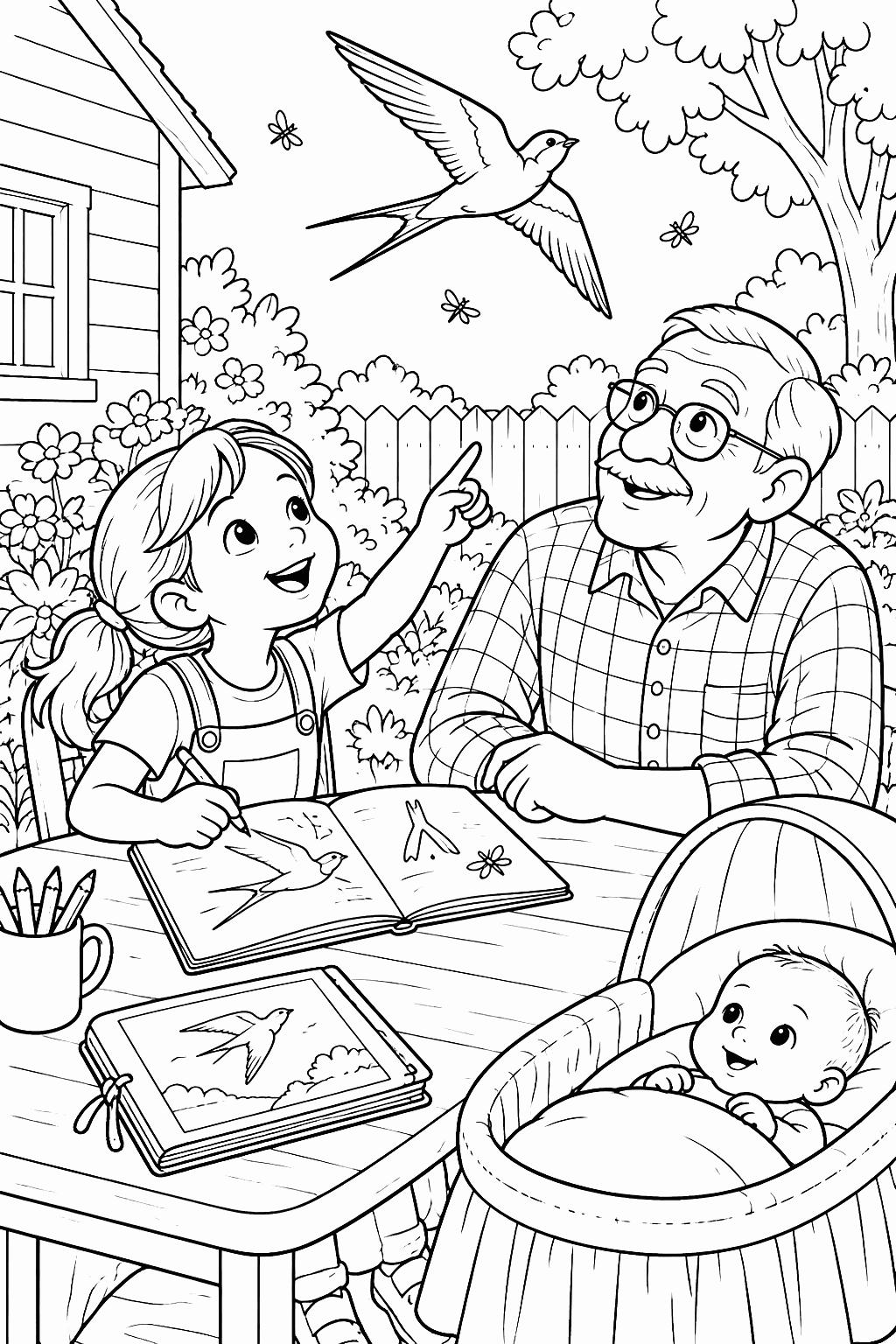
Coloring page
Print the story’s hero and color it in together — with crayons, markers or paints.