
Long ago, in a town where the rooftops nearly touched, Kay and Gerda lived in houses facing each other. Their families were close friends, and the two children spent nearly every day together. Between their windows stood two wooden boxes filled with rich soil. In spring and summer, roses opened there—red roses on Kay’s side and pink roses on Gerda’s.
The children leaned across the little bridge between their windows to water the flowers. They read stories, shared apples, and made up games in which the roses were a garden gate and the sky was a blue kingdom.
Far above the town, a mischievous troll made a crooked magic mirror. It did not show people and places as they truly were. Kind faces looked foolish in it. Beautiful gardens looked dull. A warm smile became a crooked grin, and a bright star looked like a dirty speck.
The troll and his helpers carried the mirror through the sky, laughing at the unhappy pictures it made. But the mirror was so wild and wobbly that it slipped from their hands. It fell toward the earth and shattered into countless pieces.
The pieces were no bigger than grains of sand. Some flew into windows. Some landed on roads and fields. A few drifted into the clouds. Wherever they went, they made good things seem ugly and cold.
One winter afternoon, Kay and Gerda sat beside their window boxes. Snow rested on the rooftops, and the roses were sleeping beneath the frozen soil. Kay was looking at a snowflake through a magnifying glass when a tiny splinter flew into his eye.
He blinked hard. “Ouch!”
Gerda hurried closer. “Is something in your eye?”
“It’s gone now,” Kay said, though he rubbed his eye again and again.
Then another splinter slipped into his heart. No one could see it, but Kay suddenly looked at the rose branches and frowned.
“Why do you care about those silly flowers?” he asked. “They’re crooked and covered with thorns.”
Gerda stared at him. “But they’re our roses.”
“Everything looks foolish today,” Kay said. “Your stories, your flowers, even your smile.”
Gerda felt a pinch in her chest, but she still reached for his hand. Kay pulled away. From that day on, he laughed at kind things and pushed away anyone who tried to help. Winter seemed to settle inside him, even when the fire was warm.
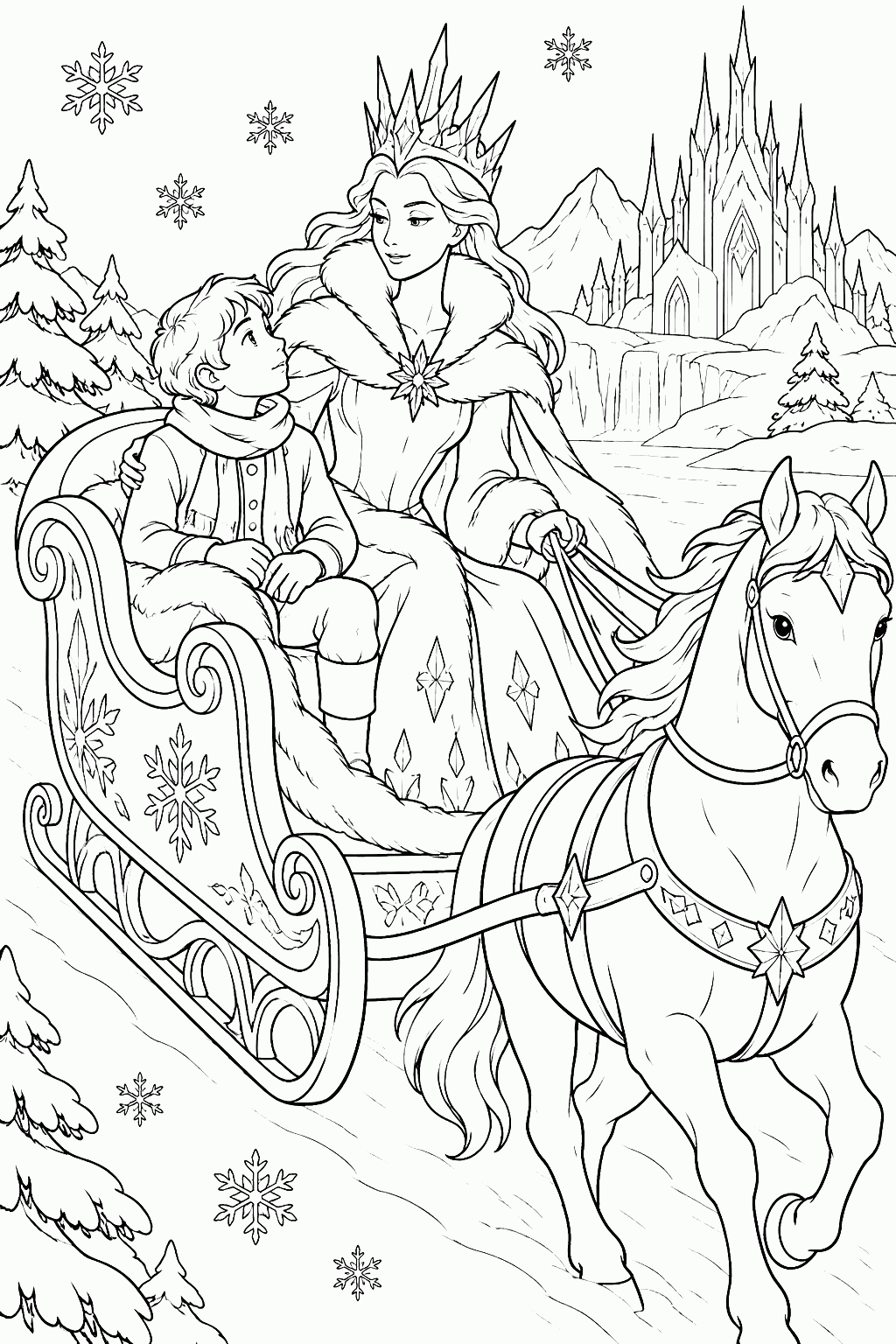
One afternoon, Kay went out to study the snowflakes. He saw that each one had a lovely pattern, like a tiny white flower. As he watched, a large sleigh glided down the street. Its runners shone like silver, and a tall woman wrapped in white fur held the reins.
She was the Snow Queen, ruler of the winter lands, and her eyes were clear and bright as ice.
She stopped beside Kay. “You have a sharp eye,” she said. “Would you like to ride where the snow never melts?”
Kay climbed into the sleigh. The Snow Queen covered him with a warm white cloak, and the horses carried them northward, over fields and forests, past frozen rivers and sleeping villages.
Gerda saw the sleigh disappear beyond the town wall. She waited all evening, but Kay did not return. She waited the next day, and the next. At last, she told her mother that she wanted to search for him. Her mother listened carefully, gave her permission, and went with her to the river.
“Have you seen Kay?” Gerda asked the water.
The river moved quietly beneath its thin skin of ice. Gerda’s mother found a sturdy boat and helped Gerda step inside. Then she climbed in too, took the oars, and carefully rowed along the open water near the bank. They passed snowy trees and quiet meadows until the boat came to rest beside a garden wall. There, an old woman with a wide straw hat reached down and helped them ashore.
Gerda’s mother spoke with the old woman and saw that the garden was warm and welcoming. When the old woman promised to look after Gerda, her mother kissed Gerda goodbye and returned home, trusting that Gerda would be cared for while she searched for Kay. Gerda thanked her mother and turned toward the garden.
The old woman listened while Gerda told her about Kay. She felt sorry for the girl, but she also wished to keep Gerda with her. So she touched the tops of the flowers with her golden comb, and every rose in the garden sank beneath the earth.
“If Gerda sees roses,” the old woman thought, “she will remember Kay and wish to leave.”
The garden became the most beautiful garden Gerda had ever seen. Red tulips opened beside blue bells. Lilies nodded in the breeze. Vines curled around silver gates. Yet no roses grew anywhere.
Gerda stayed for many days. She enjoyed the garden, but something inside her felt unfinished. One morning, she noticed a picture of a rose painted on the old woman’s straw hat.
“Where did that come from?” Gerda asked.
The old woman looked away. Gerda knelt and pressed her fingers into the soil. She remembered that real roses had thorns and that thorns made tiny scratches. She remembered the scent of warm summer air. Most of all, she remembered Kay.
“Roses!” Gerda cried. “Why have I forgotten them?”
She hurried through the garden, looking under leaves and beside the walls. At last she found a rosebush tucked beneath a bench. Its blossoms had been hidden by broad leaves. When Gerda saw them, she began to cry.
Her tears fell onto the ground, and the buried roses rose up all around the garden. Their petals opened in a bright red circle.
“Have you seen Kay?” Gerda asked them.
The roses swayed in the breeze. They had not seen him, but they reminded her of her promise. Gerda thanked the old woman and hurried out through the garden gate.
She walked until the path led her to a forest. There she met a black crow perched on a branch. The crow tilted his head and listened carefully as Gerda told her story.
“I may know something,” said the crow. “A prince in a nearby castle has a face much like the boy you describe. He is clever and quiet, and he often looks through the windows at the snow.”
“Then take me to him,” Gerda said.
The crow flew ahead, and Gerda followed the forest path in daylight with the castle’s kind adult gatekeeper walking beside her. Before sunset, the gatekeeper led them through a side door of the castle. Inside, the halls were still and bright with candlelight. The crow led her to a room where a prince was reading beside a fire.
Gerda looked at him. He was not Kay.
The prince looked up kindly. “I’m sorry,” he said. “But I’m glad you came. You must have been very brave to travel so far.”
A princess entered the room wearing a blue robe. She listened to Gerda’s story and understood that the prince had never met Kay.
“We will help you continue your journey,” the princess said.
They gave Gerda warm clothes, a small loaf of bread, and a pair of sturdy boots. The crow received a bowl of crumbs and a place to rest by the fire. Before Gerda left, the prince and princess gave her a golden carriage with soft cushions and strong horses.
Gerda thanked them and set off again. The carriage rolled beyond the castle gates, but the road soon passed through a dark pine forest. A group of friendly forest folk stopped the horses. Among them was a little robber girl with bright eyes and a red cap.
She climbed onto the carriage step and looked at Gerda.
“Where are you going?” she asked.
“I’m looking for my friend Kay,” Gerda replied. “The Snow Queen took him to the far north.”
The little robber girl studied Gerda’s tired face. Then she lowered her hand.
“Don’t be afraid,” she said. “I can be stubborn, but I’m not unkind. You may keep your carriage, and you may keep going.”
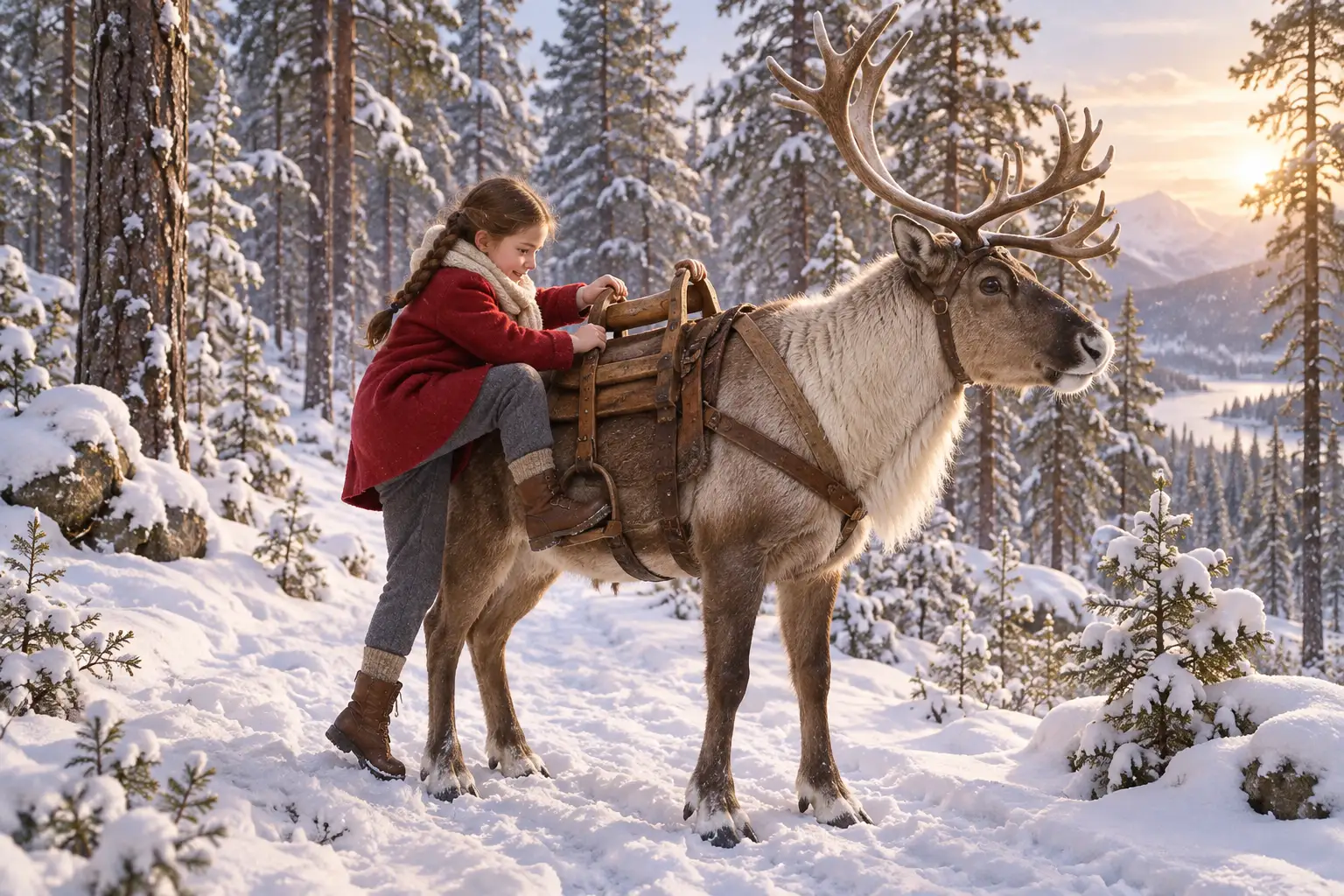
She called for her reindeer, a gentle animal with wide antlers and quick, steady feet. He had traveled north before and knew the way to the cold lands.
“Take Gerda as far as you can,” said the little robber girl. “And come back when you’ve helped her.”
The reindeer bent his head. Gerda climbed onto his back, and he carried her between the tall pines. The little robber girl waved until the trees hid her from view.
After a long journey, the reindeer brought Gerda to the home of a wise woman of the north. The woman lived in a small house warmed by a stove. She listened to Gerda and gave the reindeer hay while she thought.
“I cannot give you great strength,” the woman said. “But I can tell you what lies ahead. The Snow Queen’s palace is not far now. Kay is there, sitting before a frozen lake. He is trying to arrange pieces of ice into a shape that will spell a word he does not understand.”
“Can you give me a magic coat or a powerful charm?” Gerda asked.
The wise woman shook her head. “You already carry what will help you. I can only send you on your way.”
The reindeer carried Gerda farther north, where the air glittered with tiny crystals. At last they reached the home of a second wise woman, who lived in a land where the northern lights moved like green ribbons across the sky.
Gerda told her everything. The wise woman looked at the girl for a long moment.
“Kay does not need a stronger spell,” she said. “He needs to remember what his heart already knows. Go to him with the warmth you have kept through every cold place.”
Gerda took the wise woman’s hand. “I’m afraid I won’t be enough.”
“Then go afraid,” the woman said gently. “Courage does not always feel like a bright flame. Sometimes it is only one small step taken in the right direction.”
The reindeer carried Gerda onward. Snow blew across the path, and the sky turned pale. Soon the walls of the Snow Queen’s palace appeared. They rose like clear mountains, shining blue and white beneath the northern lights.
The reindeer stopped at the gate.
“Go on,” he said. “I cannot carry you inside.”
Gerda slid from his back and hugged his neck. “Thank you.”
She walked through the tall doors. The rooms were enormous, with floors as smooth as frozen ponds. In the middle of the largest hall sat Kay. He was pale with cold, and he pushed pieces of ice across the floor.
“Kay!” Gerda called.
He looked up. “Who are you?”
Gerda ran to him and wrapped both arms around him. For a moment he sat stiffly, as if he had forgotten how to be held. Then Gerda began to cry—not from fear, but from love, relief, and all the days she had spent searching.
Her warm tears fell onto Kay’s cheeks. They warmed his eyes and loosened the splinter that had lodged there. He blinked. The ice in his heart began to melt.
“Gerda?” he whispered.
“Yes,” she said. “I came to find you.”
Kay pressed his hands over his face. “I was so cold inside. I couldn’t remember the roses.”
Gerda held him more tightly. “You remember them now.”
A tear slid down Kay’s cheek. When it reached his heart, the last splinter melted away. The pieces of ice on the floor no longer looked like a cold puzzle. Kay saw that they formed a single word: eternity. But he did not want to stay forever in an empty palace. He wanted to go home.
The Snow Queen was away among the clouds, and the palace doors stood open. Gerda and Kay walked out together. The reindeer waited nearby, and he carried them southward through the bright snow.
Along the way, they met the second wise woman and thanked her. They passed the first wise woman’s little house and waved. In the forest, the little robber girl ran to greet them, and the reindeer lowered his head so she could pat his neck. The crow flew overhead, calling cheerful news toward the castle.
At last, Gerda and Kay reached their own town. The snow had melted. Green leaves shone in the sunshine, and roses bloomed in the window boxes exactly as they had before.
The children leaned across the little bridge between their windows. Kay touched one of the roses carefully.
“It’s beautiful,” he said.
Gerda smiled. “It always was.”
That evening, they sat together beneath the open window. The roses nodded in the warm summer air, and somewhere high above the rooftops, a crow called once and then settled quietly for the night. Kay and Gerda listened until the town grew still, with the soft scent of roses between them.
Talk about the story
1.Where did Kay and Gerda live?
2.What happened to the troll’s magic mirror?
3.What did the splinter in Kay’s heart make him think about the roses?
4.Who took Kay away in a sleigh?
5.How did Gerda travel through the forest after leaving the little robber girl?
6.What was Kay trying to arrange in the Snow Queen’s palace?
7.What helped melt the last splinter in Kay’s heart?
Coloring page
Print the story’s hero and color it in together — with crayons, markers or paints.