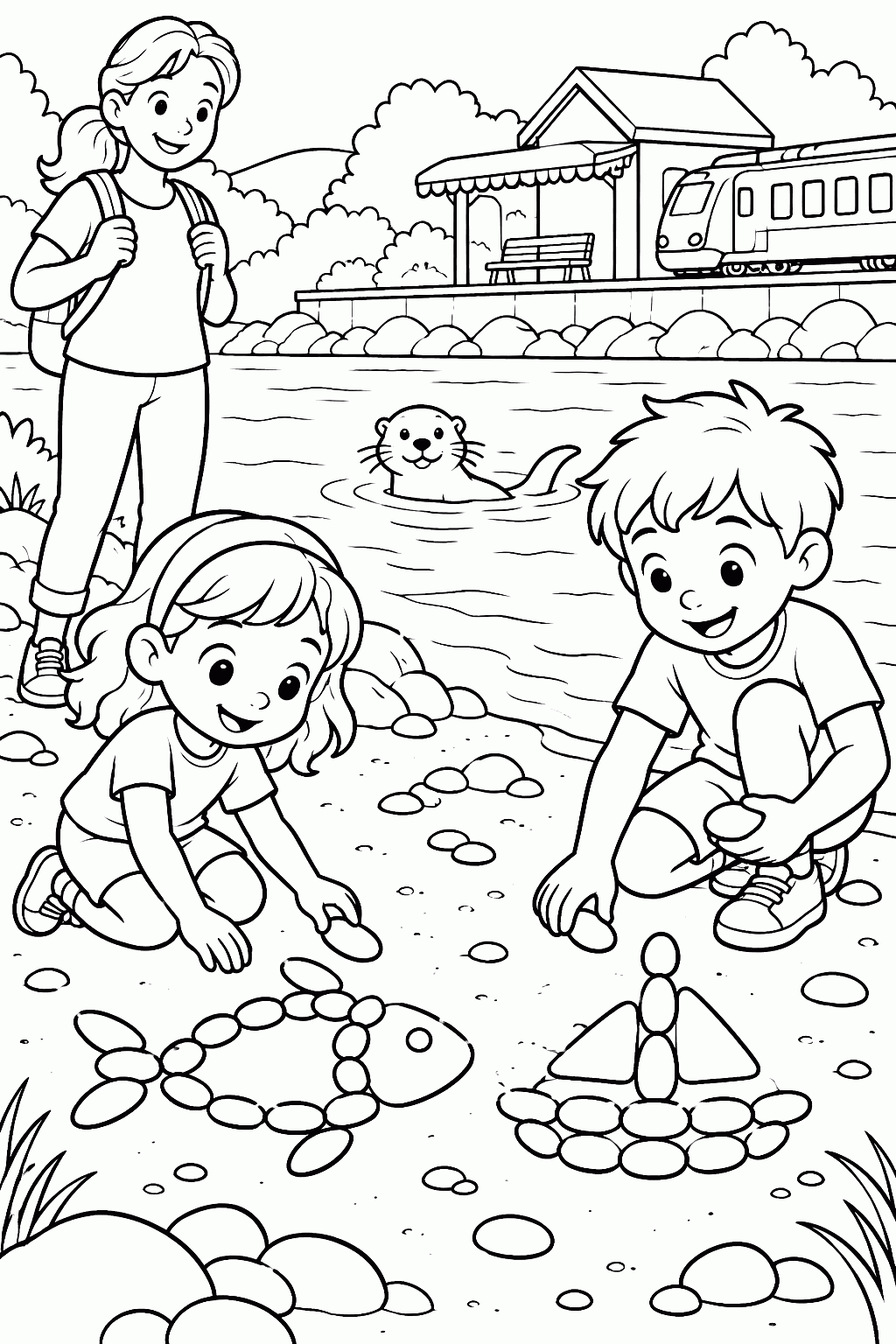
The little train station stood beside the river, with a red roof, a wooden bench, and a clock that ticked softly above the door. Across the water, tall grasses nodded in the breeze. Every now and then, a train rumbled past and made the window glass buzz.
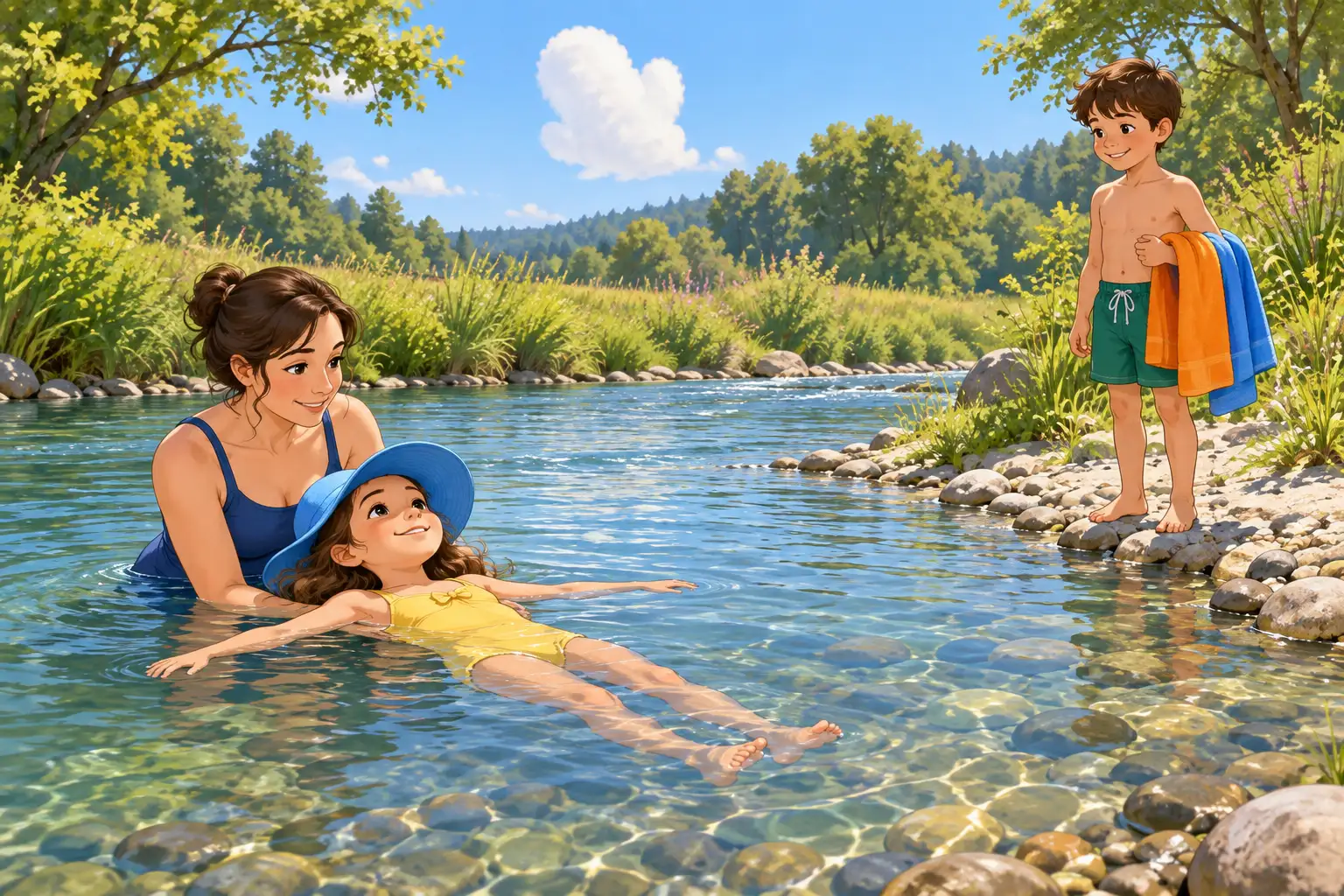
Cora held her parent’s hand as they walked down to the riverbank. Her older brother, Hugo, carried two bright towels and a small basket.
“Today is our floating lesson,” Hugo said. “I’m going to float like a log.”
“I’m going to float like a leaf,” Cora said.
Near the shallow water, their instructor, Ms. Lena, waited with a smile. She showed them how to step carefully onto the smooth stones and listen to the river’s quiet swish.
“First, we practice slow breaths,” she said. “Breathe in gently, and breathe out slowly.”
Cora lifted her shoulders as she breathed in. Then she let them drop as she breathed out.
“In,” said Hugo.
“Out,” said Cora.
They tried again. In came the cool river air. Out went the little puffs of worry fluttering in Cora’s chest.
Soon, Cora lay back in the shallow water with Ms. Lena’s hand supporting her shoulders. The river curled around her arms. She looked up at a white cloud shaped like a mitten.
“Your ears are under,” Ms. Lena said. “The water is holding you.”
Cora took a slow breath. For one quiet moment, she floated like a leaf.
When the lesson ended, she and Hugo climbed onto the sandy shore. A river otter popped up nearby. Its whiskers glistened, and its dark head turned from side to side. Then it rolled onto its back and paddled in a lazy circle.
“Tumble!” Cora called.
Tumble often played in this part of the river. He didn’t come onto the shore, but he swam close enough for the children to see his shiny nose and bright, curious eyes.
Hugo opened the basket. Inside were smooth pebbles in gray, cream, brown, and blue.
“Let’s make something for Tumble to see,” he said.
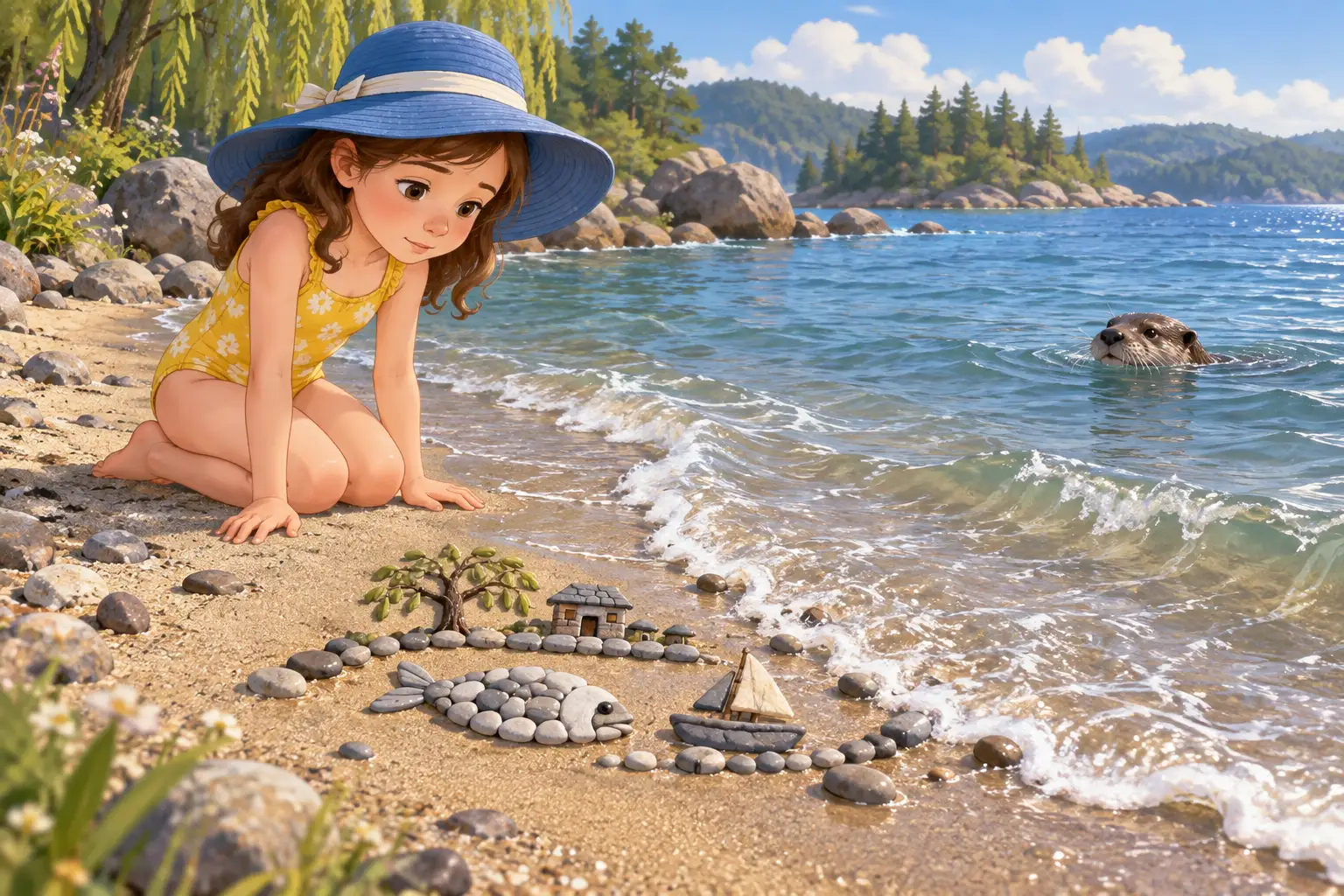
Cora chose a long gray pebble for a fish’s body. Hugo found two tiny white stones for eyes. Together, they arranged pebbles on the sand. A curved line became the fish’s tail, and smaller stones made its fins. Beside the fish, they built a boat with a pointed front and a wide pebble for a sail.
Cora used a twig to draw waves around the boat. Hugo drew a sun above it. Tumble swam closer and slapped the water with his tail.
“He likes it!” Cora said.
The otter dove. A moment later, he popped up beside a floating leaf.
Then the river made a soft, surprising shushing sound.
A small wave slid onto the shore. It washed over the sand, smudging the waves, the sun, and the bottom of the pebble boat. A few pebbles tipped sideways.
“Our picture is disappearing,” Cora said.
Hugo looked at the damp sand. “We can make it again.”
Cora glanced up the bank. A flat patch of firm sand rested beneath a willow tree, safely above the little waves.
“What if we move the pebbles there?” she asked. “The river can keep flowing, and our fish can stay dry.”
“That sounds like a good plan,” Hugo said.
They carried the pebbles together. Cora held the little white eyes in both hands. Hugo carried the larger stones in the basket. They worked slowly, stopping whenever the pebbles grew too heavy.
At the higher place, they built the fish again. This time, Cora made its tail point toward the river. Hugo shaped the boat beside it. Then he used a twig to draw a simple picture label under each one: a fish beneath the fish and a boat beneath the boat.
Cora added a round sun and three wavy lines.
“What should we call our display?” Hugo asked.
“The River Friends,” said Cora.
Tumble swam in a wide loop below the willow tree. He lifted his nose from the water as if he were looking at their new picture.
Their parent took out a small camera that printed pictures. Cora stood beside the pebble fish, and Hugo stood beside the pebble boat.
Click! The first picture showed the river, the willow, and Tumble’s little head in the water. Click! The second showed the children smiling beside their work.
A cheerful whistle sounded from the station.
“Our train will be here soon,” their parent said.
Cora looked at the display. She liked the fish and the boat exactly where they were, but she remembered that the pebbles belonged beside the river.
“We should put them back,” she said.
Hugo nodded. Together, they carried every pebble down to the shore. They placed the gray stones near the water, the cream stones beside the reeds, and the blue stones where the river had polished them smooth. Then Cora brushed away the sand drawings with one gentle sweep of her hand.
The train arrived with a soft rumble. Cora climbed aboard beside Hugo, holding the pictures. Through the window, she watched Tumble make one last shining turn in the river.
As the train rolled away, Cora tucked the pictures safely into her bag. The river flashed between the trees, and the little station grew small behind them. In the fading light, Tumble slipped beneath the willow branches while the pebbles rested quietly on the shore, ready for the river to smooth them again.
Talk about the story
1.Who taught Cora and Hugo how to float?
2.What did Cora use to draw waves around the boat?
3.Why did Cora and Hugo move the pebbles beneath the willow tree?
4.What did Cora call their display?
5.What did Cora watch through the train window?
Coloring page
Print the story’s hero and color it in together — with crayons, markers or paints.