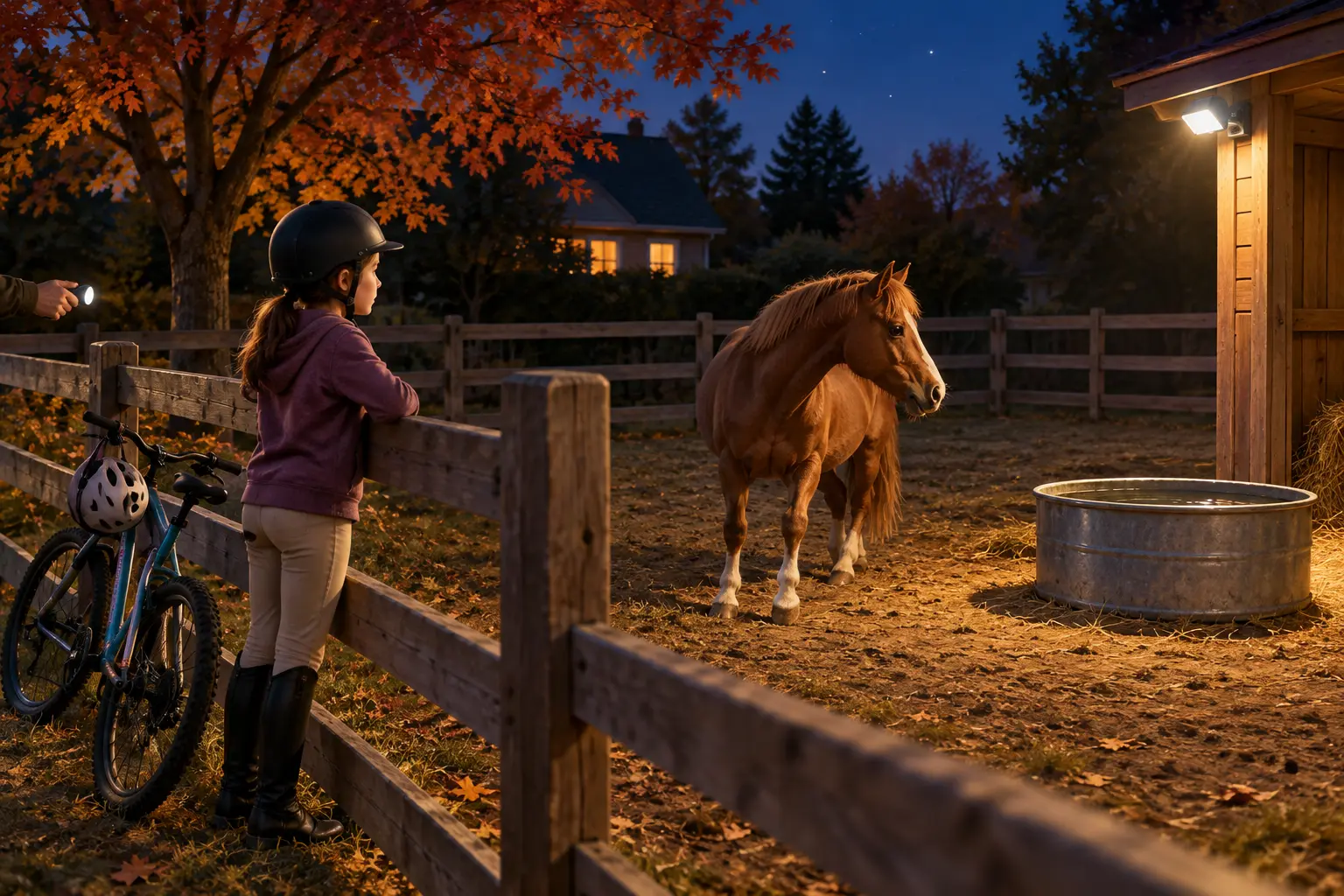
After sunset, Mae fastened her helmet and wheeled her bicycle down the porch steps. The evening sky was deep blue, and the first stars had appeared above the maple trees. In the backyard paddock, Chestnut the pony stood beside the fence, his brown coat catching the last soft glow of daylight.
Mae had promised to check his water before bedtime. She climbed onto her bicycle and pedaled slowly along the smooth path beside the garden. Her dad walked a few steps behind her, carrying a small flashlight pointed at the ground.
“I’m right here,” he said. “And I brought the treats you forgot on the kitchen counter.”
Mae grinned. “Chestnut will forgive me, then.”
The family’s backyard paddock sat beyond the garden. It had a wooden fence, a wide shelter, and a water trough where Chestnut could drink. A motion light was mounted on the corner of the shed. It usually helped everyone see the path after dark, but that evening Mae noticed something strange.
As she coasted to a stop, the light flashed on.
Chestnut lifted his head. He took one step toward the trough, then stopped. His ears turned toward the shed. When the light clicked off again, he lowered his head and began nibbling hay.
Mae leaned her bicycle against the fence. “That’s odd.”
Her dad set the treats on a fence post. “What did you notice?”
“He wanted a drink. Then the light came on, and he changed his mind.”
They waited. The yard grew quiet except for crickets singing in the grass. Chestnut walked toward the trough again.
The motion light flashed.
Chestnut stepped back.
Mae’s eyebrows rose. “It happened again.”
She looked closely at the trough. It was clean and full. Nothing floated in it, and no leaves covered the surface. Chestnut wasn’t avoiding the water itself. He was avoiding the sudden burst of light.
A soft fluttering sound drifted around the shed. Mae looked up and saw moths swirling near the lamp. One looped past her helmet. Another brushed the side of the shed and circled back.
“Maybe the light is bothering more than Chestnut,” Mae said.
Her dad smiled. “That sounds like a question worth investigating.”
Mae pulled a small notebook from the basket on her bicycle. She always carried it when she was curious about something. On the first page, she wrote, “Why won’t Chestnut drink when the light turns on?” Then she drew a star beside the question.
“Let’s watch without getting too close,” her dad said. “Animals sometimes act differently when people are standing right beside them.”
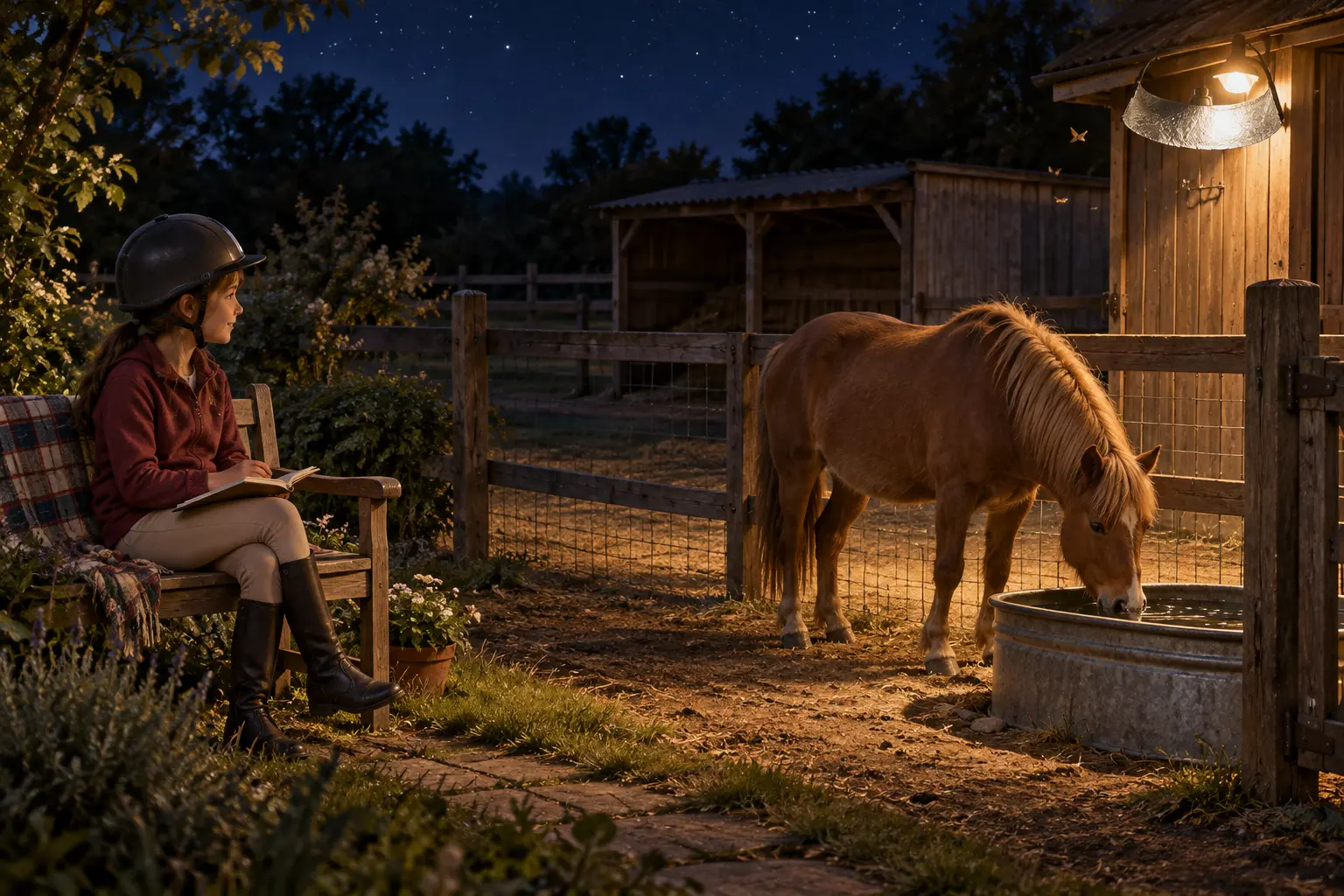
They moved to a bench near the garden. Mae sat with her notebook on her knees, and her dad sat beside her. From there, they could see the paddock, the trough, the shed, and the bright circle of light on the ground.
Chestnut waited for a while. Then he ambled toward the water. The motion light flashed, and he stopped again.
Mae counted the moths as they spiraled around the lamp. “One, two, three…”
A fourth moth joined them. Then a fifth.
“Six,” Mae whispered. “No, seven. That one came from behind the shed.”
The moths kept circling the brightest part of the light. Their pale wings flickered like tiny scraps of paper in the air. A few smaller insects hovered near the garden, where the moonlight was dimmer.
Chestnut turned away from the trough and walked toward his shelter.
Mae felt a pinch of worry. “He still needs water.”
“He can drink in the morning,” her dad said, “but it would be better if we could make the light do its job without shining straight into the paddock.”
Mae looked at the shed. “Could we turn it?”
“We could try a shield,” her dad said. “Something that blocks the light on one side and reflects some of it toward the path.”
They went to the garage, leaving the paddock gate closed. Mae found a piece of sturdy cardboard, a roll of foil tape, two clothespins, and a short wooden ruler. With her dad’s help, she made a curved shield that could hang beneath the lamp. It wasn’t fancy. It looked a little like a silver hat for a very small robot.
Mae held it up. “If this works, the path should stay bright, but the paddock should be less dazzling.”
“Let’s test it before we attach anything,” Dad said.
He carried the shield to the shed while Mae held the flashlight and watched where its beam fell. They clipped the cardboard beneath the motion light and angled it toward the path. Then they walked away until the lamp turned off.
Mae waited for the light to go dark. “Ready?”
Her dad took three steps toward the shed.
The lamp flashed on.
The path brightened, but the paddock stayed mostly in shadow. A gentle edge of light rested along the fence instead of spreading across the grass. Chestnut lifted his head, but he did not step backward.
Mae opened her notebook. “That’s better.”
“It’s a good first try,” Dad said. “Now let’s see what happens when Chestnut chooses what to do.”
They returned to the garden bench. Mae tried not to stare at the trough. She watched the stars instead. A thin cloud passed over the moon, and the crickets continued their steady song.
Chestnut took one step toward the water.
The light flashed on.
He paused, but this time he did not turn away. He took another step, then another. The moths fluttered around the lamp, but the beam no longer poured into the paddock.
Chestnut lowered his muzzle to the water and drank.
Mae let out a quiet cheer. “He did it!”
Her dad raised one finger to his lips, and they both laughed softly. Chestnut drank for a long time. When he lifted his head, a drop of water trembled on his chin. He shook it away and walked back toward the hay.
The moths began spreading out, too. Some drifted along the darker edge of the garden, where small white flowers opened in the moonlight. Others settled on the shed wall. The bright lamp no longer held the whole night in one sharp circle.
Mae added notes to her notebook: “Chestnut drank. Path is bright. Paddock is softer. Moths moved toward the garden.”
Her dad peered over her shoulder. “That’s careful observing.”
“I had to watch more than once,” Mae said. “The first time, I only knew he didn’t like the light. The second time, I noticed the moths. Then we tried something.”
“Good thinking often takes all three.”
Mae looked toward Chestnut. “Do you think he’ll be okay with the shield tomorrow?”
“We’ll check it in the morning and make sure it’s still secure. If we need to adjust it, we can.”
Mae nodded. She liked that the job wasn’t finished just because the first attempt worked. The shield had helped, but caring meant paying attention again later.
Before going inside, Mae rode one slow loop around the garden. Her helmet strap rested snugly beneath her chin, and her bicycle bell gave a tiny ring when she passed the porch. Dottie, the family beagle, pressed her nose against the screen door and barked once.
“You missed the investigation,” Mae told her.
Dottie wagged her tail so hard that her whole back end wiggled.
Inside, Mae washed her hands and carried her notebook to the kitchen table. Her class was putting together a presentation about ways people could care for animals at night. Mae had planned to record a gentle read-aloud about quiet observation, but now she had a real example to share.
She placed a tablet on a stack of books and opened the recording app. Dottie sat beside the table, watching with hopeful eyes. Mae set a small bowl of water on the floor for her, then pressed the record button.
“Good evening,” Mae began. “Tonight I’m going to read about noticing what animals need after dark. Sometimes a bright light helps people see, but it can also bother animals and attract insects. Watching patiently can help us find a kinder way to use it.”
Dottie sneezed.
Mae stopped the recording. “That was a very important comment.”
Dottie blinked.
Mae tried again. This time, Dottie yawned so widely that her ears tipped sideways. Mae had to stop once more because she was laughing.
She opened the family photo folder and chose three pictures of Dottie. In the first, Dottie had her head gently stuck inside an empty laundry basket. In the second, she was asleep with one paw on a squeaky toy. In the third, she was looking at the camera with a leaf balanced on her nose.
Mae arranged the pictures at the end of her class presentation. Beneath the last one, she added a caption: “Dottie reminds us that nighttime animals can be curious, sleepy, and sometimes very funny.”
Then she recorded the read-aloud again.
“Chestnut the pony needed a drink,” Mae said. “When the motion light flashed, he stepped away from the trough. My dad and I watched from a distance and counted the moths around the lamp. We tested a shield that sent the light toward the path instead of the paddock. After that, Chestnut came back and drank calmly, while the moths moved toward the darker garden.”
She paused and listened to the recording. Her voice sounded clear and gentle. Behind her, Dottie gave a quiet snort.
Mae added, “Sometimes helping begins with noticing one small change.”
She ended the recording, saved it, and showed the pictures to her dad.
“The laundry basket picture is definitely going in,” he said.
“It’s part of the animal-care research,” Mae replied solemnly.
Dottie thumped her tail against the floor.
Later, Mae brushed her teeth and looked out her bedroom window. The motion light still shone toward the path, leaving the paddock calm and dim. Chestnut stood beneath the shelter, his shape peaceful against the silver-blue night. Near the garden, a few moths fluttered among the flowers.
Mae placed her notebook beside her bed. On the page beneath her notes, she drew the shield, the lamp, three moths, and a small star above Chestnut’s back.
From downstairs came the soft click of Dottie’s paws on the floor. Outside, the crickets kept singing, and the garden held its quiet glow.
Mae pulled the blanket to her chin. The last thing she heard before sleep was her dad checking the back door and saying, “Everything looks good.”
Beyond the window, the path was bright enough for people, the garden was gentle enough for moths, and Chestnut rested comfortably beneath the stars.
Talk about the story
1.Why did Chestnut step away from the water trough?
2.What did Mae notice flying around the lamp?
3.Where did Mae and her dad watch Chestnut from?
4.What did Mae write in her notebook first?
5.What did Mae and her dad use to shield the light?
6.What happened after they attached the shield?
7.What did Mae add to her class presentation about Dottie?
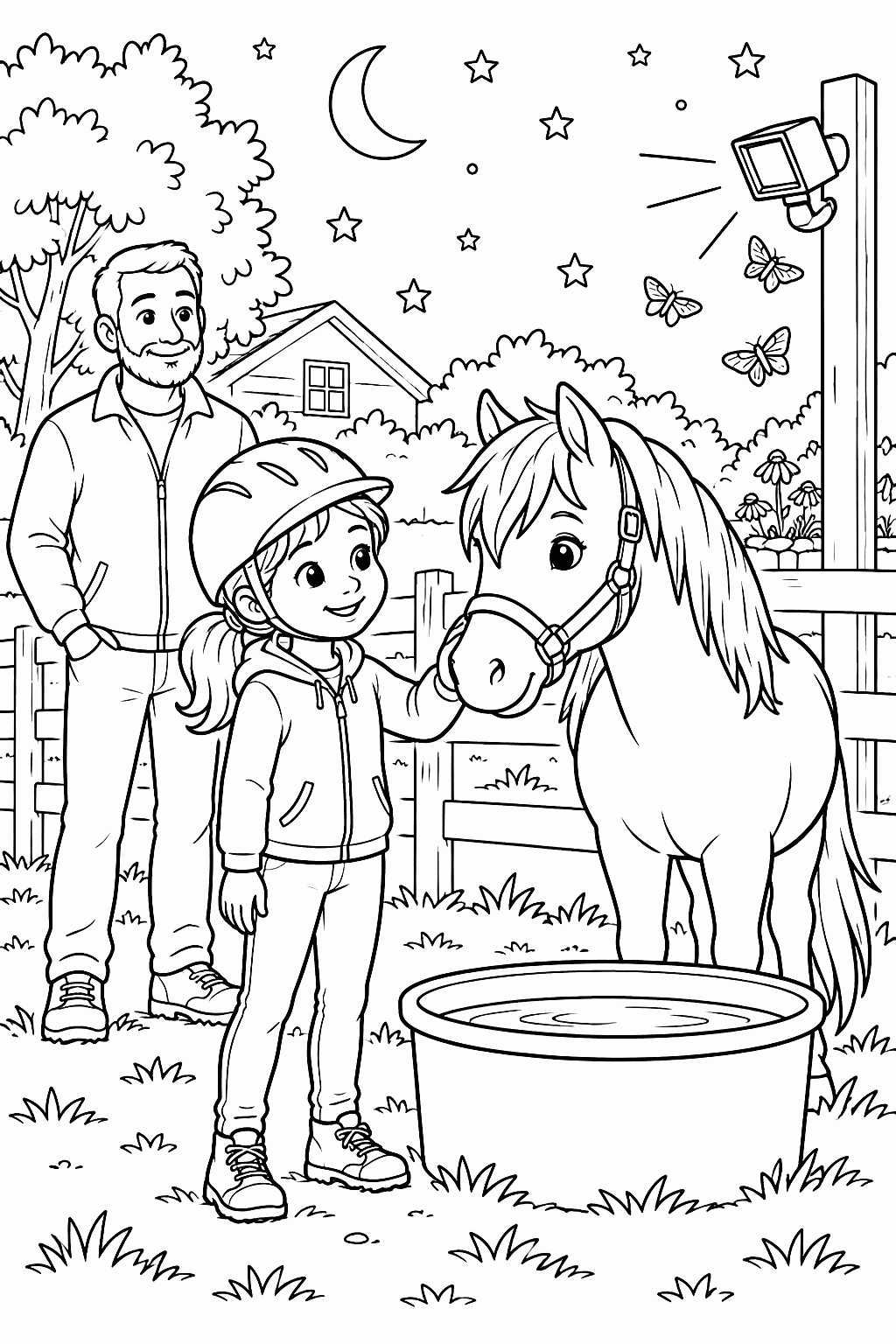
Coloring page
Print the story’s hero and color it in together — with crayons, markers or paints.