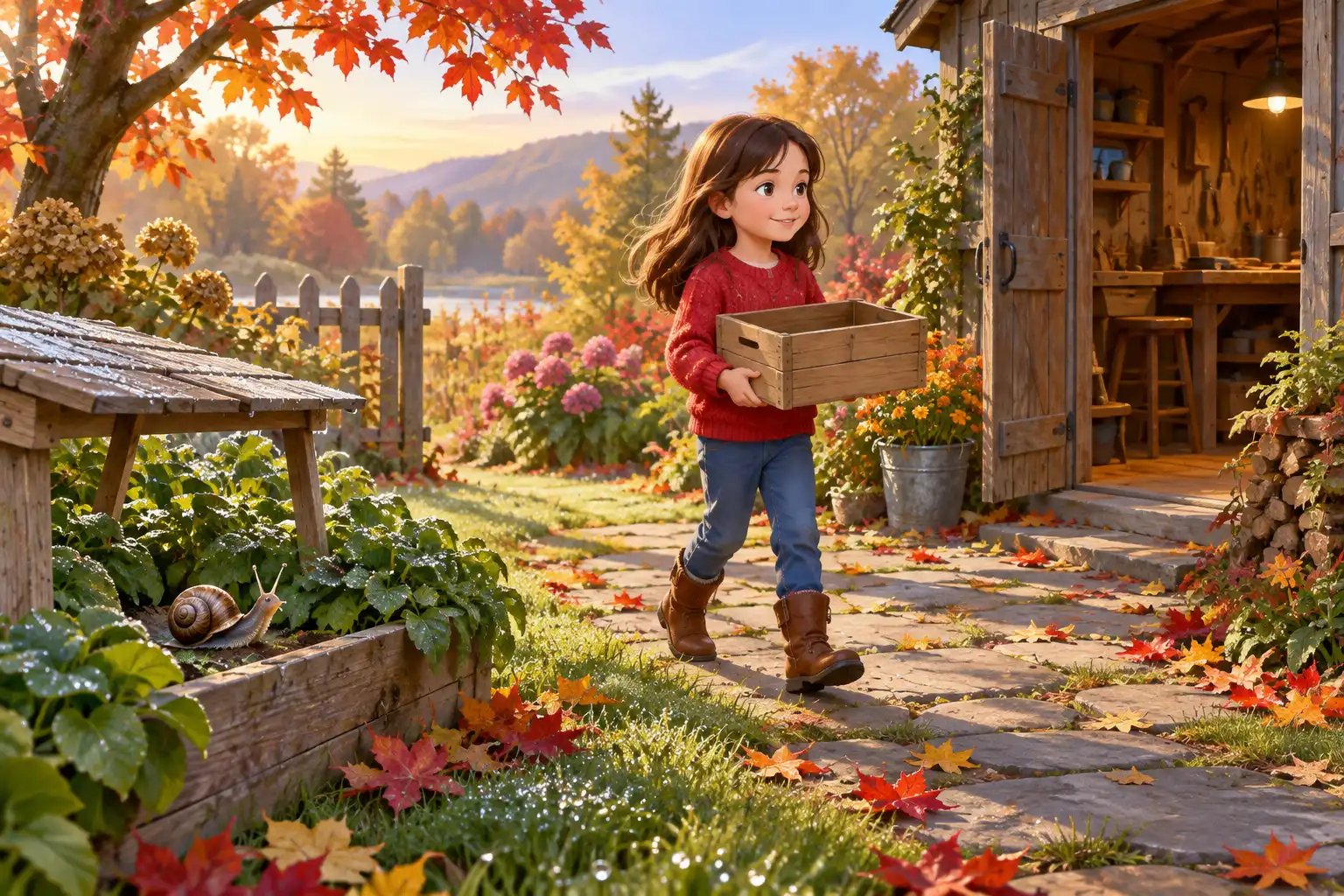
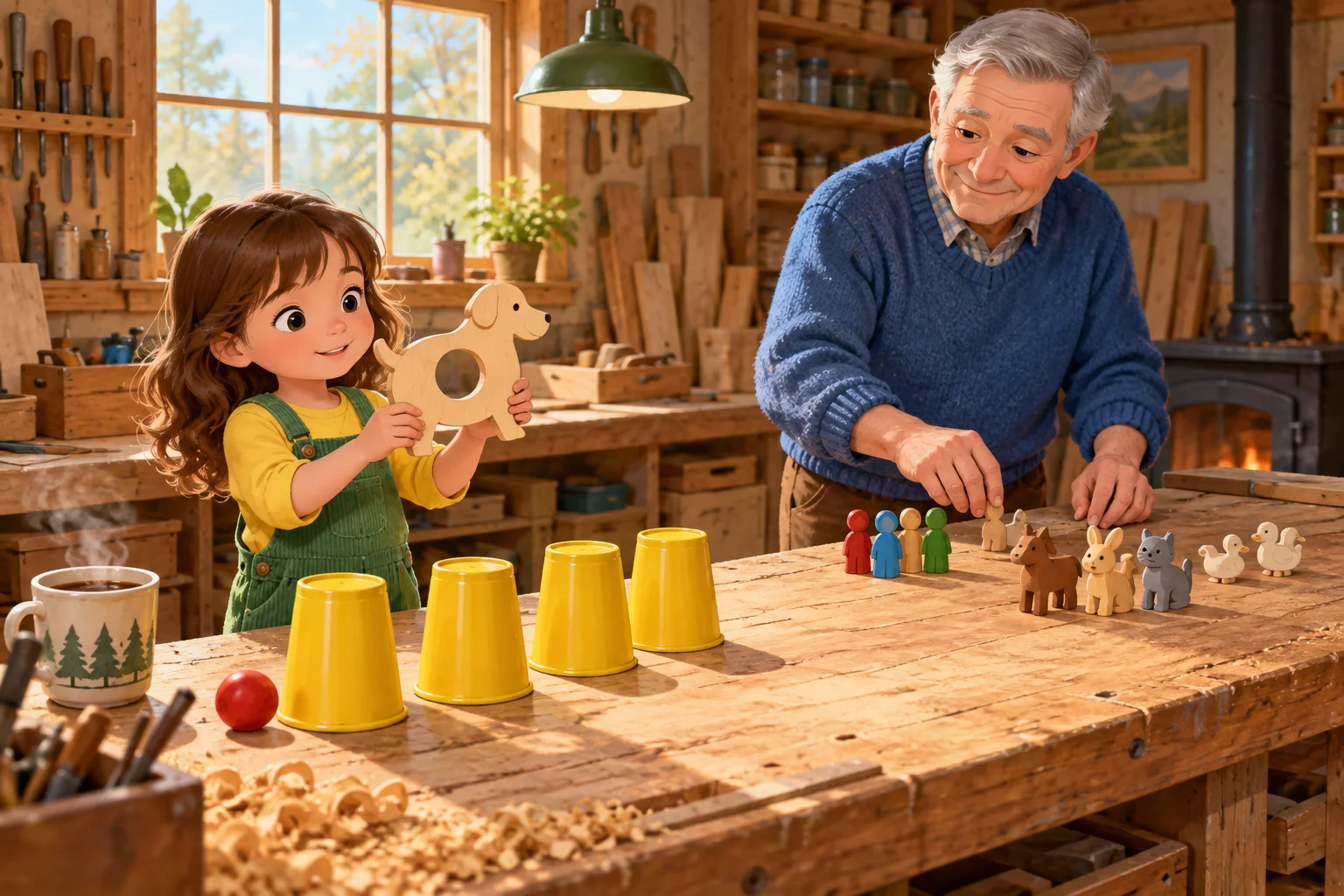
June pushed open the workshop door and breathed in the scents of sawdust, pine, and warm cinnamon tea. Her grandparent stood at the workbench, sorting smooth wooden pieces into small piles.
“Today we’re making something for the wildlife center,” her grandparent said. “The young visitors need a game they can play together.”
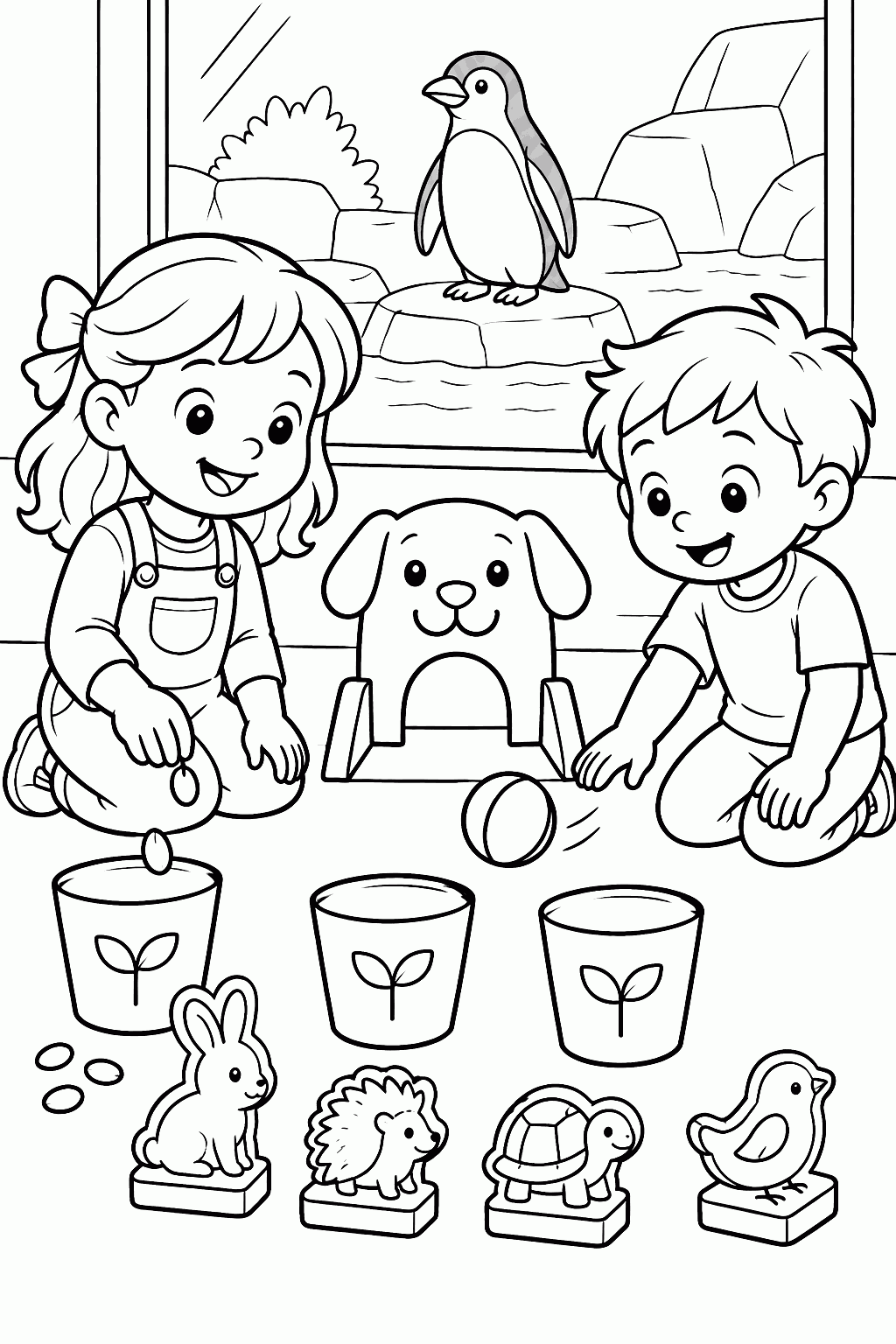
June climbed onto a sturdy stool and peered across the workbench. There were bright wooden people and animals, a row of large yellow cups, a small red ball, and a flat wooden dog with a round hole in its middle.
“The dog is the target,” June said, lifting it carefully. “The ball can roll toward the dog. Maybe it will go right through!”
“Let’s find out,” said her grandparent.
Together, they painted green leaves on the cups. June added blue dots to a wooden bird and a purple scarf to a wooden girl. Her grandparent sanded the edges of the story characters until they felt soft and smooth. Then they placed a cup in each corner of a wooden board.
“What are the cups for?” June asked.
“They can hold soil and seeds,” her grandparent explained. “The garden can grow while children play.”
June smiled. “That sounds like one of the best toys for four-year-olds.”
When the game was ready, June and her grandparent carried it to the wildlife center. The center was full of quiet sounds: water trickling in a tank, leaves rustling in an indoor garden, and visitors whispering as they watched the animals.
Before setting up the game, June stopped at the viewing window. On the other side of the glass, Wren the penguin waddled across the smooth floor. She dipped her beak into a shallow pool, then shook tiny drops of water from her feathers.
“Hi, Wren,” June whispered. “We brought something new for the children.”
Wren tilted her head and gave a soft, curious call.
Near the game table, a new boy stood with his grandmother. His name was Milo, and he was four years old, just like June. He studied the cups, the wooden characters, and the red ball. Then he looked at the dog-shaped target.
June carried the board over to him. “Would you like to play?” she asked.
Milo nodded.
June showed him the first set of rules. “First, you choose a character. Then you put it beside the garden. After that, you roll the ball three times. The ball has to touch the dog.”
Milo chose the wooden bird. But when June began counting the rolls, he picked up a cup instead and set it on top of the board. Then he rolled the ball too hard.
The ball bumped the dog, bounced off a table leg, and rolled under a bench.
Milo’s smile faded. He looked at the game as if it had suddenly become too difficult.
June crawled down and found the ball. As she handed it back, she thought about the workshop. The cups were waiting for soil and seeds. The wooden characters could become anyone in a story.
“Let’s try a different way,” June said. “We don’t have to follow my first rules.”
Milo looked up. “We don’t?”
“No. We can make our own.”
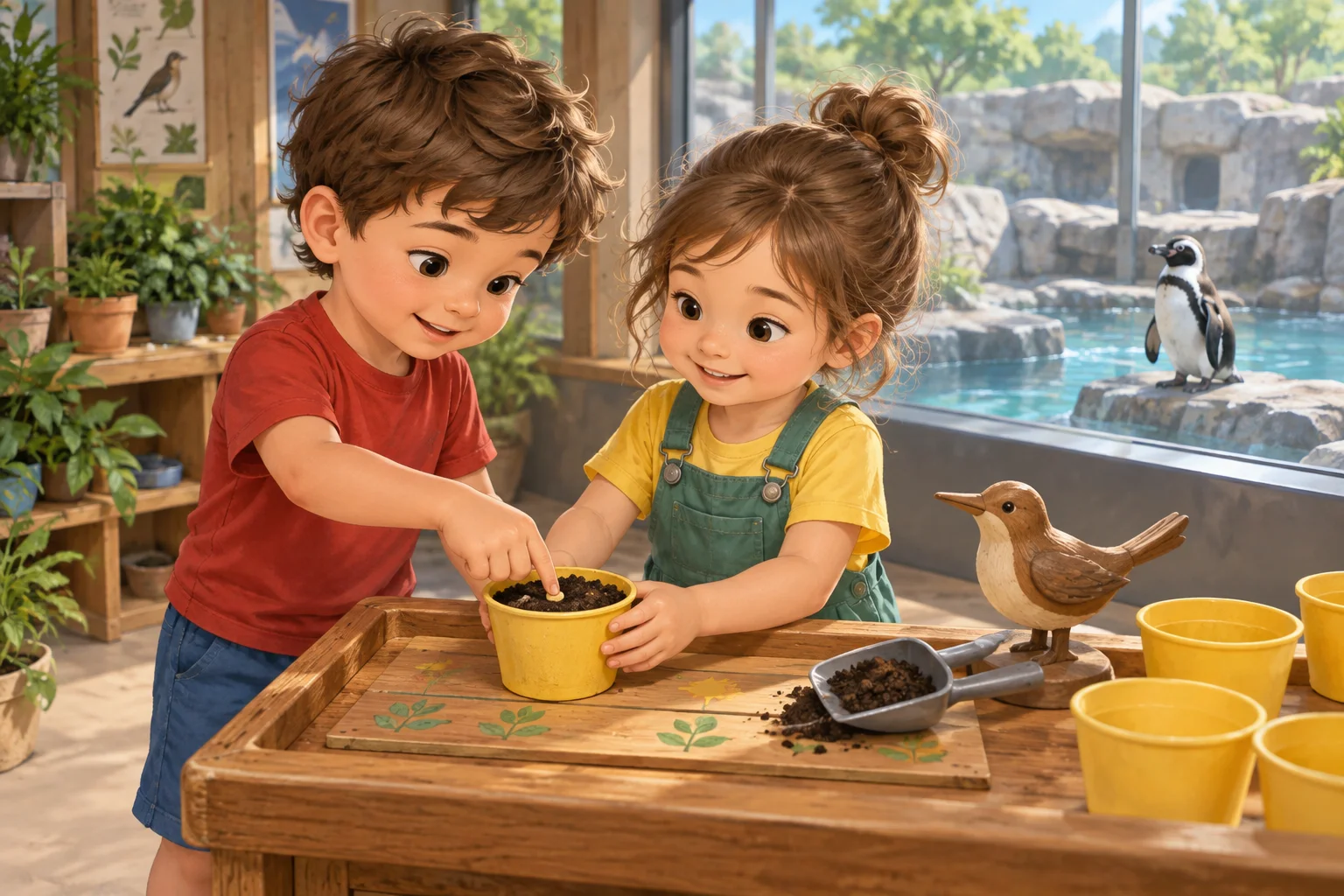
June found a small scoop of potting soil beside the center’s indoor garden. She helped Milo fill one yellow cup, then gave him a seed.
“You can plant it,” she said. “After that, choose a character for your garden.”
Milo pressed the seed into the soil with one finger. Then he chose the wooden bird and placed it beside the cup.
“My bird is looking for a place to grow,” he said.
“Maybe it needs a path,” June replied. She set down another cup.
Milo planted a second seed, and June planted one too. Then they took turns choosing characters. The wooden girl became a gardener. The wooden bear became a sleepy visitor. A small wooden tree stood near the edge of the board.
At last, June placed the dog-shaped target at the end of the garden.
“Now the bird can roll the ball down the path,” she said. “It doesn’t have to go through the dog. It can just say hello.”
Milo rolled the ball slowly. It bumped one cup, curved around the wooden tree, and tapped the dog’s painted paw.
“Hello, dog!” Milo called.
June laughed. “The dog says, ‘Welcome to the garden!’”
Milo rolled the ball again. This time, it stopped beside the wooden bear.
“The bear is taking a nap,” Milo whispered. “Shh. The flowers are growing.”
Soon, Milo was adding more parts to the story. The wooden girl watered the seeds. The bird carried a message. The bear woke up and helped build a little bridge from one cup to the next. June followed Milo’s ideas and added a few of her own.
From the viewing window, Wren waddled past the glass. Milo noticed her and waved.
“Wren can visit the garden too,” he said.
June placed the wooden bird near the window. “She can watch from her pond.”
Milo nodded. “And when the seeds grow, we’ll save her the biggest flower.”
A few more children gathered around the table. June showed them how to take turns planting a seed, choosing a wooden character, and rolling the ball toward the dog. Some children rolled gently. Some rolled fast. Every garden looked different.
When it was time to leave, Milo touched the edge of the board. “Can we play again next time?”
“Of course,” June said. “You can help make the rules.”
That evening, June and her grandparent carried the game back to the workshop. The cups sat in a neat row, each one holding dark soil and a carefully planted seed.
June bent close to look at them. “I wonder what our garden will become.”
“Whatever the children imagine,” her grandparent said.
June thought of Milo’s sleepy bear, Wren by the window, and all the different gardens waiting to be made. She placed the red ball beside the wooden dog, where it rested quietly beside the cups until the next child came to play.
Talk about the story
1.What did the workshop smell like?
2.What were June and her grandparent making for the wildlife center?
3.Who was Wren?
4.What did Milo plant in the yellow cup?
5.What did June say Milo could help make?
Coloring page
Print the story’s hero and color it in together — with crayons, markers or paints.