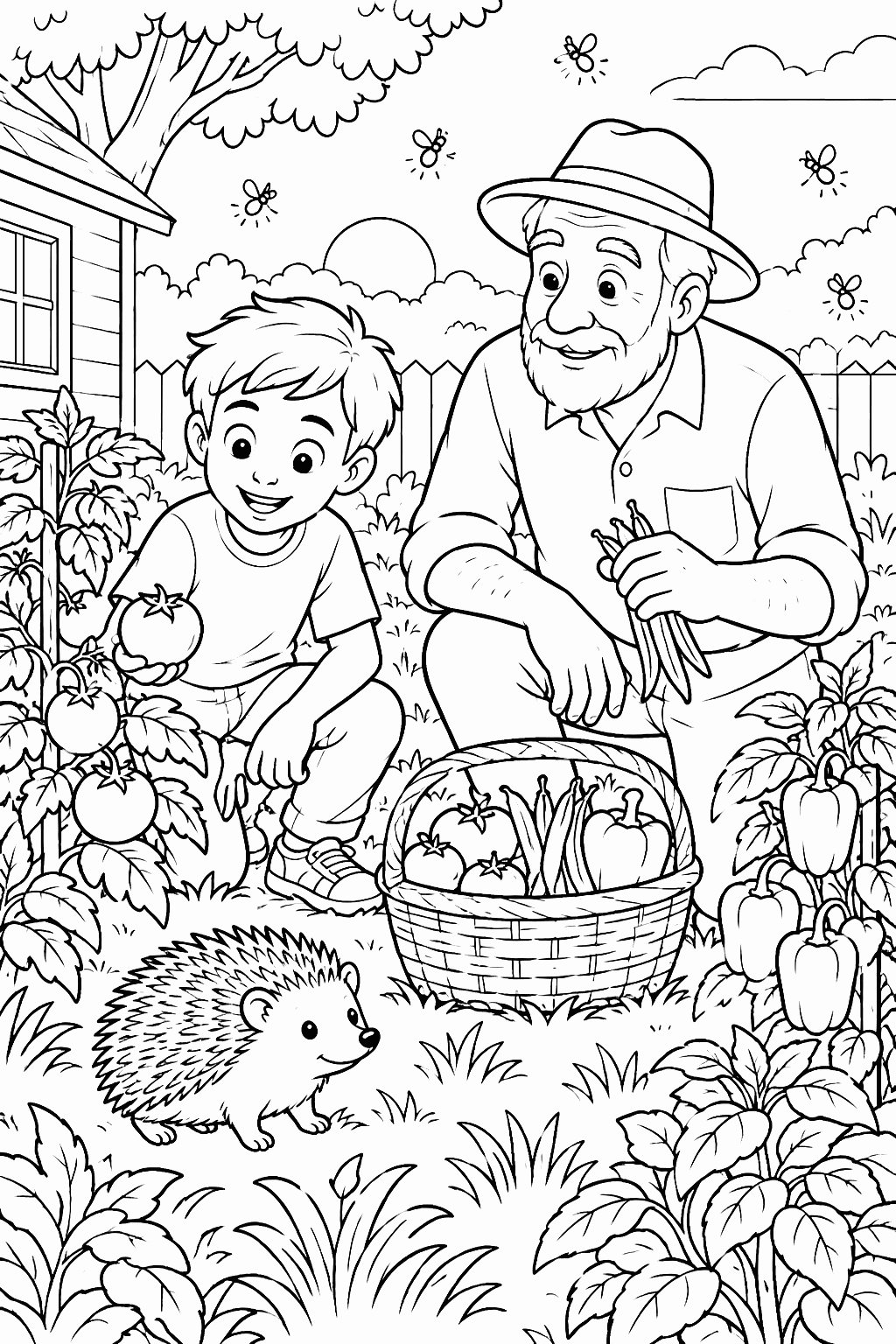
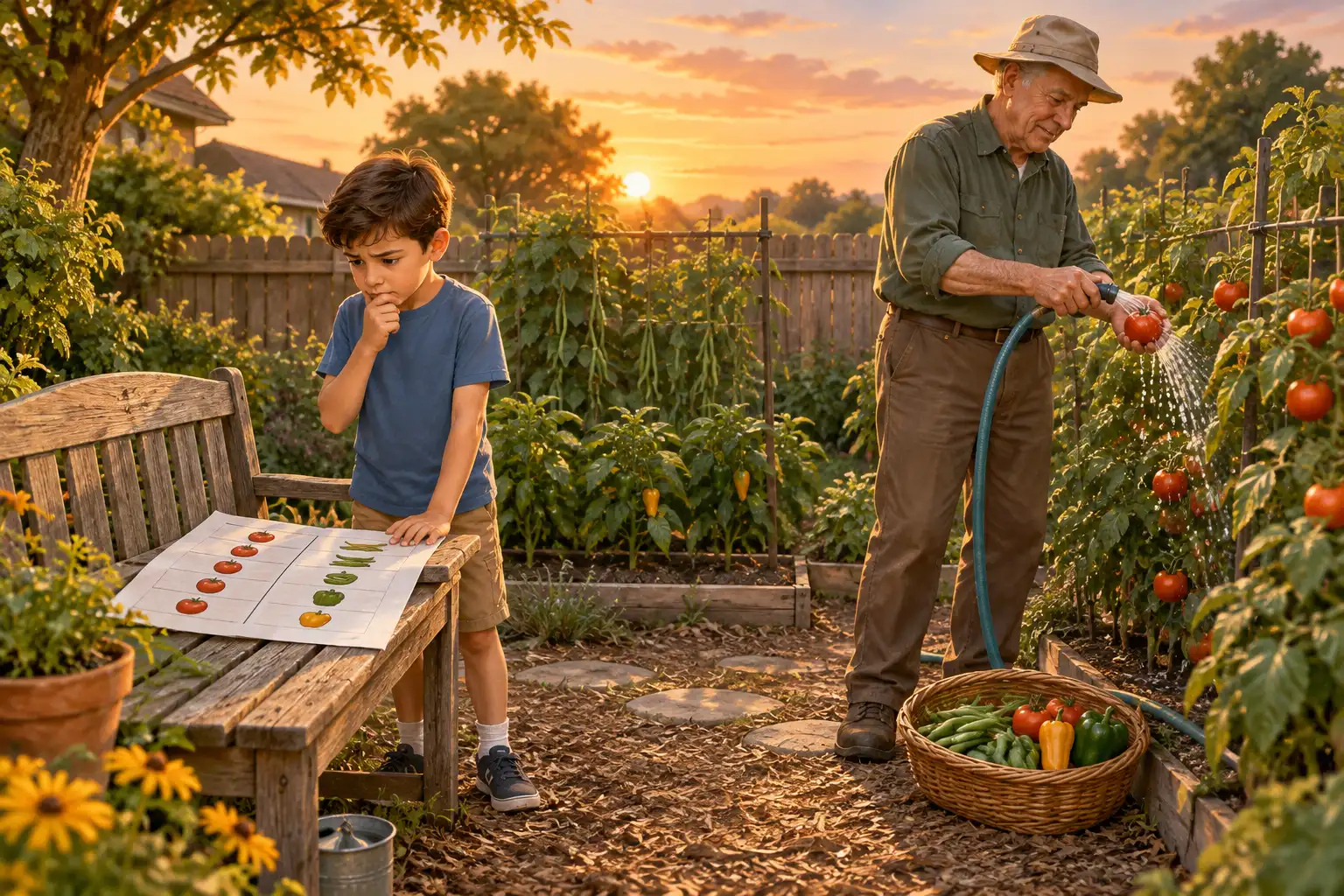
At the edge of the backyard, the garden held the last warm light of the day. Red tomatoes glowed beneath their leaves, green beans curled around their supports, and small peppers hung like bright lanterns among the stems.
Arjun carried a shallow basket between the rows while his grandfather Omar knelt beside the tomato plants. Omar wore an old sun hat, even though the sun was already slipping low behind the fence.
“Look for tomatoes that give a little when you press them gently,” Omar said. “Not too hard.”
Arjun pressed one with his thumb. It was firm but not hard. He twisted it carefully until the stem let go and placed it in the basket.
“One for the basket,” he said. “And one for the science club.”
Omar raised his eyebrows. “Are we taking a tomato to your meeting?”
“No. I’m taking my chart.” Arjun reached into his back pocket and pulled out a folded sheet of poster paper. “We have to explain how people fit into the animal world. I’ve been working on it all afternoon.”
He unfolded the paper across the flat top of a garden bench. At the top, he had written PEOPLE AND ANIMALS. Underneath, two columns stretched down the page.
People wear clothes. Animals have fur, feathers, scales, or shells.
People build houses. Animals live in nests, dens, burrows, or other shelters.
People use tools. Animals use their bodies.
People talk with words. Animals make sounds.
Arjun studied the chart. It looked neat. The letters were straight, and the lines had been drawn with a ruler. Still, something about it bothered him.
“It has a lot of differences,” Omar said as he rinsed a tomato with water from the garden hose. “What made you choose those?”
“They’re true,” Arjun said. “People aren’t exactly like animals.”
Omar set the tomato beside the others. “People are animals, too.”
Arjun blinked. “I know that for science club. But it sounds strange.”
“Sometimes true things sound strange until you look closely.” Omar picked up the basket. “Let’s finish gathering dinner. Then you can decide whether your chart needs another look.”
They moved down the row together. Arjun searched beneath the leaves while Omar steadied the vines. They found tomatoes in three shades of red, beans as thin as pencils, and peppers that were still green except for one turning yellow at the tip.
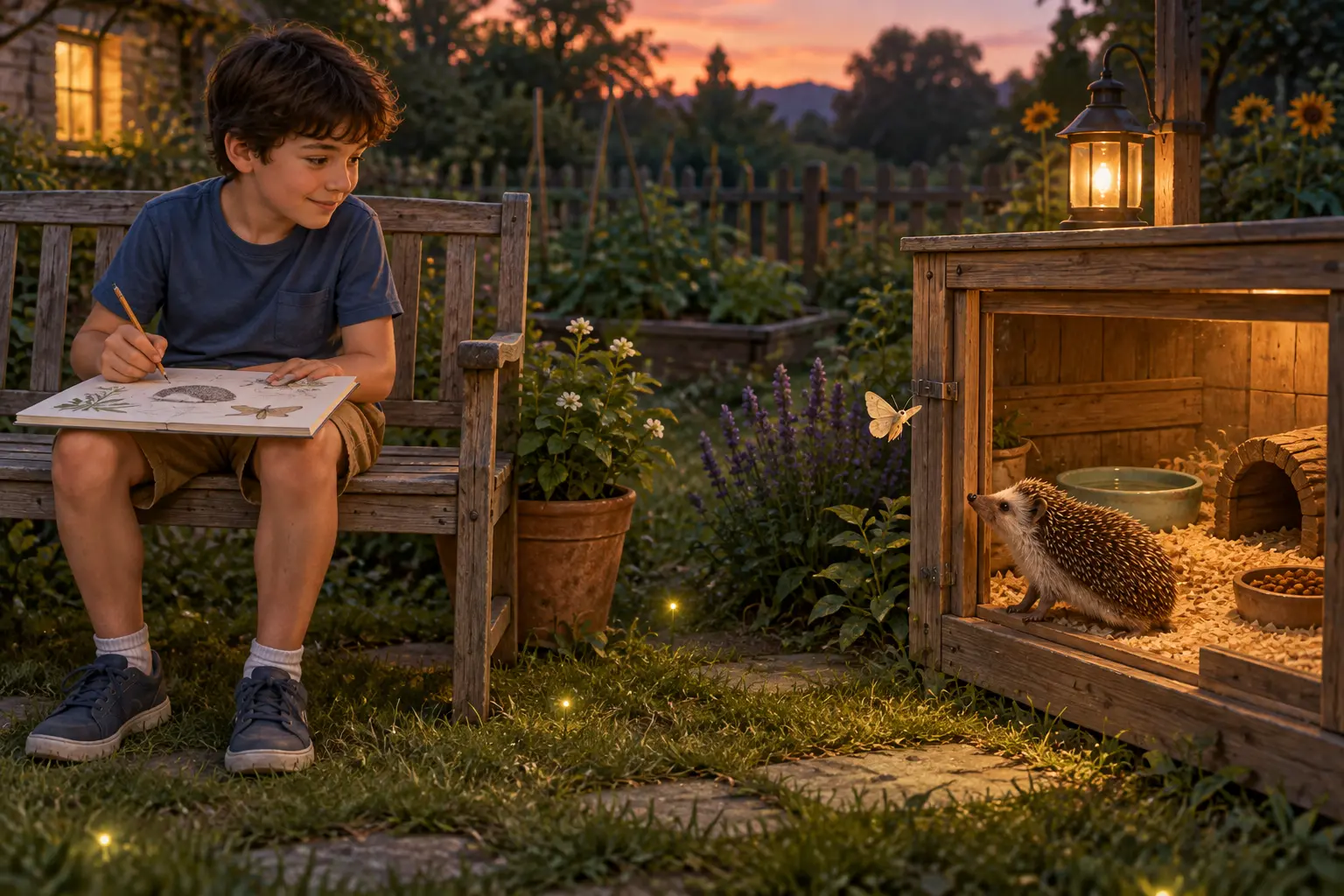
At the far end of the garden stood a small covered pen. Inside was a wooden box with a low opening. Prickle, their curious pet hedgehog, lived there. The box had clean bedding, a shallow dish of water, and a dish for food. Prickle was awake, nosing around in the bedding with his pointed snout.
When Arjun and Omar approached, Prickle paused. His nose twitched. Then he tucked his head beneath a curl of dry grass and sniffed again.
“Should we watch him for my chart?” Arjun asked.
“We can observe him quietly,” Omar said. “We don’t need to touch him or interrupt what he’s doing. A good observer gives an animal room to be an animal.”
Arjun sat on the garden bench with his chart and pencil. Omar placed the basket on the ground nearby. They watched through the open side of the pen.
Prickle moved slowly through the bedding. He sniffed one corner, turned around, and pushed a loose piece of grass with his nose. His tiny feet made a soft rustling sound.
“Movement,” Arjun whispered. “That’s something people and hedgehogs both do.”
He wrote a new line beneath his old list.
Both people and hedgehogs move.
Prickle stopped beside his food dish. Inside were a few pieces of his regular food. He sniffed one, picked it up in his mouth, and chewed.
“Both eat,” Arjun said, adding another line. “People and hedgehogs need food.”
Prickle took a sip of water. Then he raised his head and looked toward the garden. A firefly blinked above the grass. Its small green light appeared, disappeared, and appeared again.
“Both need water, too,” Arjun said.
Omar nodded, but he did not speak. He let Arjun keep watching.
The sky deepened from blue to violet. More fireflies began to blink over the lawn, scattered like tiny green stars close to the ground. A breeze stirred the bean leaves. In the pen, Prickle curled beside the wooden box and rested.
“He rests,” Arjun said. “People rest.”
He wrote that down as well.
For several minutes, nothing else happened. Prickle stayed still, breathing gently. Arjun could see the small movement of his sides. In and out. In and out.
“He breathes,” Arjun murmured. “So do we.”
He drew a line through the words People use their bodies in his first chart. Under them, he wrote, People and hedgehogs breathe, eat, drink, move, and rest.
Then Prickle suddenly lifted his head. His nose pointed toward the garden fence. He sniffed the air and took three quick steps toward the opening in the box.
“What did he notice?” Arjun asked.
A moth fluttered past the pen, pale against the darkening yard. Prickle followed it with his nose, but he did not chase. He simply watched until it drifted away.
“Animals notice the world around them,” Omar said. “So do people. We use different senses in different ways, but we both gather information.”
Arjun added another sentence, then paused. His pencil hovered above the page.
“Would it be right to say we’re the same?” he asked.
“Not exactly,” Omar said. “Shared traits don’t erase differences. They help you see the whole picture.”
Arjun looked back at his old chart. He had written that animals used only their bodies, but that no longer seemed fair. Prickle had used his nose to explore, his feet to move, and his mouth to eat. He had not used a tool, but he had not needed one.
“Maybe my chart was trying too hard to separate everything,” Arjun said.
“Charts can make us choose boxes,” Omar replied. “Nature doesn’t always fit neatly inside them.”
Arjun turned to a fresh section of poster paper. He drew a large circle and labeled it THINGS WE SHARE. Around it, he wrote: breathe, need food, need water, move, rest, sense the world, grow, and respond to what happens around us.
Then he drew a second circle beside it. This one said IMPORTANT DIFFERENCES.
People have language, build many kinds of tools, and can make plans that change the world around them. Hedgehogs have spines, live close to the ground, and use their bodies and senses in ways that fit their lives.
Arjun read the sentence about plans twice.
“Is that too much?” he asked.
“It’s a good start,” Omar said. “But test every idea against what you’ve actually observed or learned. Don’t add something just because it sounds impressive.”
Arjun tapped the pencil against his chin. “We observed Prickle breathing, eating, drinking, moving, resting, and noticing the moth. We didn’t observe him growing.”
“Not tonight,” Omar said. “But you know hedgehogs grow from young animals into adults. You can check your science book when you get home.”
Arjun nodded. He liked that Omar did not simply tell him what to write. He showed Arjun how to find out whether an idea belonged on the chart.
A light tap came from inside the pen. Prickle had bumped the side of his food dish. One piece of food rolled a short distance across the bedding. Prickle followed it, sniffed it, and ate it.
Arjun grinned. “That’s another observation. He can make something happen and then respond to it.”
Omar smiled. “Write it down if it helps your explanation.”
Arjun did. He added a small note beside the line: Prickle’s body is suited to his life. Then he drew a tiny picture of a hedgehog curled beneath a piece of grass.
The fireflies blinked faster as the evening grew darker. Their lights floated above the grass and between the garden rows. Omar picked up the basket and began sorting the vegetables. He placed the tomatoes together, lined the beans along one side, and set the peppers in a small pile.
Arjun kept working. He crossed out People use tools. Animals use their bodies and wrote People and animals have bodies that help them live, but they use them in different ways. Underneath, he added examples: people can hold a shovel; hedgehogs can curl into a ball and use their spines for protection.
He stopped before writing more.
“What about talking?” he asked. “My first chart says people talk with words and animals make sounds. That’s a difference, right?”
“It can be,” Omar said. “But be careful with the word only. Animals communicate in many ways. Sounds are one way. Movements, scents, and other signals can matter, too.”
Arjun watched Prickle sniff the air again. “So I should write that people use spoken and written language, while hedgehogs communicate through sounds, scents, and body signals?”
“That would be more precise.”
Arjun added the sentence. It was longer than the others, but it felt stronger because it did not pretend the world was simpler than it was.
At last, Arjun held up the completed chart. The first page showed differences. The second page showed shared traits and differences together, with arrows connecting the ideas. At the bottom, he had written:
LOOK CLOSELY. ASK WHAT THE EVIDENCE SHOWS.
He turned to Omar. “I think I can present this.”
Omar leaned toward the page, careful not to bump Arjun’s pencil. “I think you can.”
“Thanks for helping me.”
“I mostly picked beans.”
“You taught me how to look.”
Omar’s smile grew warm in the firefly light. “Then I’m glad I picked beans.”
A few moments later, Prickle settled into the wooden box. Only the tip of his nose showed in the opening. Arjun lowered the cover partway, leaving plenty of air and a clear space for Prickle to move. Then he carried his chart inside while Omar brought the basket to the kitchen.
The next afternoon, Arjun stood at the front of the science club room. His poster was clipped to a board beside projects about clouds, soil, and bird migration. Several students had made charts with bright arrows and carefully labeled drawings.
Arjun’s first page, the one with only differences, was at the back. He showed it briefly.
“This was my first idea,” he said. “I thought I needed to explain how people and animals were different. But I was leaving out too much.”
He turned to the second page.
“I observed my pet hedgehog, Prickle, with my grandfather. We didn’t touch him or disturb him. We watched him breathe, eat, drink, move, rest, and notice things around him. People do those things, too. We also have important differences. Our bodies, ways of communicating, shelters, tools, and abilities are not the same.”
His science club teacher, Ms. Rivera, nodded. “How did you decide what belonged on the chart?”
“I tested each idea against my notes,” Arjun said. “If I hadn’t observed it, I checked a science book. And I tried not to use words like only unless I was sure.”
A student named Maya raised her hand. “So people are animals, but people and hedgehogs aren’t the same kind of animal?”
“Right,” Arjun said. “We share some basic needs because we’re living animals. But each kind of animal has traits that fit its own life.”
Ms. Rivera invited the group to look at his chart. Soon everyone was pointing to different parts and asking questions. Arjun did not know every answer, but he knew how to mark a question for later. That made him feel steadier than pretending to know everything.
When the meeting ended, he folded the poster carefully. At home, Omar sat at the kitchen table, waiting beside a plate of garden vegetables. The tomatoes had been sliced, the beans had been steamed, and the peppers had been cut into small pieces.
Arjun set the chart on the chair and took a bite of tomato. It was sweet and warm from the afternoon sun.
“I saved the best ones for you,” he told Omar.
Omar tasted a pepper and smiled. “Then I’m grateful you were paying attention.”
Outside the window, evening gathered over the backyard. Prickle rustled softly in his box. Above the grass, the first firefly blinked once, then twice.
Arjun leaned back in his chair, listening to the quiet chewing, the soft rustle, and the gentle night beyond the glass. On the table, his chart rested beneath the kitchen light, full of circles, arrows, questions, and careful answers.
Talk about the story
1.What did Arjun first write on his chart about people and animals?
2.What did Arjun and Omar observe Prickle doing?
3.Why did Arjun change his chart?
4.What did Prickle use to explore his surroundings?
5.How did Arjun decide what belonged on his chart?
6.Who helped Arjun observe Prickle and improve his chart?
7.What lesson did Arjun write at the bottom of his completed chart?
Coloring page
Print the story’s hero and color it in together — with crayons, markers or paints.