Imani packed three pencils, a blue notebook, and a folded letter from her friend Maya. She tucked the letter into the front pocket of her backpack, beside a bottle of water and a bag of apple slices.
Cocoa trotted in circles while Imani checked the zipper. The little Shih Tzu’s silky brown-and-white fur bounced around his face, and his tail curled over his back like a question mark.
Dot waited on the porch beside the backpack. He was a simple classroom robot with two round wheels, a small microphone, and a bright green light that blinked whenever he was ready to record.
“Beach notebook, pencils, water, dog, robot,” Imani said, touching each item. “I think we’re ready.”
Cocoa gave a cheerful bark.
Dot’s green light blinked twice. “Ready for observation.”
At the ocean beach, the morning breeze smelled like salt and clean, wet sand. The tide had rolled in during the night, and a wide ribbon of shining water stretched along the shore. Farther up the beach, gulls called from the roof of a small snack stand, but Imani and her companions walked toward a quieter stretch where the sand was smooth.
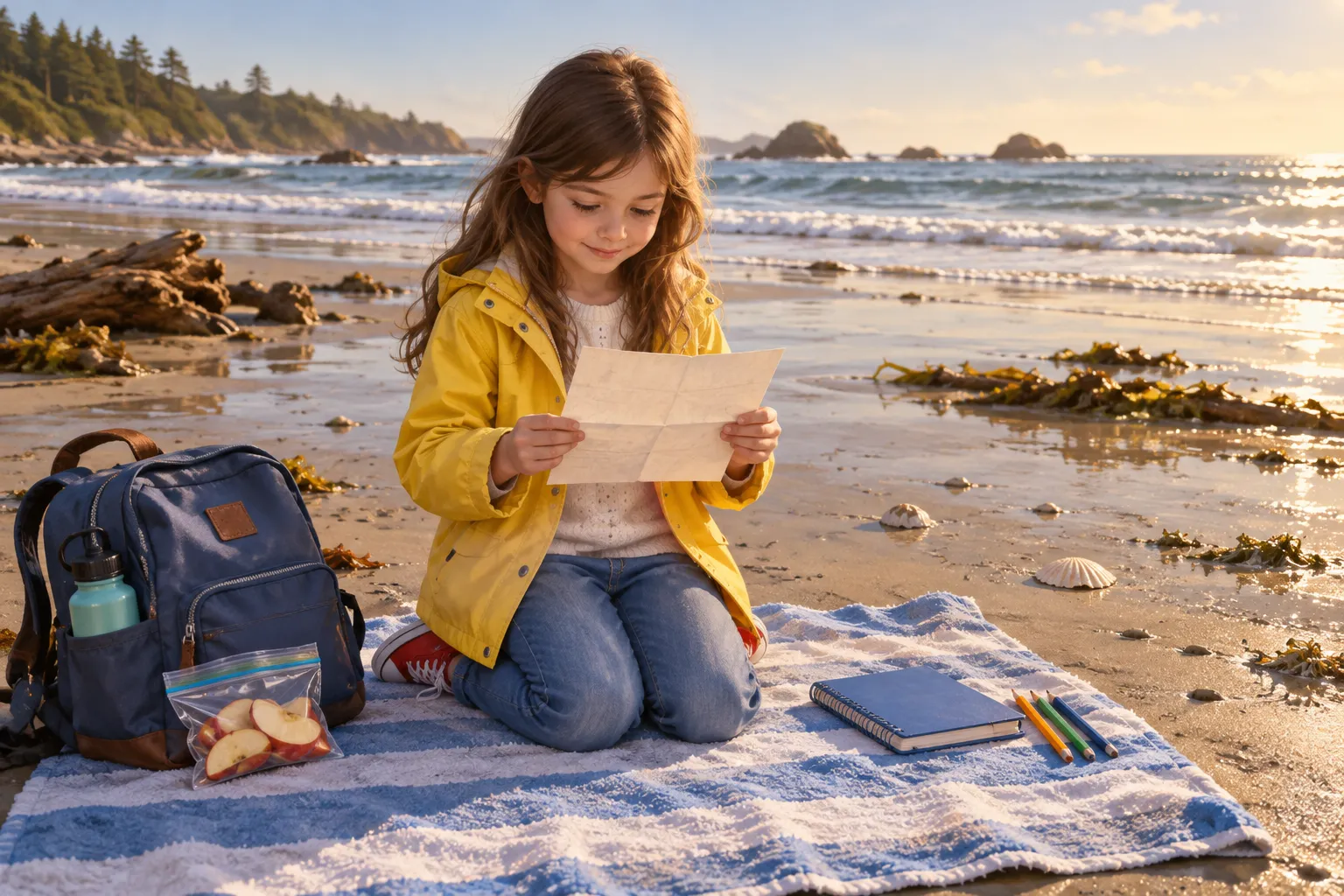
Imani spread out a towel and opened Maya’s letter. Maya had written three questions in purple ink:
What animals live at the beach? What do they eat? And why do birds run away from the waves?
Under the questions, Maya had added one more sentence: Please send me the most interesting thing you see.
Imani smiled. “I know what I’ll write about. I just have to find it.”
Cocoa sniffed the edge of the towel, then the sea breeze, then a piece of driftwood. Dot rolled carefully over the firm sand, leaving two narrow tracks behind him.
For a while, Imani saw only shells, seaweed, and tiny holes in the sand. She was beginning to wonder whether the beach was saving its most interesting animals for another day when a flock of small shorebirds appeared near the water.
They were sandpipers, with slim legs, pointed bills, and brown-and-white feathers that blended with the beach. The birds hurried toward a wave, stopped just before the water touched them, and then dashed back when the wave slid away.
Imani’s eyes grew wide.
“They’re chasing the wave!” she said. “Maybe they’re playing tag with it.”
The flock rushed forward again. The birds moved together like a little feathered broom sweeping across the sand.
Cocoa leaned forward, ears lifted. He did not bark or pull at his leash. He simply watched.
Dot rolled closer, stopping well behind the birds. “Would you like a recording?”
“Yes,” Imani said. “Record the birds chasing the wave.”
Dot’s microphone began to capture the soft rush of water, the faint tapping of tiny bills, and the quick patter of many bird feet. Imani watched the flock for another minute, then began to write.
Sandpipers chase the waves because they like to play. They run forward and backward together. It looks like a game of tag.
Cocoa made a small huffing sound and stared at the wet sand.
“What?” Imani asked. “Do you think I’m wrong?”
Cocoa took one careful step toward the water. Imani shortened his leash and followed, keeping him on the dry sand. The next wave spread a thin sheet of foam over the beach. When it pulled back, Cocoa lowered his nose.
The sandpipers rushed in.
Instead of simply running, each bird poked its bill into the damp sand. One bird poked three times in a row. Another took a quick step, tilted its head, and poked again.
Cocoa sniffed the same place. His tail stopped wagging.
Imani crouched beside him. “You found something?”
The dog looked from the sand to the birds, as if he wanted her to pay closer attention.
Imani erased the last sentence in her notebook. She drew a small circle around the words chase the waves and wrote a question mark beside them.
Dot played back the recording. Beneath the rushing water, Imani heard a faint, repeated sound: tap, tap, tap-tap. She had not noticed it while she was watching.
“That sounds like their bills,” she said.
Dot’s green light blinked. “The recording includes repeated tapping after each wave moves away.”
“Maybe they’re looking for food,” Imani said, though she was not ready to change her letter yet. “But we need to know for sure.”
She took Maya’s letter from her backpack and pressed the button on the small message player clipped to the paper. Maya’s voice sounded bright and curious.
“What do sandpipers eat, and why do they keep running beside the waves?”
Imani listened once. Then she listened again.
The second time, she heard the important words more clearly: What do they eat, and why?
“I almost answered the wrong question,” she whispered.
She and Dot moved farther along the shore while Cocoa walked beside them. Imani looked for patterns. When a wave covered the sand, the birds waited. When the water slid away, they hurried into the shining strip it left behind.
At first, the flock scattered, and Imani lost track of which birds had been feeding and which had simply been moving. She tried to count them, but one bird crossed in front of another, and the whole group seemed to become a fluttering blur.
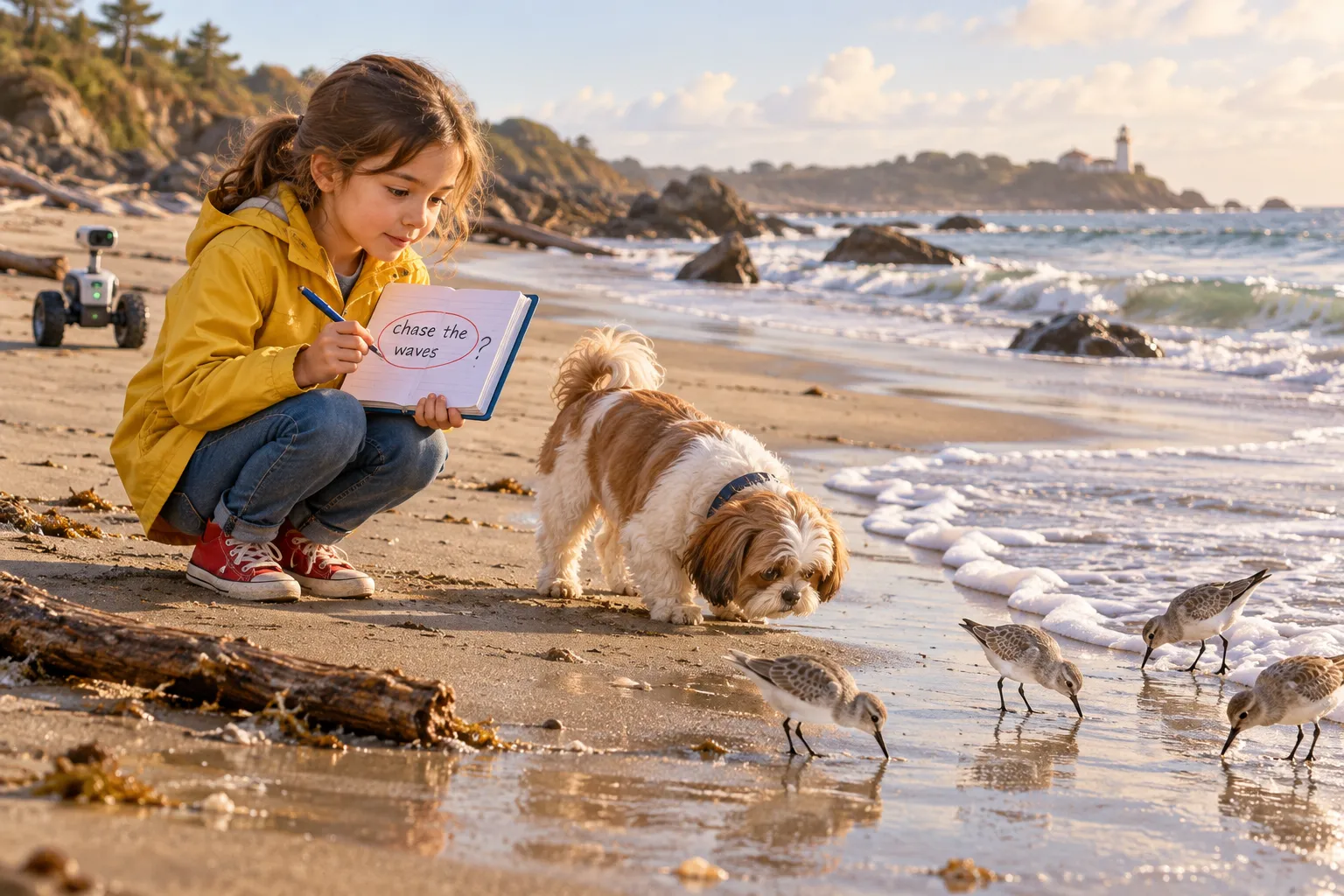
“I need a better way,” she said.
Dot rolled beside a piece of smooth driftwood. Imani picked it up and used it to draw three lines in the sand: high water, middle water, and wet sand.
Then she made three small marks in her notebook for three different times. At each time, she watched what the birds did after a wave pulled back.
At the first mark, most of the birds poked the sand.
At the second mark, they poked the sand again. Sometimes they pulled up tiny dark shapes that disappeared before Imani could see them clearly.
At the third mark, the birds paused longer. One sandpiper found a small creature and swallowed it quickly. Another shook its bill, then searched in a new spot.
“Food,” Imani said. “They’re finding food in the wet sand.”
Cocoa sniffed the spot where the bird had fed. Then he looked up at Imani with a proud expression, as if he had been waiting for her to catch up.
Imani laughed softly. “You noticed before I did.”
Dot played the recording again. This time, Imani listened for sounds that matched the birds’ actions: wave rush, water pulling back, tap, tap, quick footsteps, and another wave.
She wrote the pattern in her notebook: The sandpipers wait for the wave to go out. Then they search the wet sand for tiny animals and other food. They run because the water keeps changing the places where they can look.
A stronger wave rolled in than the others. It reached nearly to the driftwood line and washed away the three marks Imani had drawn. Her notebook stayed dry, but the clues in the sand were gone.
“Oh, no,” she said. “Now I can’t show Dot the feeding spots.”
Dot’s wheels made a quiet whir as he turned toward the water. “The marks are not available. Other evidence remains.”
Imani looked at Cocoa. The Shih Tzu stood with his nose pointed toward a fresh patch of wet sand. The birds had already hurried there, tapping and pecking.
Cocoa had found the pattern again.
Imani made a new plan. She would not try to save every clue in one place. Instead, she and Dot would compare what they could hear, see, and count.
She held up one finger when a wave came in. She held up two fingers when it pulled away. Dot recorded the sounds. Cocoa watched the moving edge of the water and sniffed the places where the birds gathered.
For ten waves, Imani counted. The sandpipers did not poke much while the water covered the sand. After almost every wave pulled back, they began searching. Sometimes they ran a few steps. Sometimes they stood still and poked rapidly.
“Not playing tag,” Imani said. “Searching on a schedule made by the waves.”
Dot gave a pleased electronic chirp. “The observations agree.”
Imani looked again at Maya’s question. She could answer it now, but she wanted to answer it carefully. She did not know the exact names of the tiny animals hidden in the sand, so she would not pretend she did. She knew what she had actually seen: the birds searched for small food in the wet sand after the waves moved away.
Before they left, Imani sat on the towel and wrote a rough letter.
Dear Maya,
Today I watched sandpipers at the beach. At first, I thought they were chasing the waves for fun. Then Cocoa watched closely, and Dot recorded the sounds. I noticed that the birds waited for a wave to pull back. After that, they searched the wet sand with their bills. They were looking for tiny animals and other food.
They do run beside the waves, but they are not only playing. The water uncovers new places to search, and the birds hurry to look there before the next wave arrives. I listened to your question twice so I could answer the whole thing.
Your friend,
Imani
She read the letter aloud. The wind lifted one corner of the page, and Cocoa placed a paw on the towel beside it. Imani quickly held the paper down.
“What do you think?” she asked him.
Cocoa leaned close to the page. His whiskers brushed the edge, and then he sneezed.
Dot’s green light blinked. “Cocoa may be requesting an illustration.”
Imani grinned. “He should be in the letter.”
She added a picture beneath the words. In the drawing, Cocoa stood beside the sandpipers with his nose pointed toward the wet sand. She gave him an enormous detective hat, even though Cocoa had never worn a hat and certainly did not need one. The sandpipers marched in a neat line behind him, and a wave curled nearby with a speech bubble that said, “Not so fast!”
Cocoa studied the drawing. When Imani showed him the giant hat, he wagged his tail.
On the walk back, the sandpipers followed the edge of the next wave while Imani, Cocoa, and Dot climbed toward the path. Imani no longer thought of the birds as playing a silly game. She imagined the tiny lives hidden beneath the wet sand and the careful way each bird searched.
That evening, after dinner, Imani copied the letter neatly onto fresh paper. She added the drawing at the bottom and placed the page in an envelope for Maya. Then she set the envelope beside her backpack so she would remember it in the morning.
Dot sat on the rug while Imani listened once more to the beach recording. The waves sounded softer indoors. Tap, tap, tap-tap. The quiet pattern made her think of tiny bills working in the sand.
Cocoa curled beside her, his nose tucked under his fluffy tail.
Imani opened her bedtime story notebook. On the cover, she had written Free Bedtime Stories for Seven-Year-Olds because she liked giving her little collection a grand title, even though most of the stories were only for her family and friends.
She placed the new letter inside and read it aloud as one of her free bedtime stories. Dot listened without interrupting. Cocoa opened one eye when Imani reached the part about the detective hat.
At the end, Imani closed the notebook and turned off the lamp. Moonlight rested on the envelope beside her backpack. On the floor, Dot’s green light glowed quietly, and Cocoa’s tail gave one sleepy thump.
Far away, waves slipped over the shore and pulled back again. Along the wet sand, the sandpipers hurried forward, tapping for their tiny supper beneath the shining water.
Talk about the story
1.What did Imani pack in her backpack?
2.What did the sandpipers look like?
3.What did the sandpipers do after a wave pulled back?
4.How did Dot help Imani study the birds?
5.Why did Imani change what she wrote about the sandpipers?
6.What did Imani use to draw lines in the sand?
7.What picture did Imani add to her letter?
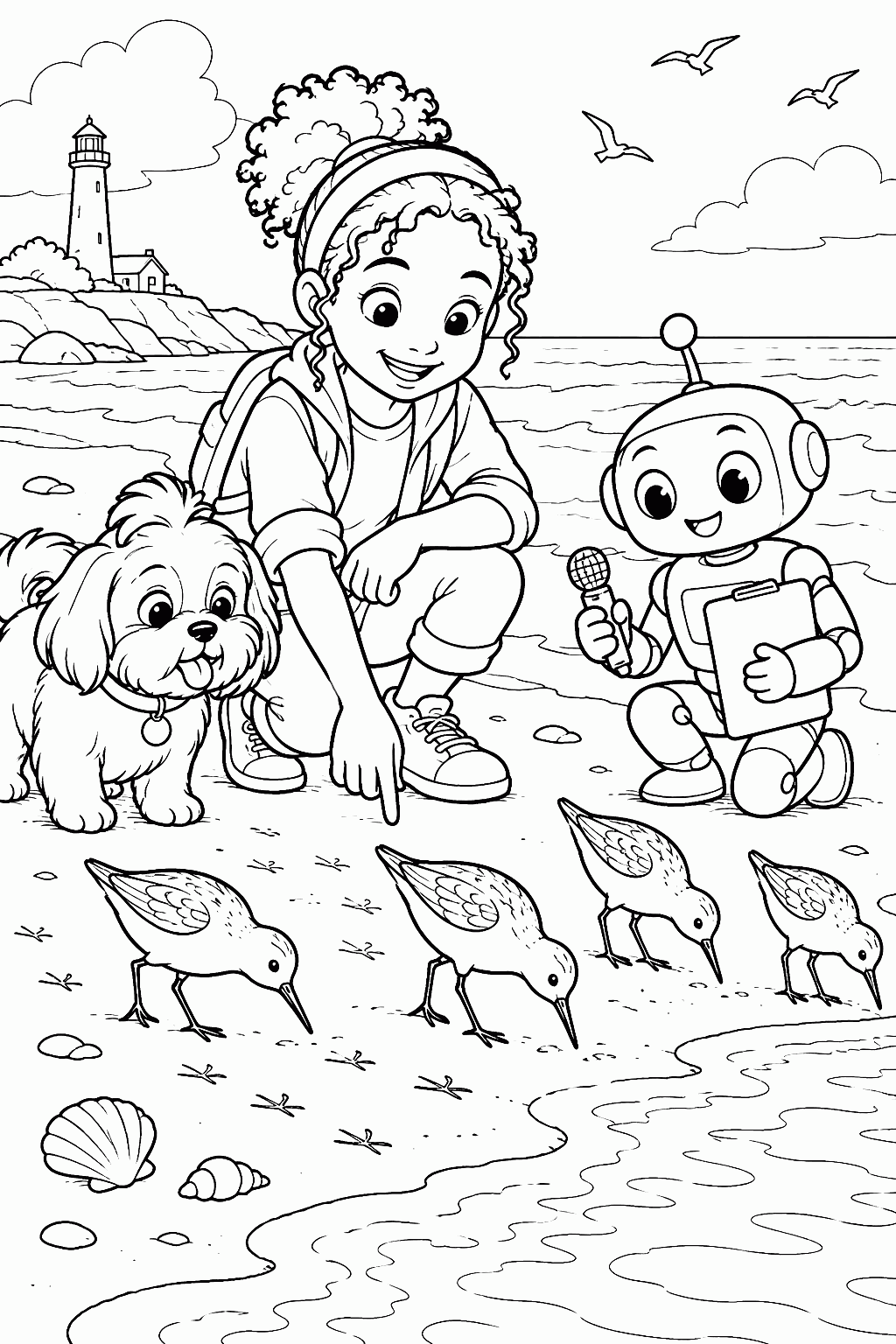
Coloring page
Print the story’s hero and color it in together — with crayons, markers or paints.