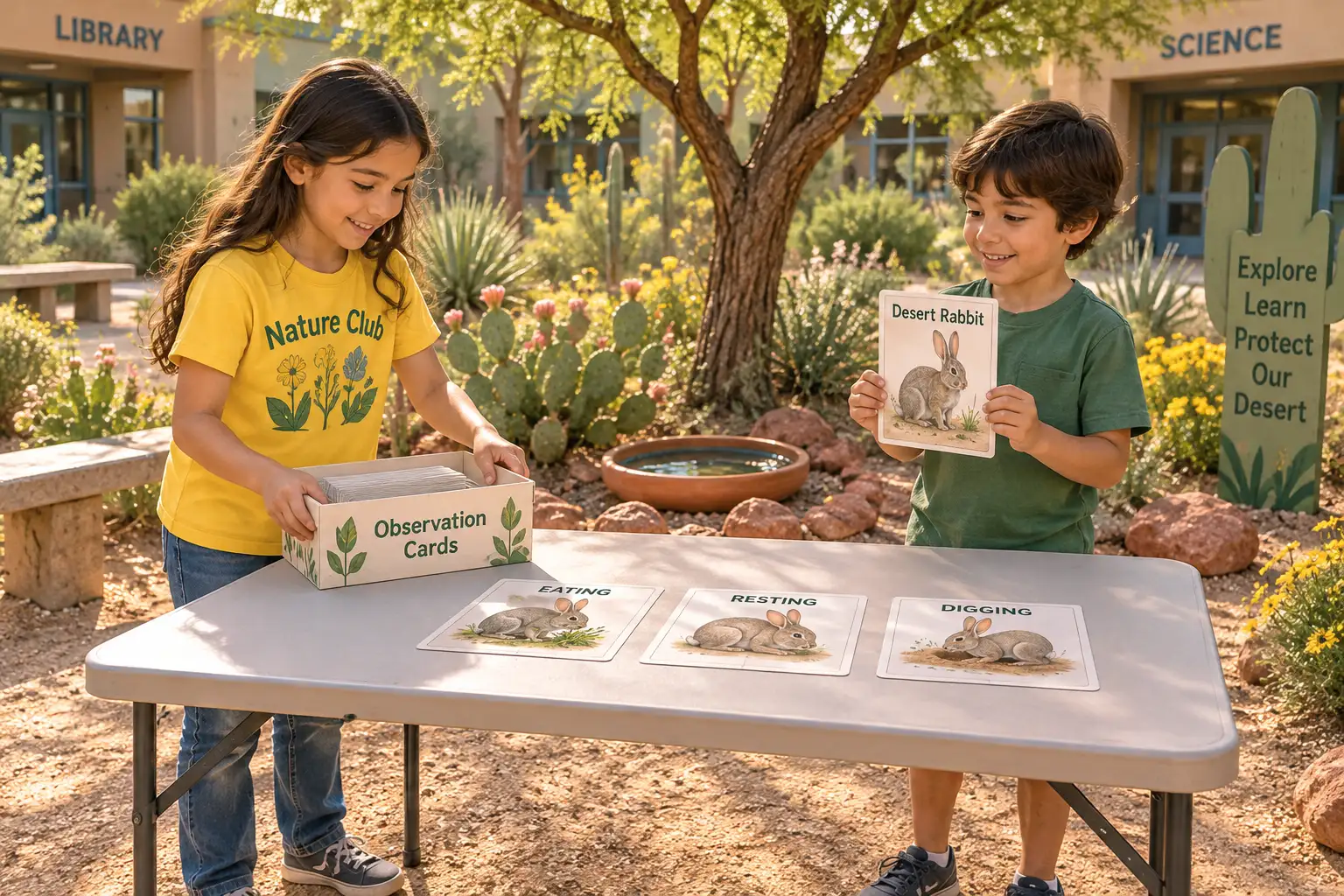
On Tuesday afternoon, Luna carried a box of observation cards through the school courtyard and into the desert garden. The garden lay between the library and the science room, with prickly pear, desert marigolds, smooth red stones, and tall signs shaped like saguaros. Beside a mesquite tree, a shallow dish of water caught the afternoon light.
Luna was a member of the school’s nature club, and the club had an important job. The students were creating a display about what animals did in their habitats. Their cards showed actions they had observed: eating, resting, digging, drinking, and moving from place to place.
“Let’s start with the three actions we’ve seen most often,” said Ms. Patel, the club’s teacher.
She placed three large cards on a folding table. EATING. RESTING. DIGGING.
Luna set down the box. “I can sort the cards while everyone checks the garden.”
Her friend Mateo picked up a card with a photograph of a desert cottontail rabbit nibbling a stem. “This one goes under eating.”
“Good,” Luna said. “But read the note on the back. It says the rabbit paused and lifted its head every few seconds.”
Mateo turned the card over. “So it was eating and watching at the same time?”
“Animals can do more than one thing,” Ms. Patel said. “For our display, choose the action the note describes most clearly. Then write down any extra details.”
Luna liked that idea. She added a small yellow sticker to Mateo’s card and wrote, Rabbit nibbled a desert marigold and paused to look around. She wanted the display to show not only what the animals did, but also how carefully the students had watched them.
The club members spread out around the garden. Some sat on the low stone wall. Others knelt near the plants, keeping their voices soft. Luna checked beneath the mesquite tree and glanced toward the water dish. Nothing moved except a blue dragonfly flashing through the afternoon light.
Then a cottontail rabbit stepped from behind a clump of prickly pear.
Luna froze. The rabbit’s ears stood tall, and its nose twitched as it studied the garden. Its fur was the warm brown color of dry earth. When it turned, the white underside of its tail showed for just a moment.
Luna slowly lowered herself onto the wall. She did not reach for her pencil. She did not whisper to Mateo. She simply watched.
The rabbit hopped to a patch of desert marigolds and began to nibble. After a few bites, it lifted its head. A breeze stirred the flowers. The rabbit waited, its ears turning toward a sound somewhere beyond the garden. Then it took two small hops toward the mesquite tree and rested in the shade.
Luna noticed the rabbit’s steady breathing and the way its body stayed still while its eyes moved. She noticed how its ears turned toward a birdcall. She remembered what Ms. Patel had said: “Quiet watching gives animals room to show us what they really do.”
After several minutes, the rabbit slipped beneath a low shrub and disappeared.
Only then did Luna reach for her pencil. On a fresh card, she wrote, Cottontail rabbit ate a marigold, paused to watch, then rested under mesquite shade.
Mateo leaned over to read it. “That’s more than one action.”
“I know,” Luna said. “Maybe we need a place for details that don’t fit in one box.”
Ms. Patel smiled. “That sounds like a useful idea. Keep it in mind.”
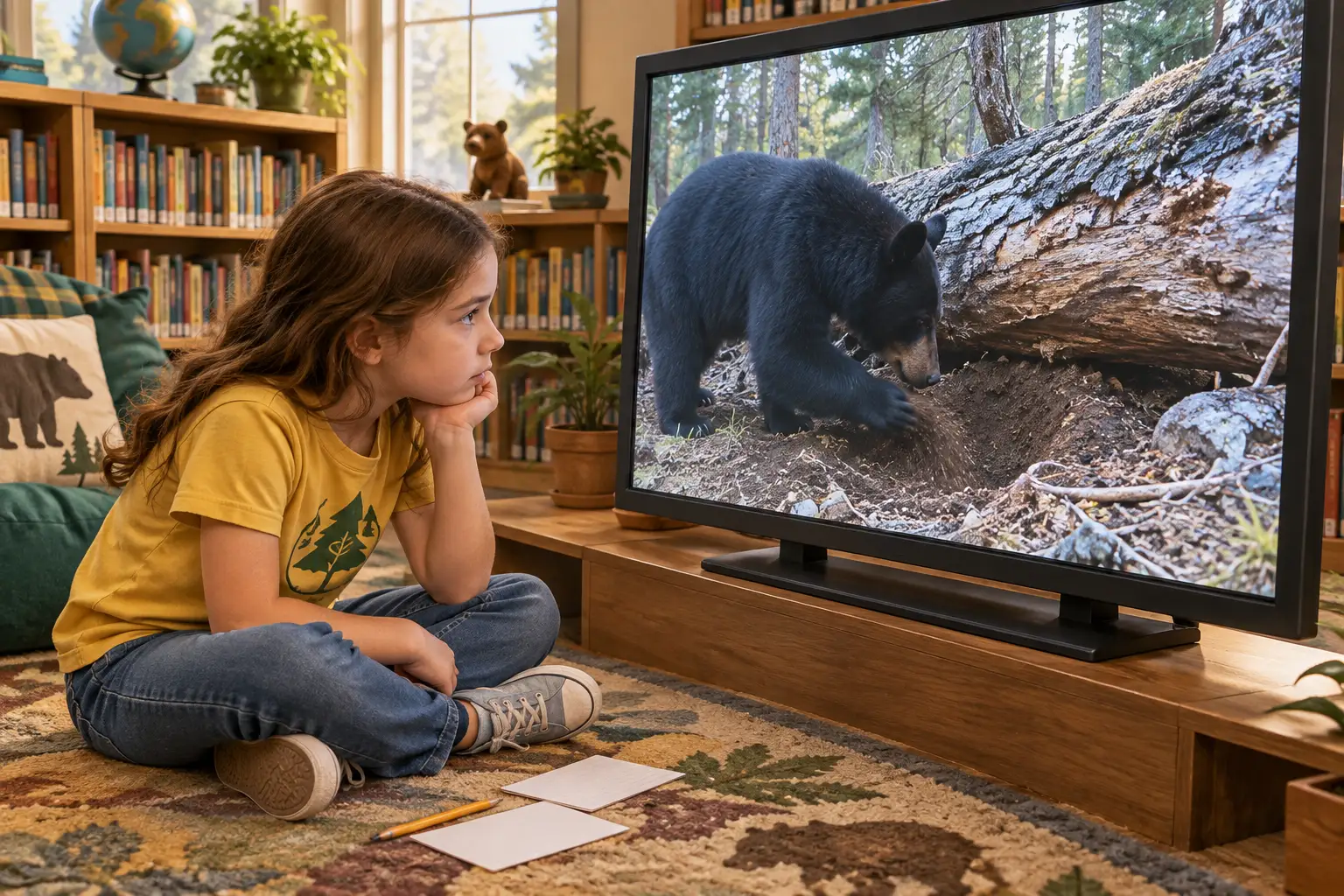
When the club returned to the library, Ms. Patel turned on a large screen near the reading corner. The nature club had been watching wildlife webcams from different places. Today’s camera showed a wooded area in Big Bear, California, where a black bear sometimes visited a fallen log.
The picture was wide and quiet. Pine trees stood behind the log, and patches of sunlight moved across the ground. A clock in the corner showed the time. The video system also saved recorded moments with time stamps, so viewers could go back and watch them again.
“We’ll add one webcam observation to the display,” Ms. Patel said. “Remember, this is a live camera, so we may not see anything right away.”
The students settled on the rug. Luna placed three blank cards beside her knees. She planned to listen, watch, and write.
For several minutes, the camera showed only the fallen log and the shifting light. Then a black bear entered from the edge of the picture. It moved slowly toward the log and lowered its nose to the ground.
“Is it sniffing?” Mateo whispered.
The bear pushed its nose along the bark. Then it lifted one front paw and scraped at the soil beneath the log.
“Digging!” Luna whispered back.
The bear scraped again. Loose dirt slid away from the log. It paused, sniffed the opening, and pawed at the ground once more. When it moved close to the camera, the picture blurred.
Luna quickly wrote on a card, Black bear dug beneath a fallen log.
The bear shifted behind a branch. For a moment, the screen showed only a dark blur and a patch of brown earth. When the picture sharpened, the bear stood beside the log with its nose near the ground.
Luna looked at her card. A small doubt pressed against her first answer.
“Maybe that blurry part was only sniffing,” she said.
Mateo pointed to the screen. “But it scraped the dirt.”
“Before the blur, yes. I’m not sure what it did during the blur.”
Ms. Patel nodded. “That’s a good question. What could we do instead of guessing?”
Luna thought about the rabbit. She had waited before writing. She had watched the whole sequence instead of choosing the first thing she noticed.
“We could check the time stamp,” she said. “And compare it with everyone else’s notes.”
“Exactly.”
Luna wrote down the time shown in the corner of the screen. The students watched the bear move away from the log and disappear among the trees. Then Ms. Patel opened the recorded moments from that time.
The first replay showed the bear approaching the log. The second showed its nose close to the bark. The third was the blurry moment. Luna leaned forward.
“I still can’t tell,” she said.
Ms. Patel played the clip again, this time more slowly. The bear’s shoulder moved. A thin line of dirt shifted beneath the log.
“Look at the ground, not just the bear,” Ms. Patel said.
Luna watched the dirt. On the next replay, she saw a small spray of soil move backward from beneath the log. The bear’s paw appeared for half a second, then vanished behind the branch.
“It scraped the ground,” Luna said. “So it was digging, even though its nose was down, too.”
Ms. Patel paused the video. “That is a careful observation. You can say the bear sniffed and dug. If you want to be especially clear, explain which action the time-stamped video showed most strongly.”
Luna crossed out her first sentence and wrote a new one: At 2:18, the black bear sniffed beneath a fallen log, then scraped soil backward with its paw. The bear was digging for food.
She felt better, but she wasn’t finished. The students had made many notes, and they did not all match.
Sana had written, Bear looked under log. Mateo had written, Bear scratched dirt. Priya had written, Bear sniffed, paused, and scratched. Another student had drawn a small paw near the log but had not added any words.
Luna spread the notes across the rug. At first, the papers seemed to make the question harder. Some observations described what the bear’s nose did. Others described what its paw did. One note focused on the bear’s whole body, while another focused on the ground.
Then Luna remembered the extra space she had wanted for the rabbit card.
“What if we organize the notes in two parts?” she asked. “One part can show the main action. The other can show the clues we noticed.”
Mateo placed the rabbit card on the table. “Main actions: eating and resting. Clues: lifted ears, careful pauses, and shade beneath the mesquite.”
Sana moved her note beside the webcam card. “Main action: digging. Clues: the paw moved soil, the nose searched beneath the log, and the time stamp said 2:18.”
The group began arranging the cards. They made one large section called WHAT THE ANIMAL DID and another called WHAT WE NOTICED. Luna drew arrows between the cards so visitors could follow each observation from an action to the evidence behind it.
For the rabbit, she added a small drawing of the cottontail beneath the mesquite tree. For the bear, she drew the fallen log and a few curved lines showing the dirt moving backward. She did not try to draw the bear perfectly. She wanted the picture to make the action clear.
When the students placed the finished cards on the display board, a problem appeared. The rabbit’s card and the bear’s card both seemed to fit under more than one heading. The rabbit had eaten and rested. The bear had sniffed and dug.
Luna almost reached for the scissors. She thought about removing the smaller actions so the board would look neater.
But then she remembered the rabbit’s quiet pauses and the bear’s blurred movement. The extra details were part of what made the observations honest.
“Let’s not force every animal into only one box,” she said. “We can show the action that helps us understand the habitat, and we can keep the other action in the clues.”
Ms. Patel looked pleased. “That choice will help visitors see that animals use their surroundings in many connected ways.”
The club added arrows from the rabbit’s eating card to the marigolds and from its resting card to the mesquite shade. They connected the bear’s digging card to the fallen log and added the words searching for food. Luna placed a note beside the webcam picture: When an image is blurry, watch again and look for evidence.
By the time the display was ready, the library windows had turned gold with late-afternoon light. A sign above the nature club’s board read, ANIMAL ACTIONS IN THEIR HABITATS. Beside it stood a shelf of books about animals finding food, shelter, or a place to rest.
Luna stepped back. The display was colorful, but it was not crowded. A visitor could learn about the cottontail rabbit in the desert garden, then follow the arrows to the black bear in Big Bear, California. The animals lived in different habitats, yet both used the places around them in careful, practical ways.
“Do you think the bear card is clear enough?” Luna asked.
Mateo read it aloud. “At 2:18, the black bear sniffed beneath a fallen log, then scraped soil backward with its paw. The bear was digging for food.”
“It answers the question,” he said. “And it shows how you found out.”
Luna glanced through the library window toward the garden. The marigolds were still, and the mesquite branches made thin shadows across the stones. Somewhere beneath the shrub, the cottontail rabbit might have been resting again.
She picked up the last blank card and wrote one more note: Questions can be part of careful watching.
Then she placed the card at the bottom of the display, where the afternoon light touched its yellow sticker. In the quiet library, the webcam continued showing the forest at Big Bear. Outside, the desert garden settled into the soft blue edge of evening.
Talk about the story
1.What did Luna carry into the desert garden?
2.What did the rabbit do after nibbling the desert marigolds?
3.Why did Luna wait before writing about the rabbit?
4.Where did the webcam show a black bear?
5.How did Luna find out that the bear was digging during the blurry part?
6.What were the two main parts of the display?
7.What did Luna write on the last blank card?
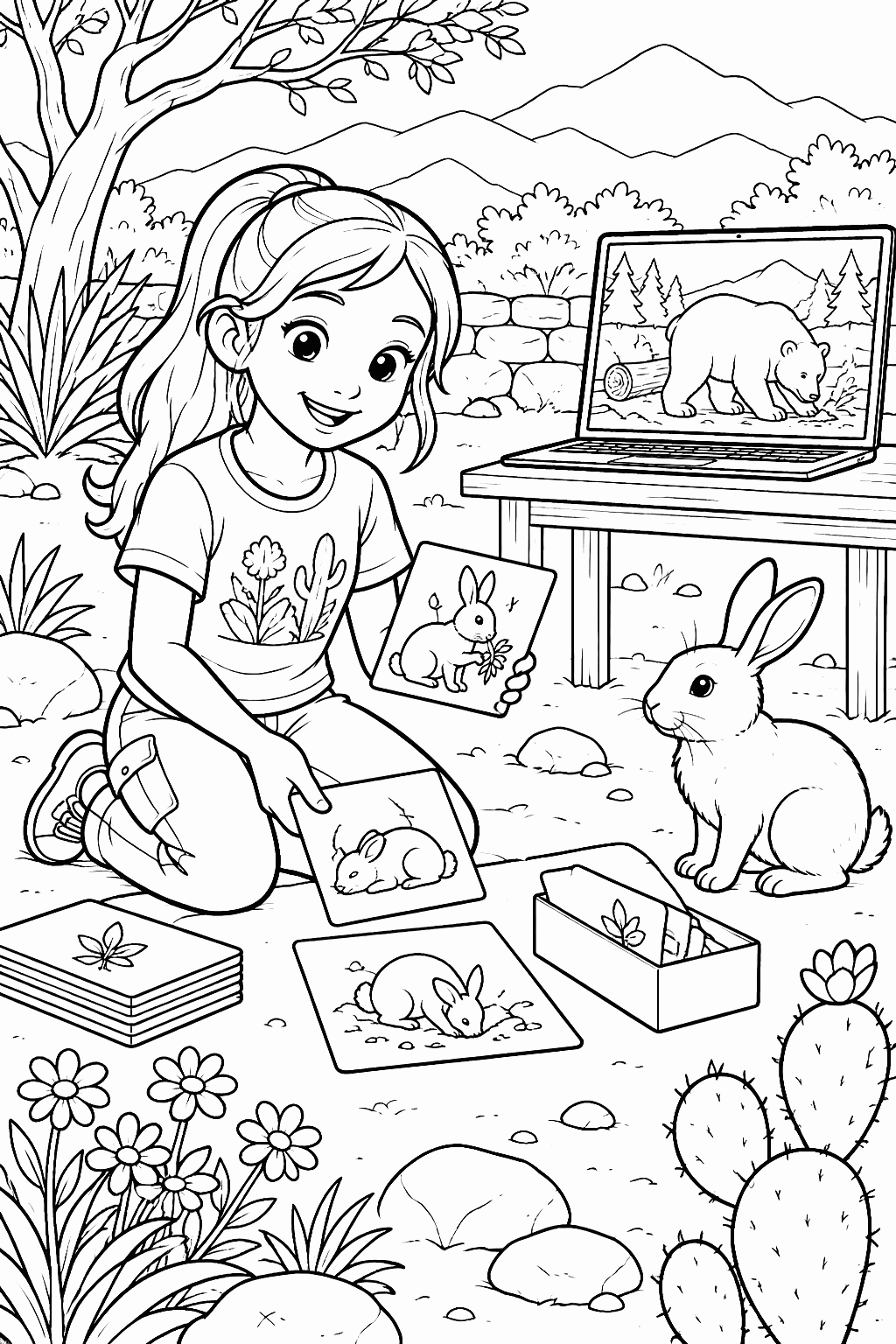
Coloring page
Print the story’s hero and color it in together — with crayons, markers or paints.