At the children’s library, Iris, Noah, and Camila work together to create a care guide for Pebble, a baby goat visiting with his animal caretaker. When excitement over the tablet and art supplies leads to an argument, Iris suggests taking turns and making a plan. Their finished display combines Noah’s photographs, Camila’s labeled diagram, and Iris’s clear care tips to help families learn what responsible pet care involves.
Loading audio…
On a bright Saturday morning, the children’s library smelled like paper, crayons, and cinnamon muffins from the reading club. Near the windows, a low wooden pen stood on a washable mat. Inside it, a baby goat named Pebble nibbled a strand of hay and watched the room with shiny brown eyes.
Pebble had come with Ms. Lena, his adult animal caretaker from a nearby small farm. She had agreed to visit the library for the afternoon’s Caring for Animals program. After observing Pebble, the children would make a display showing families what a goat needed each day.
Iris had been thinking about the display all week. She wanted it to be useful, not just pretty. She had brought a blue notebook and had even drawn a tiny goat in the corner of the first page.
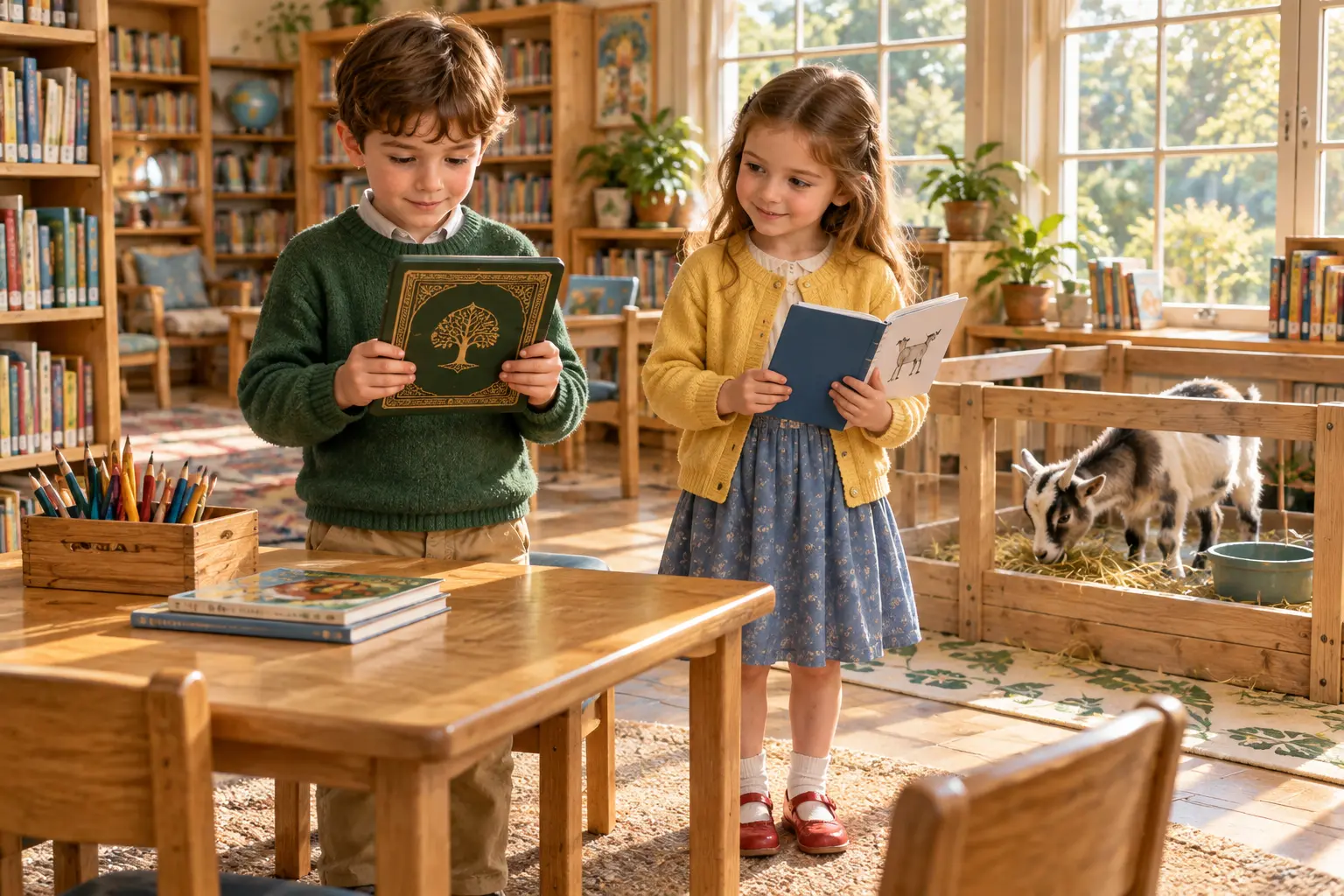
As soon as Ms. Lena finished explaining the plan, Noah hurried to the activity table. He picked up the library tablet and held it carefully in both hands.
“I’ll take pictures,” he announced. “I know how to get the best angles.”
Camila reached for the box of colored pencils and pulled it close. “Then I’ll draw the goat. I need all the good colors.”
Iris stopped beside the table, her notebook pressed against her chest. “Could I use the tablet after you take a few pictures?”
Noah shook his head. “I need it for the whole project. A care guide should have lots of photographs.”
“And I need the colored pencils,” Camila said. “If everyone uses them, the tips will get dull.”
Iris glanced at the empty chair between them. “I thought we were making the guide together.”
“We are,” Noah said, though he kept the tablet tucked against his sweater.
Camila opened the pencil box and began sorting the colors into little groups. “You can write something later.”
The word later landed heavily. Iris had planned to record what Pebble ate, where he drank, and how much space he needed to move around. Writing was not an extra job to her. It was part of the guide.
She waited while Noah took three pictures of Pebble’s ears, two pictures of his nose, and one picture of the corner of the pen. Then she waited while Camila tested a green pencil on scrap paper and drew a row of grass.
Pebble lifted his head. A strand of hay hung from his mouth. He gave a soft, questioning bleat.
“I think he wants us to stop arguing,” Iris said.
Noah lowered the tablet. “He can’t understand us.”
“Maybe not,” Iris replied. “But we can understand that this isn’t working.”
Ms. Lena, who was standing nearby, gave them time to work things out. She did not reach for the tablet or take away the pencils. Instead, she knelt beside Pebble’s pen and checked that the gate was latched.
Iris took a slow breath. She opened her blue notebook to a clean page and uncapped her pencil.
“Before we choose jobs,” she said, “what does each person actually want to try?”
Noah looked at the tablet. “I want to take pictures of Pebble’s feeding area. I want people to see the hay rack, the water bucket, and the space he has.”
Talk about the story
1.What did the library smell like on Saturday morning?
2.Who brought Pebble to the library?
3.What did Iris want to record for the care guide?
4.How did the children decide to share the supplies?
5.What did Ms. Lena tell the children to do before touching an animal or moving anything in the pen?
6.What did Camila draw for the display?
7.What did Ms. Lena add to the finished display?
Loading more stories…
Camila glanced at the colored pencils. “I want to draw a diagram. I can show where everything goes and label it.”
Iris nodded. “I want to observe, write down what we learn, and make the care tips clear.”
The three friends looked at one another. Their jobs were different, but none of them could finish the guide alone.
Iris wrote as she spoke. “What if we rotate? First, we observe Pebble. Then we help Ms. Lena check his water and hay. After that, we record what we found. Last, we make the display.”
Noah leaned over the notebook. “Who gets the tablet first?”
“Maybe you do,” Iris said. “But only for the feeding-area pictures. Then Camila gets the table and pencils for her diagram while you help me record the details. After that, I’ll write the tips, and we’ll all put the display together.”
Camila touched one of the pencils. “What if I need to see the real pen while I draw?”
“Then we can leave the diagram unfinished and come back to it during the next turn,” Iris said. “We don’t have to grab everything at once.”
Noah studied the plan. “What if someone has an idea while another person is working?”
Ms. Lena smiled. “That sounds like a thoughtful plan. You can add one more thing: ask before touching an animal or moving anything in the pen.”
Iris wrote that at the bottom of the page. Then she read the plan aloud: Observe Pebble. Help the adult check his water and hay. Record the findings. Make the display.
Noah set the tablet on the table. “I’m sorry I grabbed it first,” he said. “I got excited about taking pictures.”
Camila pushed the pencil box toward the center. “I’m sorry I acted like the pencils belonged only to me.”
Iris smiled a little. “I’m sorry I stayed quiet until I was upset. I should have told you what I wanted sooner.”
The tight feeling in the room loosened. Even Pebble seemed to notice. He stepped to the side of the pen and sniffed the air near the children.
“Ready to observe?” Ms. Lena asked.
The friends gathered several feet away. Iris opened her notebook, but she did not write yet. First, she watched.
Pebble stood on four sturdy little legs. He nibbled hay slowly, pulling one piece at a time. When a page turned somewhere in the library, his ears pointed toward the sound. Then he went back to eating.
“He likes to know what’s happening around him,” Noah whispered.
“His ears move in different directions,” Camila said.
Iris wrote both observations. She also noticed that Pebble had room to walk, a dry place to rest, and a low platform for climbing. Ms. Lena explained that goats need fresh water, suitable food, shelter, space to move, and gentle care from people who understand their needs.
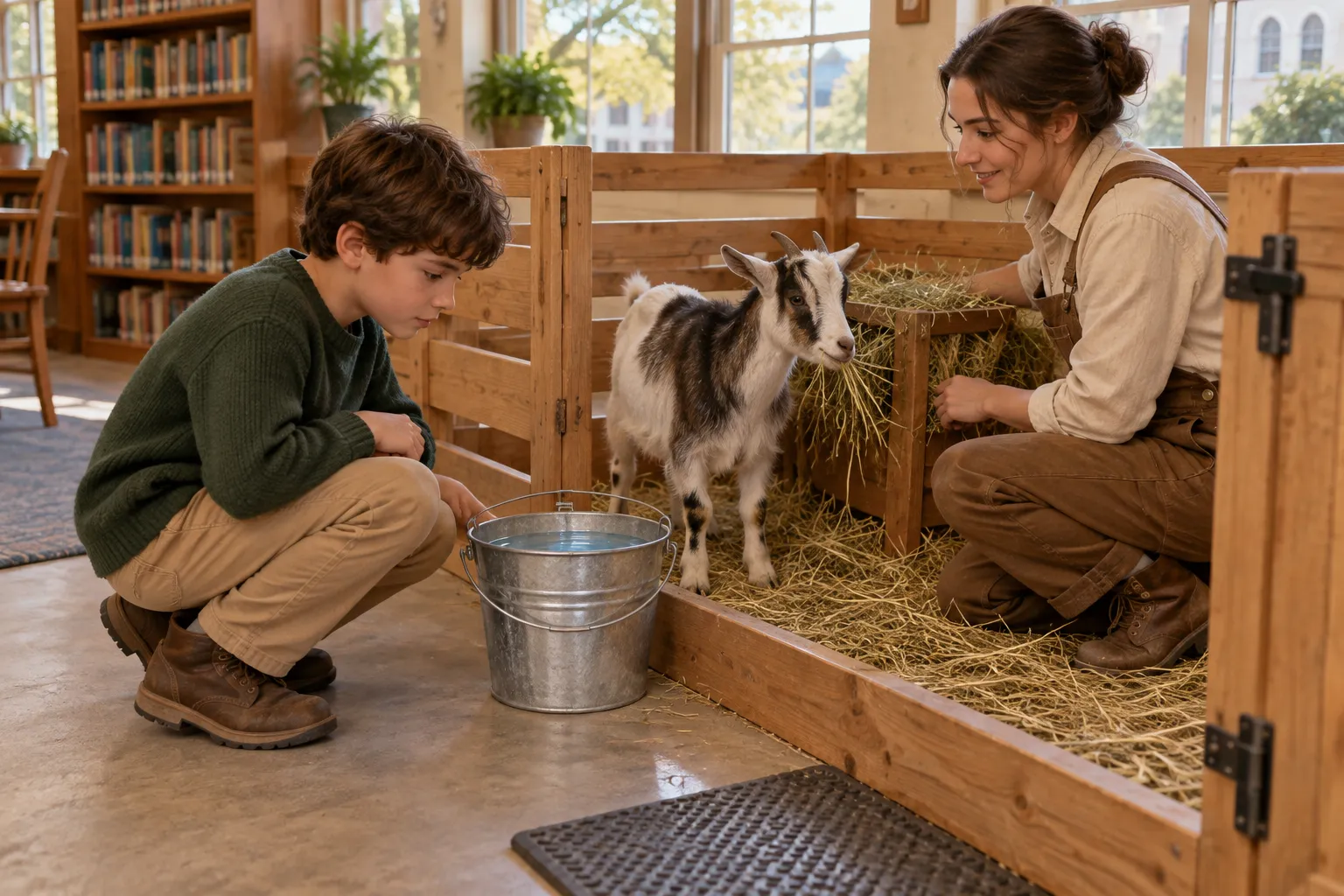
When it was time to check the feeding area, Ms. Lena invited the children closer. She opened the gate herself and showed them how to stand calmly at the side. Pebble stayed near the hay rack, chewing.
“First, we look at the water,” Ms. Lena said. “Is the bucket clean? Is there enough for the day?”
Noah crouched beside her but did not touch the bucket. He inspected it carefully. “The water is clear, and the bucket is almost full.”
Iris wrote that down.
“Now the hay,” Ms. Lena continued. “Does Pebble have enough to eat? Is it dry and clean?”
Camila leaned forward to look. “There are no wet pieces, and there’s plenty left.”
Pebble took a step toward Camila’s shoe. She froze, then looked at Ms. Lena.
A boy carefully inspects Pebble’s clear water bucket beside the woman
“You can stay still and let him decide what he wants to do,” Ms. Lena said.
Pebble sniffed the edge of Camila’s shoe, seemed satisfied, and returned to the hay.
Camila let out a quiet breath. “He’s curious.”
“Very,” said Ms. Lena. “But curiosity doesn’t mean he wants to be picked up. Caring for an animal means paying attention to its signals.”
Iris underlined that sentence in her notebook.
Next came Noah’s turn with the tablet. He photographed the feeding area from three spots. One picture showed the hay rack, another showed the water bucket, and the third showed the open space around them. He checked each image before moving on.
“This one has the whole area,” he said. “But the bucket is hard to see.”
He tried again, stepping to the side so the window light would not shine across the picture. The second photograph showed the bucket clearly.
“Good,” Iris said. “That helps families notice what they need to check.”
Noah grinned. “I can take a close-up of the hay, too.”
He did, then lowered the tablet when Pebble wandered toward the far end of the pen. Noah had wanted a picture of the goat looking straight at the camera, but he remembered their plan. He waited instead of calling or chasing Pebble’s attention.
“Some pictures show care better than a pose,” he said.
Camila’s turn began at the drawing table. She chose a large sheet of white paper and arranged the pencils in a neat row. She drew the pen from above, adding the hay rack, water bucket, resting place, and climbing platform. Then she drew small arrows and wrote each label in careful block letters.
When she tried to draw Pebble, however, her pencil slipped. His back came out too long, and one leg looked as if it were growing from the wrong place.
Camila frowned and began to erase. The paper became gray and fuzzy.
“I can’t make him look right,” she said.
Noah leaned over. “Maybe draw him from the side.”
“I am drawing him from the side.”
Iris looked at Pebble, who had settled near the hay. “You don’t need to draw every part of him. The important thing is where the food and water go. You could draw Pebble smaller and use the space for labels.”
Camila considered this. “The guide is about care, not about drawing a perfect goat.”
“That’s what I mean.”
Camila turned the paper slightly and tried again. This time, she drew a simple goat shape beside the feeding area. She added a small note: Leave room for walking and resting.
When Iris’s turn came, she spread her notes beside Noah’s tablet and Camila’s diagram. Some of her handwriting was crowded because she had written quickly. She crossed out a sentence and began again.
“Pebble needs food, water, and love,” she read aloud.
“That sounds nice,” Camila said.
“It does,” Iris replied, “but it doesn’t tell families what to do.”
She rewrote it: Check that fresh water is clean and available. Provide the right food, such as clean hay recommended for goats. Give the animal dry shelter, room to move, and patient care. Ask an animal expert what the goat needs.
Noah nodded. “That would help someone know where to start.”
Iris added one more tip: Never feed a pet something just because it is safe for people. Ask a trusted animal caretaker first.
The friends began assembling the display on a wide piece of blue poster board. Noah printed three photographs. Camila trimmed the edges of her diagram. Iris wrote the title in large letters: WHAT DOES PEBBLE NEED?
They placed the diagram in the center, but the board looked crowded. Noah’s best photograph covered part of Camila’s label for the water bucket, and Iris’s care tips ran too close to the edge.
“We can’t fit everything,” Noah said. “Maybe we should take off the close-up.”
Camila held the diagram in both hands. “Or we could remove the climbing platform from the drawing.”
Iris looked at the board. She remembered how quickly they had claimed the supplies that morning. She did not want to start pushing pieces around without listening.
“What does each part help people understand?” she asked.
Noah pointed to the close-up. “It shows what clean hay looks like.”
Camila touched the platform on her drawing. “This shows that Pebble needs places to move and climb.”
Iris tapped the care tips. “And these explain how to check everything.”
They thought for a moment. Then Iris found a larger sheet of poster board in the supply cabinet. The librarian helped them join the two boards with wide strips of tape on the back. Now there was room for every part.
Noah placed his pictures along the bottom. Camila’s labeled diagram went in the center. Iris’s tips fit neatly across the top, with a small space for a note from Ms. Lena.
Ms. Lena read their work and added, “Before bringing an animal home, learn about its needs and make sure you can meet them every day.”
Iris copied the sentence carefully. Then the friends carried the finished display to the library’s front table, where families could see it beside the children’s books about farms and pets.
A father and his daughter stopped first. The girl pointed to Noah’s photograph of the water bucket. Another family studied Camila’s arrows. A little boy read Iris’s tip about asking an animal expert before offering new food.
“Could we make a guide about turtles next?” he asked.
“Maybe,” Iris said. “We’d have to learn what turtles need first.”
Noah took one last photograph, this time of the whole display. Camila placed the colored pencils back in their box, with the points facing up. Iris folded her blue notebook and slipped it into her backpack.
Before leaving, the three friends returned to Pebble’s pen. The baby goat was resting on the dry platform, his chin tucked near his front legs. His hay was still fresh, and his water bucket was clean.
“See you soon, Pebble,” Camila said.
Pebble opened one eye, then closed it again.
The library grew quieter as the afternoon faded. Sunlight rested in a golden rectangle on the floor beside the display. Iris stood with Noah and Camila, looking at the photographs, the diagram, and the careful words they had made together.
Then Pebble gave a soft, sleepy bleat. The friends smiled as the pages of the nearby books rustled gently in the warm library air.
🎧 Listen to this story
Choose a female or male narrator. Listening passes give you access to all public stories — $0.30 for 1 day, $1.80 for 7 days, or $6.00 for 31 days. Every registered user also receives 1 free day of listening each month.
Stories on this website are free. If your child enjoyed this story, you can thank the creator with an optional payment for access to the website’s materials, in an amount you choose.
Enter a dollar amount with no more than two decimal places, such as 0.01 or 1.50.
Have an account? Sign into pay from your credit balance.