Ivy and her friend Amir test paper airplanes in the school gym after one design travels far but veers sharply left. By changing one fold at a time, recording every flight, and sharing space thoughtfully in the rooftop garden with Ivy’s grandmother, they discover that a dependable plane—and careful teamwork—matters more than one impressive distance record.
Loading audio…
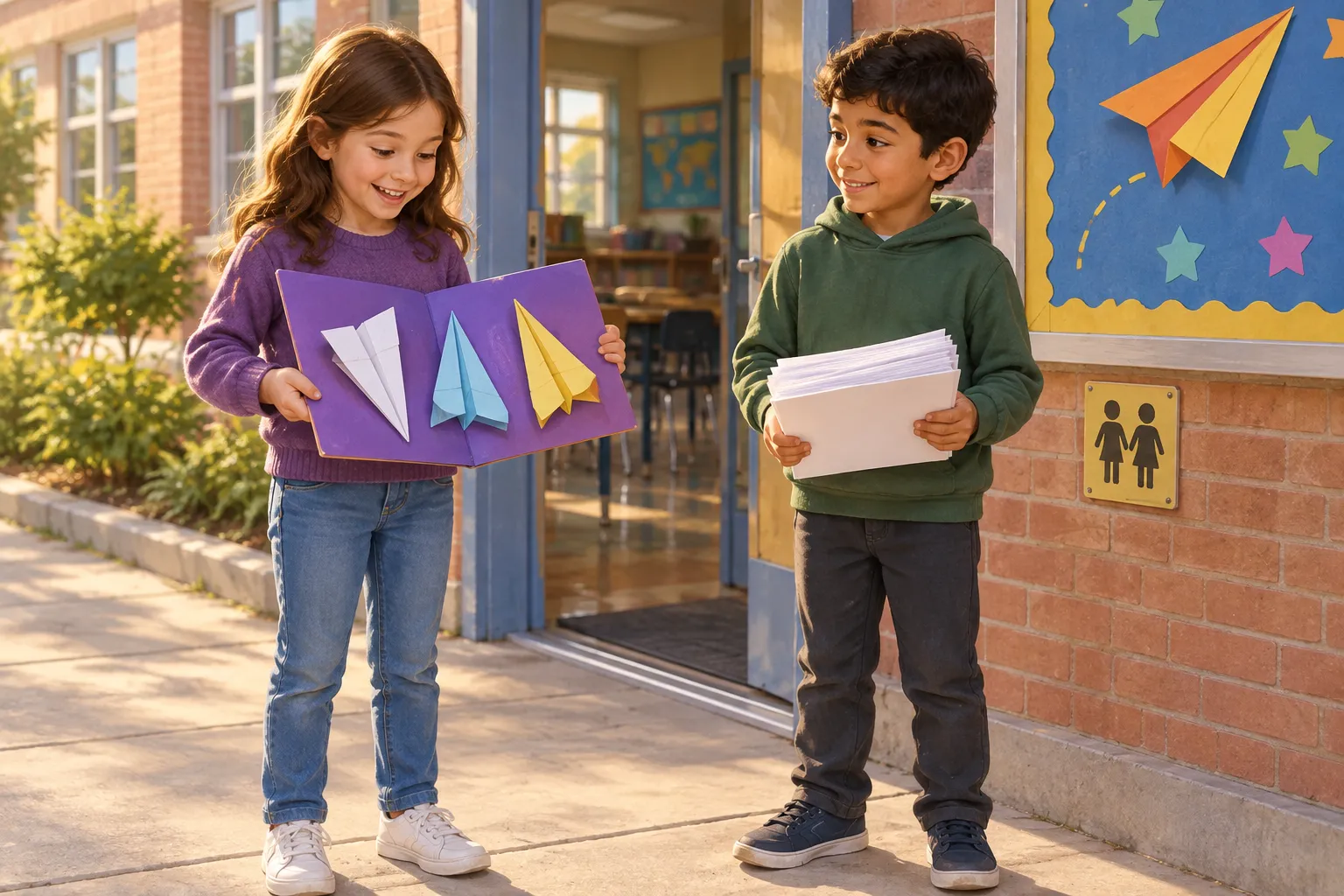
On Thursday morning, Ivy carried three paper airplanes to school inside a folder. She had folded them the night before at the kitchen table, pressing each crease smooth with the side of her thumb. One plane was narrow and pointed. One had broad wings. The third had a tiny extra fold near its nose that Ivy hoped would help it fly farther.
Amir met her outside the classroom. He was carrying a stack of paper.
“I brought more,” he said. “My little brother used the first batch for drawing, so these are clean.”
Ivy opened her folder. “I made three versions. They look almost the same, but not quite.”
“That’s good,” Amir said. “Then we can find out what each fold does.”
Before they could begin, Ms. Cora called the class to the rug. A bright paper airplane hung on the bulletin board beside a sign that read, Ask a Grown-Up Before You Fly.
“Today,” Ms. Cora announced, “we may test paper airplanes in the gym after lunch. We’ll use the center court, stay behind the line, and record what happens. No throwing toward people, windows, or basketball hoops.”
Ivy sat up straighter. “Can we change the airplanes between flights?”
“You may change one fold at a time,” Ms. Cora said. “That way, you’ll know which change made a difference.”
“The scientific way,” Amir whispered.
Ivy smiled, but her eyes drifted toward the class habitat on the shelf. Muffin, their small hermit crab, was halfway out of a blue-speckled shell. One dark eye peeked over the shell’s edge. A slice of cucumber rested beside the shallow water dish, and a little trail of sand showed where Muffin had explored during the night.
“Maybe Muffin will be our audience,” Ivy said.
Muffin stretched out one claw and touched the cucumber. Then the hermit crab tucked back into the shell.
“I think that means yes,” Amir said.
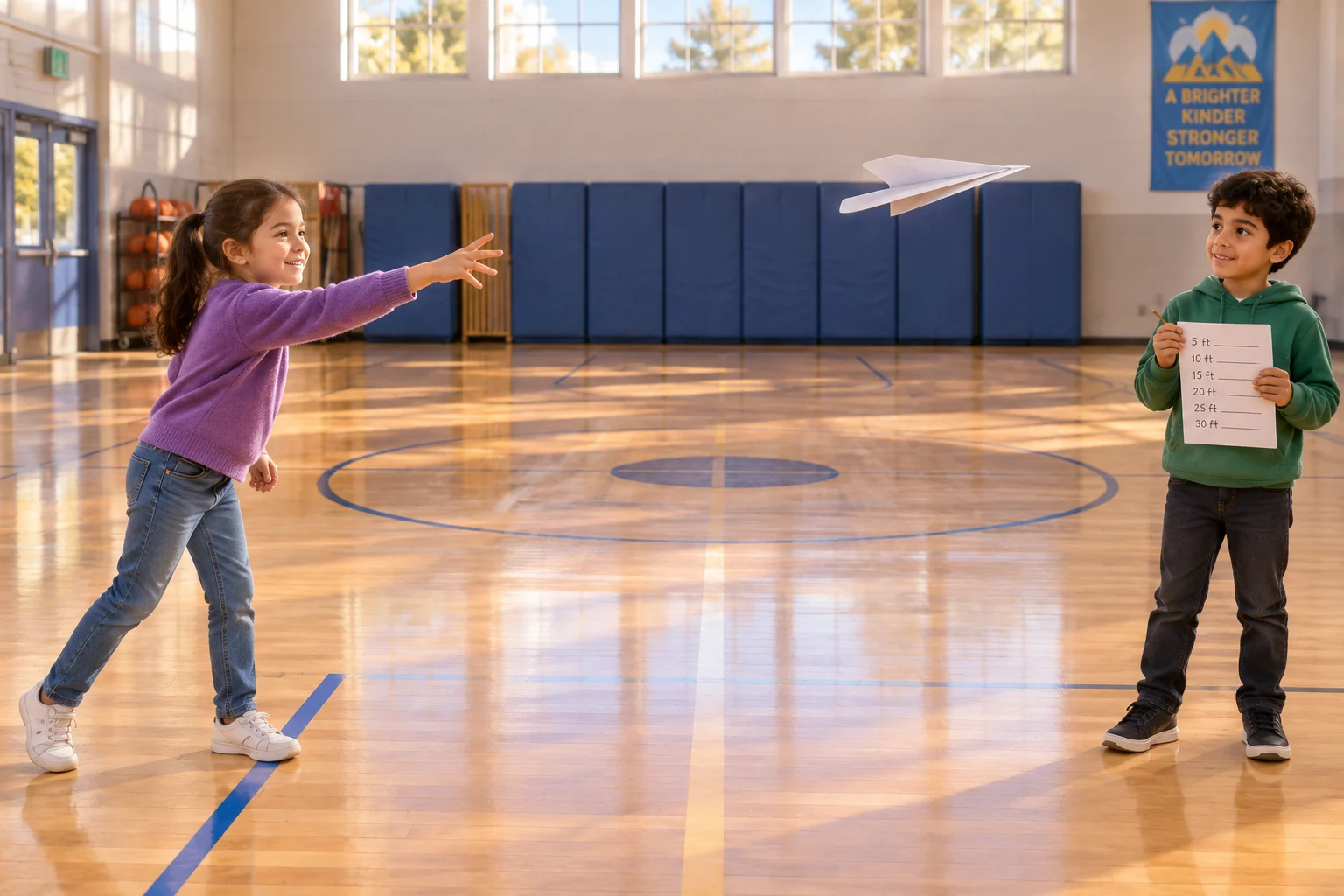
After lunch, Ms. Cora unlocked the gym doors. Sunlight lay across the polished floor in long, pale rectangles. Ivy and Amir placed a strip of blue tape on the floor. Ms. Cora stood nearby with a clipboard while the rest of the class watched from the bleachers.
“First, choose a starting point,” Ms. Cora said. “Keep it the same for every flight.”
Ivy measured twelve large steps from the wall and put down another piece of tape. Amir wrote the number twelve at the top of their chart. They named the planes Far Flyer, Steady Wing, and Small Nose.
Ivy chose Far Flyer first. Its wings were slim, and its point seemed ready to lead the way through the air. She stood with her toes behind the blue line, lifted the plane to shoulder height, and gave it a smooth, gentle push.
The airplane glided beautifully across the gym. It passed the center circle and sailed beyond the free-throw line. It looked ready to keep going. Then, without warning, it curved left. It skimmed past a stack of folded mats and landed near the wall.
The class clapped.
Talk about the story
1.How many paper airplanes did Ivy carry to school?
2.What rule did Ms. Cora give Ivy and Amir about changing the airplanes?
3.How far did Far Flyer travel on its longest flight?
4.Why did Far Flyer keep turning left?
5.Which plane did Ivy choose as the best one, and why?
6.What did Ivy do when she saw a watering can beside the narrow garden path?
7.Why did Ivy and Grandmother find another place to eat?
Loading more stories…
“That went far!” someone called from the bleachers.
Ivy hurried to retrieve the plane. She measured the distance with the long tape Ms. Cora had provided. Far Flyer had traveled thirty-eight feet—the longest flight so far.
“But it went left,” Amir said, pointing to the chart.
“Very left,” Ivy agreed. “What if I fold the right wing up a little?”
“Then we’ll be changing one thing,” Amir said. “Let’s call it Far Flyer Two.”
Ivy made the fold carefully. When she threw the plane again, it flew almost as far as before. It still curved left, though not as sharply. The third flight followed the same path, and so did the fourth.
Ivy pressed her pencil against the chart. “Maybe the wings aren’t even.”
Amir held the plane by its center crease and looked along the nose. “One side might be a little heavier. Or the fold could be leaning.”
Ivy felt a small pinch of disappointment. She had imagined Far Flyer gliding straight down the middle of the gym while everyone watched. Instead, it kept wandering away from the line.
Ms. Cora came over. “What have you noticed?”
“It travels far,” Ivy said, “but it always turns left. We changed the right wing, and it turned less, but it still didn’t fly straight.”
“That is useful information,” Ms. Cora replied. “A result doesn’t have to be perfect to teach you something.”
Ivy wrote, Still veers left, beside the four measurements. Then she picked up Steady Wing.
This plane had broader wings and a rounded nose. Its first flight was shorter than Far Flyer’s, but it floated in a nearly straight line. On the second flight, it dipped low, bounced once on the floor, and stopped.
“Something changed,” Amir said.
Ivy examined the paper. One corner of the left wing had bent upward when the plane landed.
“Should we fix it?” she asked.
“Let’s record this flight first,” Amir said. “Then fix only that corner.”
Ivy wrote down the distance and drew a small picture of the bent wing. She smoothed the corner with her fingernail and tried again. The plane flew straight for a while, dipped gently, and landed twenty-six feet away.
Far Flyer had gone farther, but Steady Wing had stayed closer to the middle. Ivy looked from one number to the other. Part of her wanted the biggest distance. Another part wanted a flight she could count on.
For the next twenty minutes, Ivy and Amir took turns throwing, measuring, and writing. They tested Small Nose, which spun once and landed upside down. They unfolded its nose and made a shorter crease. The next flight improved, but the plane still leaned right. They marked the result instead of changing several things at once, then returned to Steady Wing.
When Ivy went back to the classroom for a fresh sheet of paper, she noticed Muffin standing on top of the cork bark. The hermit crab’s antennae moved back and forth while its tiny legs held steady.
“Your timing is excellent,” Ivy told Muffin. “We’re testing again.”
Muffin turned slightly toward her. A grain of sand slid from the shell.
Back in the gym, the last few minutes of the experiment were slipping away. Ivy had one sheet of paper left. She looked at Far Flyer, with its impressive thirty-eight-foot flight, and Steady Wing, which had flown straight three times in a row after the corner was fixed.
Ivy releases a paper airplane as Amir watches with his chart
“What do you want to test?” Amir asked.
Ivy placed the last sheet on the floor. “I want to make one more Steady Wing. I’m going to copy the folds as carefully as I can.”
“Even though Far Flyer went farther?”
“Especially because of that,” Ivy said. “I want to see whether a plane that flies straight can do it again.”
She folded the paper slowly. Amir checked the center crease from one end, and Ivy checked it from the other. They compared the new plane with the first Steady Wing and adjusted one wing by the width of a pencil line.
Ivy stepped behind the blue tape. The class grew quiet.
She gave the plane a gentle push. It moved straight across the gym, passed over the center circle, and landed twenty-seven feet away.
“Straight!” someone called.
Ivy tried again. The plane flew twenty-six feet and stayed nearly in the same path. On the third flight, it glided twenty-eight feet before settling onto the floor.
Amir checked the chart. “Three straight flights.”
A warm, pleased feeling spread through Ivy’s chest. Far Flyer still held the distance record, but the new Steady Wing had done exactly what she had hoped it would do.
Ms. Cora gathered the class around the chart. “Which plane won?” she asked.
A few students pointed to Far Flyer.
“It went the farthest,” one student said.
Ivy looked at the three straight-flight measurements. “Far Flyer went farthest once, but Steady Wing flew straight more than once. I’d choose Steady Wing.”
“Why?” Ms. Cora asked.
“Because if I wanted to aim at something, I could trust it,” Ivy answered. “And we know what changed. We didn’t just keep folding until it worked.”
Amir nodded. “We tested it fairly.”
Ms. Cora smiled. “That sounds like a strong reason.”
After school, Ivy’s grandmother met her outside the main entrance. She helped care for the school’s rooftop garden and carried a small basket.
“Would you like to help me make a snack?” Grandmother asked. “The garden has carrots, snap peas, and cherry tomatoes ready to pick. I brought crackers, too.”
Ivy’s stomach gave a hopeful rumble. “Yes, please.”
They climbed the stairs to the rooftop. Planter boxes filled the space with green leaves and tiny blossoms. A breeze moved through the tomato vines. Nearby, two gardeners were watering lettuce, and a child named Leo was looking closely at a row of seedlings.
Ivy started toward the carrots, but she saw that one gardener had placed a watering can beside the narrow path.
“If I squeeze past, I might knock it over,” she said.
Grandmother set down the basket. “What could you do?”
Ivy waited until the gardener finished watering. “Could we use the other side of the path first?” she asked. “Then we won’t get in your way.”
“Thank you,” the gardener said. “That would help.”
Ivy and Grandmother walked around to the snap peas. Ivy picked only the pods that were ready and left the small ones on the vines. She carried the vegetables to the wash station, where Leo was rinsing a handful of lettuce.
“Can I use the basin when you’re finished?” Ivy asked.
Leo moved his leaves to one side. “Sure. I’m almost done.”
Ivy waited. Then she rinsed the carrots and tomatoes. Grandmother arranged the vegetables and crackers on a clean tray. There was enough for Ivy, Grandmother, Leo, and the nearby gardeners.
Ivy carried the tray toward a sunny bench. The bench had space for two people, but the other gardeners were gathering around it with their cups of water.
“Let’s find another spot,” Ivy said. “They were here first.”
They spread a cloth in a quiet corner beside a bed of marigolds. Grandmother handed around the snacks, and Ivy made sure Leo received the biggest snap pea because he had waited patiently at the wash station.
While they ate, Ivy told Grandmother about the airplane tests. She showed her the chart and explained how Far Flyer had traveled thirty-eight feet before veering left.
“That is a wonderful distance,” Grandmother said. “But I can see why you chose the plane you could count on.”
Ivy looked toward the open sky above the rooftop. “At first, I wanted the longest flight. Then Amir helped me notice that a good test isn’t just about one exciting try.”
Grandmother broke a cracker in half and placed one piece beside Ivy’s tomatoes. “It sounds as if you and Amir made room for more than airplanes today.”
Ivy thought about the gym, where they had taken turns behind the line. She thought about the garden path, the watering can, and the bench.
“Sometimes the best choice is the one that lets everyone have a turn,” she said.
A breeze lifted the corner of Ivy’s chart. She caught it before it blew into the garden beds. Far Flyer rested inside her folder, its nose slightly bent from the final landing. Steady Wing lay on top, its wings smooth and even.
When they finished eating, Ivy folded the chart carefully and tucked it beside the plane. Below the rooftop, the school windows glowed softly in the late-afternoon light. Inside Ivy’s classroom, Muffin was probably moving through the sand again, slow and steady, leaving a tiny trail behind.
Ivy and Grandmother carried the empty tray to the wash station. They waited for the gardener using it, then rinsed the tray when the basin was free.
At the stairwell door, Ivy opened her folder for one last look. Steady Wing rested quietly inside, ready to fly straight again whenever she gave it the chance.
🎧 Listen to this story
Choose a female or male narrator. Listening passes give you access to all public stories — $0.30 for 1 day, $1.80 for 7 days, or $6.00 for 31 days. Every registered user also receives 1 free day of listening each month.
Stories on this website are free. If your child enjoyed this story, you can thank the creator with an optional payment for access to the website’s materials, in an amount you choose.
Enter a dollar amount with no more than two decimal places, such as 0.01 or 1.50.
Have an account? Sign into pay from your credit balance.